What Is an HVAC Technician? A Day in the Life
From morning dispatch to the last service call, here is how heating and cooling work actually runs — tools, certifications, schedules and hazards included.
Quick answer
- Nearly all HVAC technicians must pass an EPA Section 608 refrigerant exam; the EPA offers Type I, Type II, Type III and Universal certification
- Entry routes are a certificate or associate's degree from a technical or community college HVACR program, or a paid apprenticeship (U.S. Bureau of Labor Statistics, 2025)
- Most work full time, with evening or weekend shifts, on-call emergency work and overtime in peak heating and cooling seasons (U.S. Bureau of Labor Statistics, 2025)
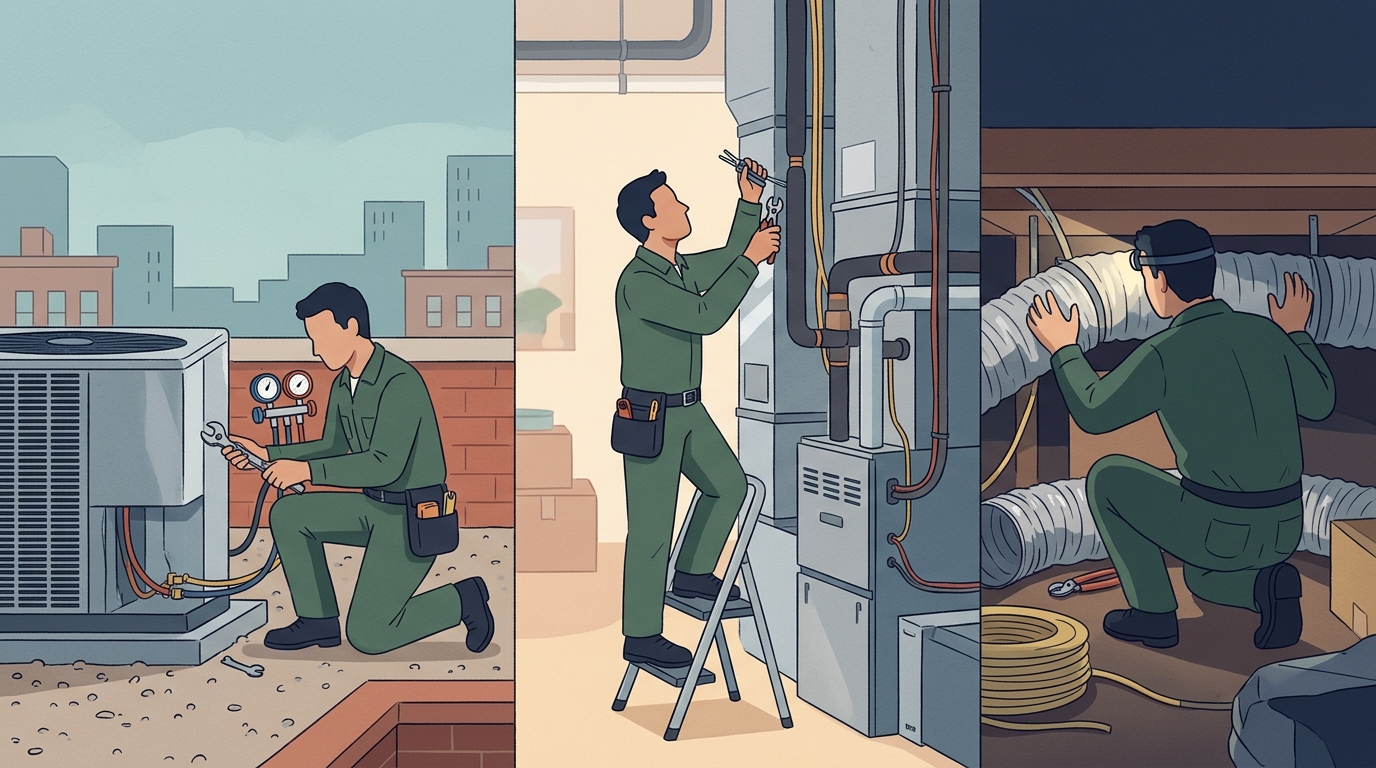
An HVAC technician installs, maintains and repairs heating, ventilation, air conditioning and refrigeration (HVACR) systems in homes, schools, hospitals and other buildings, often travelling between several jobsites in one day (U.S. Bureau of Labor Statistics, 2025). The work mixes mechanical repair with electrical wiring, system testing, customer explanations and written records of what was done (U.S. Bureau of Labor Statistics, 2025).
Most technicians train through a postsecondary HVACR program at a technical school or community college, or through a paid apprenticeship, and nearly all must hold EPA Section 608 certification to handle refrigerants (U.S. Bureau of Labor Statistics, 2025; U.S. Environmental Protection Agency).
What an HVAC Technician Does
HVAC technicians keep climate control and refrigeration equipment running. The U.S. Bureau of Labor Statistics (2025) lists the core duties as installing, maintaining and repairing HVACR systems; installing electrical components and wiring; inspecting and testing systems and their components; discussing malfunctions with customers; repairing or replacing worn parts; recommending maintenance to improve performance; and keeping records of the work performed.
The job exists wherever buildings need conditioned air or controlled cold: single-family homes and apartment buildings, schools, hospitals, offices, hotels, supermarkets with walk-in coolers, and industrial plants with process cooling. Some technicians are assigned to one jobsite for a whole project; others travel between several locations in a day making service calls (U.S. Bureau of Labor Statistics, 2025). Employers range from residential and commercial service contractors to facilities departments and wholesale distributors — wholesale trade is one of the top employing industries for the occupation (U.S. Bureau of Labor Statistics, 2025).
Entry-level and experienced duties differ. New technicians and apprentices assist on installations, change filters, clean coils, pull wire and carry equipment under supervision, and BLS (2025) lists a period of on-the-job training as typical for reaching competency. Apprentices may handle refrigerant without their own Section 608 certification only while closely and continually supervised by a certified technician (U.S. Environmental Protection Agency). Experienced technicians diagnose electrical and control faults alone, recover and charge refrigerant, commission systems, and advise customers on repair versus replacement.
A Typical Day
- Reviews the day's assigned calls in the dispatch or customer relationship management (CRM) software and checks truck stock for filters, capacitors, contactors and refrigerant (CRM software is among the tools listed for this occupation by O*NET OnLine, U.S. Department of Labor).
- Drives to the first call — a no-cooling complaint in a house, or a warm walk-in cooler at a store — and asks the customer when the fault started and what the system has been doing.
- Tests electrical components with a multimeter, reads suction and discharge pressures on a manifold gauge set, and checks superheat and subcooling to separate a charge problem from an airflow or control problem.
- Recovers refrigerant with a recovery machine, replaces the failed part, pulls a vacuum, recharges the system and records refrigerant amounts.
- Explains the malfunction and the repair options, writes the invoice, and logs parts and labor in the service or facilities management software.
- Runs a scheduled maintenance visit at a school or hospital: changes filters, cleans coils, checks belts and bearings, tightens electrical connections and closes the work order in the computerized maintenance management system (CMMS).
- Adjusts setpoints or alarm points in building automation software such as Siemens APOGEE on a commercial site, or checks install drawings in CAD software such as Autodesk AutoCAD on new construction (O*NET OnLine, U.S. Department of Labor).
- Climbs to a rooftop unit or works in a crawl space to mount equipment, braze line sets and terminate low-voltage control wiring — the heat and lifting behind the occupation's high rate of burns and muscle strains (U.S. Bureau of Labor Statistics, 2025).
- Restocks the van and takes an after-hours emergency call during peak season if on the on-call rotation (U.S. Bureau of Labor Statistics, 2025).
Salary and Job Outlook
Pay is usually hourly, with overtime for after-hours and on-call work; some service companies add commission on equipment sales and maintenance agreements, and apprenticeship wages typically rise on a fixed schedule as hours and classroom credits are completed.
| Experience level | How pay is usually structured | Where to check the current figure |
|---|---|---|
| Entry-level / apprentice | Hourly, often on a progression tied to training hours completed; apprentices earn while training | BLS Occupational Outlook Handbook, HVACR mechanics and installers (2025) |
| Mid-career | Hourly, plus overtime and on-call premiums in peak heating and cooling seasons | BLS Occupational Employment and Wage Statistics, by state and metro area |
| Experienced / lead or commercial service | Hourly or salaried, sometimes with commission on sales and service agreements | State licensing board and local union or contractor association wage schedules |
| National median | BLS publishes a median annual wage for the occupation, the amounts earned by the lowest 10 percent and highest 10 percent, and a separate median for wholesale trade | U.S. Bureau of Labor Statistics, 2025 |
Source for all occupational pay and outlook data: U.S. Bureau of Labor Statistics, Occupational Outlook Handbook, 2025. Look up the current median, the percentile figures and your own state's wages before committing to a program. BLS (2025) also publishes the number of jobs held in the occupation and its projected employment growth and change for 2025–35; read those figures directly rather than relying on claims that the field is booming.
Skills and Qualifications
Hard skills and credentials you can verify or obtain
- EPA Section 608 technician certification for refrigerant handling, required of nearly all HVAC technicians; the exam is commonly included in a postsecondary HVACR program (U.S. Bureau of Labor Statistics, 2025).
- The right Section 608 type for your work: Type I (small appliances), Type II (high- and very high-pressure appliances), Type III (low-pressure appliances) or Universal, covering all types of equipment (U.S. Environmental Protection Agency).
- A certificate or associate's degree from a technical school, trade school or community college HVACR program, or completion of an apprenticeship combining paid on-the-job training with technical instruction each year (U.S. Bureau of Labor Statistics, 2025).
- A state or local journeyman or contractor license where required — rules differ by state and sometimes by city, so check your state licensing board.
- Electrical work: reading wiring diagrams, using a multimeter, installing electrical components and control wiring (U.S. Bureau of Labor Statistics, 2025).
- Refrigeration practice: brazing, leak detection, evacuation, charging and refrigerant recovery.
- Software: CRM and service software, facilities management software or a CMMS, HVAC tools software, building automation software such as Siemens APOGEE, and CAD software such as Autodesk AutoCAD (O*NET OnLine, U.S. Department of Labor).
- Physical capability for lifting equipment, ladders, rooftops, attics and crawl spaces; the occupation has one of the highest injury and illness rates of all occupations, with burns and muscle strains among the hazards (U.S. Bureau of Labor Statistics, 2025).
- A valid driver's license, since most service roles involve driving a company van between jobsites.
Soft skills
- Explaining a malfunction and repair options to a customer who is not technical, which BLS (2025) lists as a duty in its own right.
- Methodical troubleshooting — following a diagnostic sequence rather than swapping parts.
- Record-keeping discipline, because work performed, parts used and refrigerant handled all have to be logged.
- Composure during on-call and peak-season work, when hours run long and customers have no heat or cooling.
How to Get Started
- Finish high school or an equivalency, taking math, physics and any shop, electrical or vocational HVAC courses available; check the BLS Occupational Outlook Handbook (2025) for the typical entry-level education, related work experience and on-the-job training listed for the occupation.
- Choose a training route: an HVACR program at a technical school, trade school or community college leading to a certificate or associate's degree, or an apprenticeship that pays you while providing technical instruction each year (U.S. Bureau of Labor Statistics, 2025). Ask whether the EPA Section 608 exam is included, as it commonly is.
- Sit the EPA Section 608 exam and decide which certification you need — Type I, Type II, Type III or Universal, which covers all types of equipment (U.S. Environmental Protection Agency). As an apprentice you may work with refrigerant before certifying only while closely and continually supervised by a certified technician.
- Get hours on real equipment as a helper or apprentice on installations and maintenance visits, expecting a period of on-the-job training before you are sent out alone (U.S. Bureau of Labor Statistics, 2025). Log the equipment types, refrigerants and controls you have worked on.
- Check licensing with your state board, since some states and localities require a journeyman or contractor license and set their own experience hours.
- Build a one-page resume around verifiable items — Section 608 type, program completed, equipment and software used, driver's license — and apply to residential and commercial service contractors, school district and hospital facilities departments, supermarket refrigeration companies and wholesale distributors, ideally ahead of the spring cooling and autumn heating ramp-up.
Frequently asked questions
Do you need a degree to be an HVAC technician?
No four-year degree is required. Most technicians complete a certificate or associate's degree in HVACR at a technical school, trade school or community college, or train through an apprenticeship pairing paid work with technical instruction (U.S. Bureau of Labor Statistics, 2025). What is effectively mandatory is EPA Section 608 certification for handling refrigerants.
Is being an HVAC technician stressful?
The pressure points are specific. Schedules may include evening and weekend shifts, on-call emergency work and overtime or irregular hours during peak heating and cooling seasons, when customers are without heat or air conditioning (U.S. Bureau of Labor Statistics, 2025). The work is also physically demanding, and the occupation has one of the highest rates of injuries and illnesses of all occupations, including burns and muscle strains.
What is EPA Section 608 certification and how many types are there?
Section 608 is the federal certification covering proper refrigerant handling, and nearly all HVAC technicians are required to have it (U.S. Bureau of Labor Statistics, 2025). The EPA has developed four types: Type I for small appliances, Type II for high- and very high-pressure appliances, Type III for low-pressure appliances, and Universal for all types of equipment. The exam is commonly offered within a postsecondary HVACR program.
How much do HVAC technicians make?
The U.S. Bureau of Labor Statistics publishes a median annual wage for heating, air conditioning, and refrigeration mechanics and installers (2025), along with the amounts earned by the lowest 10 percent and highest 10 percent and a separate median for wholesale trade. Pay is usually hourly with overtime for after-hours and on-call work. Check the BLS Occupational Outlook Handbook and the Occupational Employment and Wage Statistics tables for your state and metro area, since wages vary by location and by whether the work is residential, commercial or industrial.
Is HVAC a growing field?
BLS publishes a projected employment growth rate and employment change for the occupation for 2025–35, plus the current number of jobs held. Read those figures in the Occupational Outlook Handbook rather than relying on general claims about demand, and compare them with openings advertised in your own state.
Sources
- U.S. Bureau of Labor Statistics — Heating, Air Conditioning, and Refrigeration Mechanics and Installers (2025)
- U.S. Environmental Protection Agency — Section 608 Technician Certification Requirements | US EPA

Written by
Marisol steers Jobladderhq's coverage of hiring trends and the strange rituals of modern recruiting. She's drawn to the gap between what job ads promise and what the work actually feels like. Her editing hand favors clarity over jargon, always.