Nursing: A Guide for Career Changers
A plain look at the shift pattern, the licensing exam, the clinical hours and the months of reduced income before your first paid nursing job.
Quick answer
- Typical transition is 12-18 months via an accelerated BSN if you already hold a bachelor's degree, or 2-4 years via an associate's or bachelor's program from scratch (PracticeTestGeeks, 2026; CareerOneStop).
- Accelerated BSN programs cost $30,000-$80,000 in total and require 600-800 unpaid clinical hours (PracticeTestGeeks, 2026).
- Registered nurses' 2025 median pay was $97,550 a year, but the 10th percentile was $68,940 — closer to where new graduates start (U.S. Bureau of Labor Statistics, 2025; O*NET OnLine).
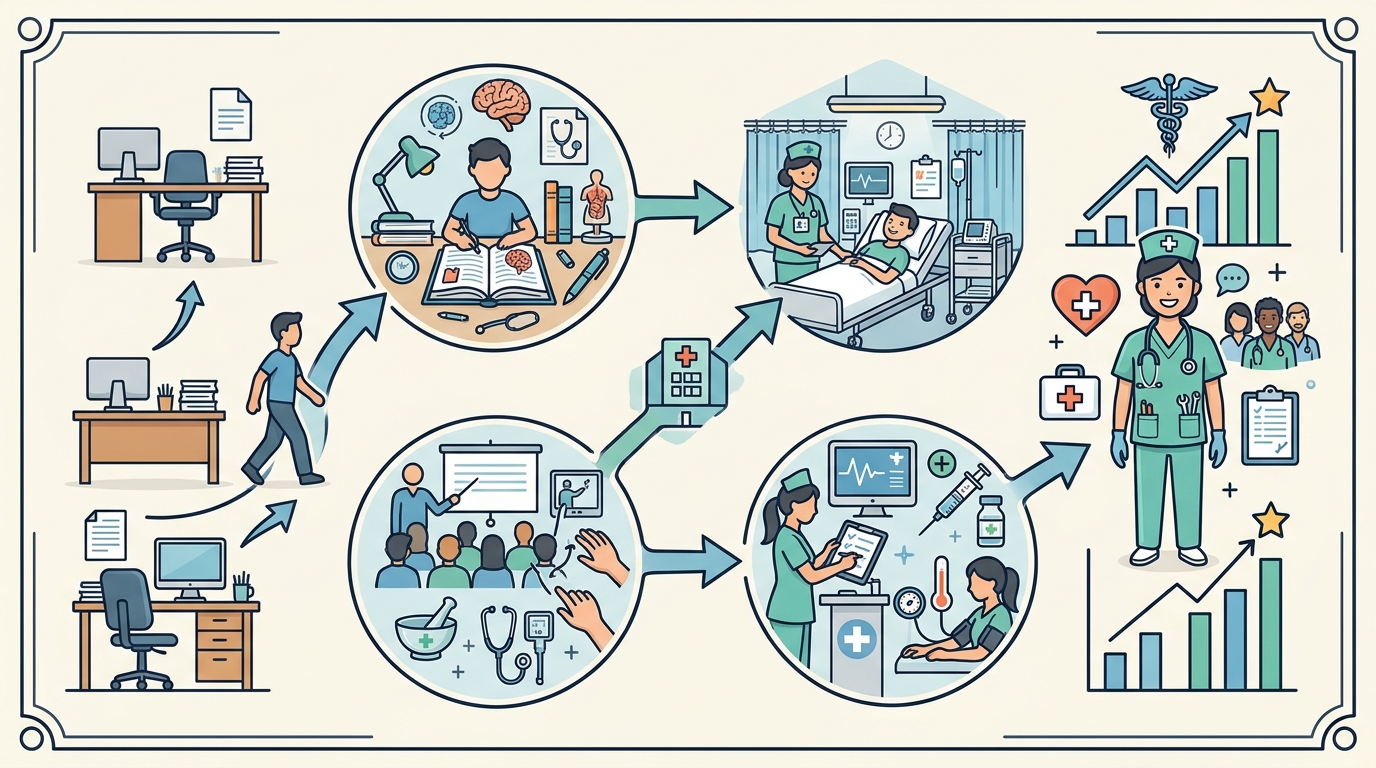
Nursing is one of the more structured mid-career switches available: the route is defined by your state's board of nursing, the credential is portable, and the demand is steady, with about 180,800 registered nurse openings projected each year on average from 2025 to 2035 (U.S. Bureau of Labor Statistics, 2025). The catch is front-loaded. You pay for school and complete 600-800 unpaid clinical hours before anyone pays you to nurse, and most career changers spend somewhere between 12 months and four years getting licensed depending on the path they pick.
If you already hold a bachelor's degree in any field, an accelerated BSN compresses the nursing curriculum into 12 to 18 months of intensive full-time study (PracticeTestGeeks, 2026) — fast, expensive, and hard to combine with a job.
What the Work Actually Involves
Most hospital registered nurses work three 12-hour shifts a week, usually 7am to 7:30pm or the reverse. Clinics, schools, dialysis centers, home health and corrections run 8- or 10-hour days instead, so the shift pattern is a choice you make by setting, not something fixed about the job.
A medical-surgical day shift with four to six patients looks roughly like this:
- 20-40 minutes of handoff and chart review at the start, taking report from the night nurse on each patient: overnight events, pending labs, new orders, who is a fall risk, who is going home today.
- 45-90 minutes per medication pass, two to four times a shift. Each one means checking the order, the dose, the patient's armband, allergies, and recent vitals, then documenting it.
- 3-5 hours of assessments and bedside care spread across the shift: head-to-toe assessments, wound care, IV starts and line changes, repositioning, catheters, blood draws, responding to call lights and alarms.
- 1.5-2.5 hours of charting in the electronic record, much of it squeezed between tasks and the rest at the end of the shift.
- 45-60 minutes per admission or discharge, including the discharge teaching that decides whether a patient takes their medication correctly at home.
Running through all of that is interruption. You will be two steps into a dressing change when a monitor alarms in the next room. The nurses who last are the ones who can drop a task, handle the urgent thing, and come back without losing the thread.
There is also a hard boundary you learn fast: knowing when to escalate to a physician or rapid response rather than solve something yourself.
Who This Career Change Suits
- Paramedics and EMTs — you already assess, triage and hold BLS or ACLS certification, which registered nursing positions may also require (U.S. Bureau of Labor Statistics, 2025). The gap is pharmacology, charting and longitudinal care, not emergencies.
- Certified nursing assistants, medical assistants and phlebotomists — you know what bodies, bodily fluids and 12-hour shifts are actually like before you commit $30,000-$80,000 to a program.
- Elementary and middle school teachers — discharge teaching is instruction: you take something complicated, break it into steps, and check for understanding. The adjustment is losing the school calendar and working holidays.
- Retail and restaurant managers — you have de-escalated angry people, covered shifts at short notice and worked Thanksgiving. Hospital scheduling will not shock you.
- Military medics and hospital corpsmen — some states and programs recognize military training toward prerequisites or advanced placement. Your state's board of nursing details what counts.
- Pharmacy and laboratory technicians — dosage math, sterile technique and protocol discipline transfer directly, and you already read orders without guessing.
- Social workers and case managers — discharge planning, family meetings and documentation that will be audited are daily nursing work.
- People who are comfortable being corrected in public — nursing runs on double-checks, cosigning and asking someone senior before you act. If being questioned in front of colleagues stings, the first year will be rough.
Transferable Skills That Carry Over
| Prior Career | Skill | How It Applies Here |
|---|---|---|
| Retail store manager | Shift scheduling and conflict de-escalation | Charge-nurse duties, covering assignments short-staffed, calming families at the bedside |
| Elementary teacher | Explaining complex material in plain steps | Discharge teaching, medication instructions, educating patients with low health literacy |
| Restaurant server or bartender | Tracking six to eight concurrent tasks and priorities | Managing a four- to six-patient assignment where everything is due at once |
| Accountant or bookkeeper | Precision with figures and defensible records | Dosage calculation, titration, and charting that stands up to audit or legal review |
| Insurance claims or call center work | Fast, accurate documentation under time pressure | Electronic health record charting within hospital timeliness standards |
| Construction supervisor or electrician | Hazard awareness and pre-task safety checks | Fall prevention, equipment and alarm checks, safe patient handling and body mechanics |
| Flight attendant | Recurrent emergency drills and CPR training | Code response and rapid-response participation; CPR, BLS or ACLS certification is often required (U.S. Bureau of Labor Statistics, 2025) |
How to Get Started
- Read your own state's rules first. Licensure requires graduating from an approved program and passing a qualifying exam, but other requirements such as criminal background checks vary by state and are set by each state's board of nursing (U.S. Bureau of Labor Statistics, 2025). CareerOneStop's License Finder lists Registered Nurse requirements state by state.
- Pick your education path. Registered nurses usually take one of three routes: a bachelor's degree in nursing, an associate's degree, or a diploma from an approved program (U.S. Bureau of Labor Statistics, 2025). CareerOneStop's Local Training Finder lists 6,544 registered nursing training programs nationally — associate's usually two years, bachelor's usually four, certificates one to under two years. If you already hold a bachelor's in a non-nursing field, look specifically at accelerated BSN programs, which run 12 to 19 months and sometimes as long as two years (Nurse.org, 2026).
- Test the work before you pay tuition. Complete a state-approved nursing assistant program and competency exam to get on your state registry (U.S. Bureau of Labor Statistics, 2025), or volunteer on a hospital floor for a few shifts. A few weeks of this tells you more than a year of reading.
- Clear the prerequisites. Anatomy and physiology I and II, microbiology, statistics, nutrition and often chemistry, usually at a community college over two to three semesters. Competitive programs expect strong grades in the science courses, and many require an entrance exam such as the TEAS or HESI A2.
- Apply early and to more than one program. Admission cycles are annual, waitlists are common at public programs, and deadlines often fall nine to twelve months before start.
- Plan the clinical hours around your life. Accelerated BSN programs typically require 600-800 clinical hours (PracticeTestGeeks, 2026), scheduled at the hospital's convenience, including early mornings. Sort out childcare and any remaining work hours before term one.
- Sit the NCLEX-RN and apply for licensure. The exam fee is $200 USD (NCSBN/Pearson VUE), paid separately from your state licensure application and background check.
- Add the certifications employers ask for and apply to new-graduate residencies. BLS first, then ACLS if you are targeting critical care or emergency work. Certification through professional associations in areas such as ambulatory care, gerontology or pediatrics is usually voluntary, though some employers require it (U.S. Bureau of Labor Statistics, 2025).
Costs and Time Commitment
| Item | Typical Cost | Typical Time |
|---|---|---|
| Prerequisite science courses at a community college | Varies widely by state and district; per-credit public tuition is the cheapest route | 2-3 semesters (6-12 months) |
| CNA program and state competency exam (optional reality check) | Varies by state; often the lowest-cost entry to paid clinical work | 4-12 weeks |
| Accelerated BSN (requires an existing bachelor's) | $30,000-$80,000 total (PracticeTestGeeks, 2026) | 12-19 months full time (Nurse.org, 2026) |
| Associate's degree in nursing | Varies by state and whether the school is public or private; check CareerOneStop's Local Training Finder | Usually 2 years, longer part time |
| Clinical hours | Unpaid | 600-800 hours (PracticeTestGeeks, 2026) |
| NCLEX-RN exam fee | $200 USD (NCSBN/Pearson VUE) | One exam day, plus 2-3 months of study |
| State license application and background check | Set by each state board of nursing | 2-8 weeks for processing |
| BLS and ACLS certification | Course fees vary by provider | 1 day (BLS), 2 days (ACLS) |
| Income gap | 12-18 months of little or no earned income on a full-time accelerated route; a part-time associate's route stretches to 3 years but lets you keep working | 12 months to 3 years |
The honest financial picture: an accelerated program means paying tuition while earning close to nothing for over a year, then starting near the bottom of the wage range. Registered nurses' 2025 median pay was $97,550 a year, or $46.90 an hour (U.S. Bureau of Labor Statistics, 2025), but the national distribution runs from $68,940 at the 10th percentile to $137,470 at the 90th (O*NET OnLine). Check current figures for your state and setting before you borrow.
One fit signal worth weighing before you spend anything: most hospital RNs work three 12-hour shifts a week including nights, weekends and holidays. Test that with a CNA job or volunteer shifts first.
Costs and Time Commitment (notes)
placeholder
Frequently asked questions
I'm 48. Is that too old to start nursing school?
Career changers in their forties and fifties are a recognized part of nursing admissions — accelerated BSN programs exist specifically for people who already hold a bachelor's in another field and compress the curriculum into 12 to 18 months (PracticeTestGeeks, 2026). What matters practically is runway: if you license at 50, you have fifteen or more working years to recoup $30,000-$80,000 in tuition, which is a different calculation than at 60. The physical side is the real constraint rather than hiring, so if 12-hour shifts on your feet worry you, aim at clinic, school, case management or dialysis roles from the start.
How hard is the NCLEX-RN?
The first-time pass rate for U.S.-educated candidates was 91.2% in 2024, with 170,256 of 186,760 candidates passing (National Council of State Boards of Nursing, 2025). That is reassuring, but the figure only covers people who finished an approved program — attrition during school is the bigger hurdle. Most candidates spend six to twelve weeks on dedicated review after graduation, and the exam fee is $200 USD (NCSBN/Pearson VUE) each time you sit it.
Should I become an LPN or CNA first instead?
Both are legitimate stepping stones, with lower upfront cost and faster entry. Licensed practical and licensed vocational nurses' 2025 median pay was $64,400 a year and typically require a postsecondary nondegree award, while nursing assistants' 2025 median pay was $41,870 and the role usually requires a state-approved program plus a competency exam (U.S. Bureau of Labor Statistics, 2025). Working as a CNA while finishing RN prerequisites is a common pattern, and it lets you confirm the work suits you before taking on degree-level debt.
Is demand strong enough to justify the switch?
Registered nurse employment is projected to grow 6 percent from 2025 to 2035, with about 180,800 openings projected each year on average, and O*NET OnLine gives the occupation a Bright Outlook designation (U.S. Bureau of Labor Statistics, 2025; O*NET OnLine, 2026). LPN employment is projected to grow 3 percent over the same period (U.S. Bureau of Labor Statistics, 2025). Demand is not uniform, though — new-graduate hiring in specific cities and specialties can be competitive, so check local postings before choosing a program.
Can I keep working while I retrain?
Partly. Prerequisite courses are usually manageable alongside a job over two to three semesters, and part-time associate's degree routes are built for working adults, stretching the degree to around three years. Full-time accelerated BSN programs are not: 600-800 clinical hours scheduled at the hospital's convenience across 12 to 18 months leaves little room for anything else (PracticeTestGeeks, 2026).
Sources
- U.S. Bureau of Labor Statistics — Registered Nurses : Occupational Outlook Handbook (2025)
- O*NET OnLine (U.S. Department of Labor) — 29-1141.00 - Registered Nurses (2026)

Written by
Desmond writes about the mechanics of job searching: resumes, interviews, the long silence after applying. He's fascinated by how much of getting hired depends on luck dressed up as skill.