What Does a Vet Tech Do? Duties, Skills, and Salary Explained
From anesthesia monitoring to x-rays and discharge calls, here is what the work asks of you, what it pays nationally, and the credential route in.
Quick answer
- Typical entry-level education is a 2-year associate's degree (U.S. Bureau of Labor Statistics, 2025).
- Median annual wage was $47,380 in May 2025 (U.S. Bureau of Labor Statistics, 2025); state and local pay vary.
- Employment is projected to grow 9 percent from 2025 to 2035, much faster than average (U.S. Bureau of Labor Statistics, 2025).
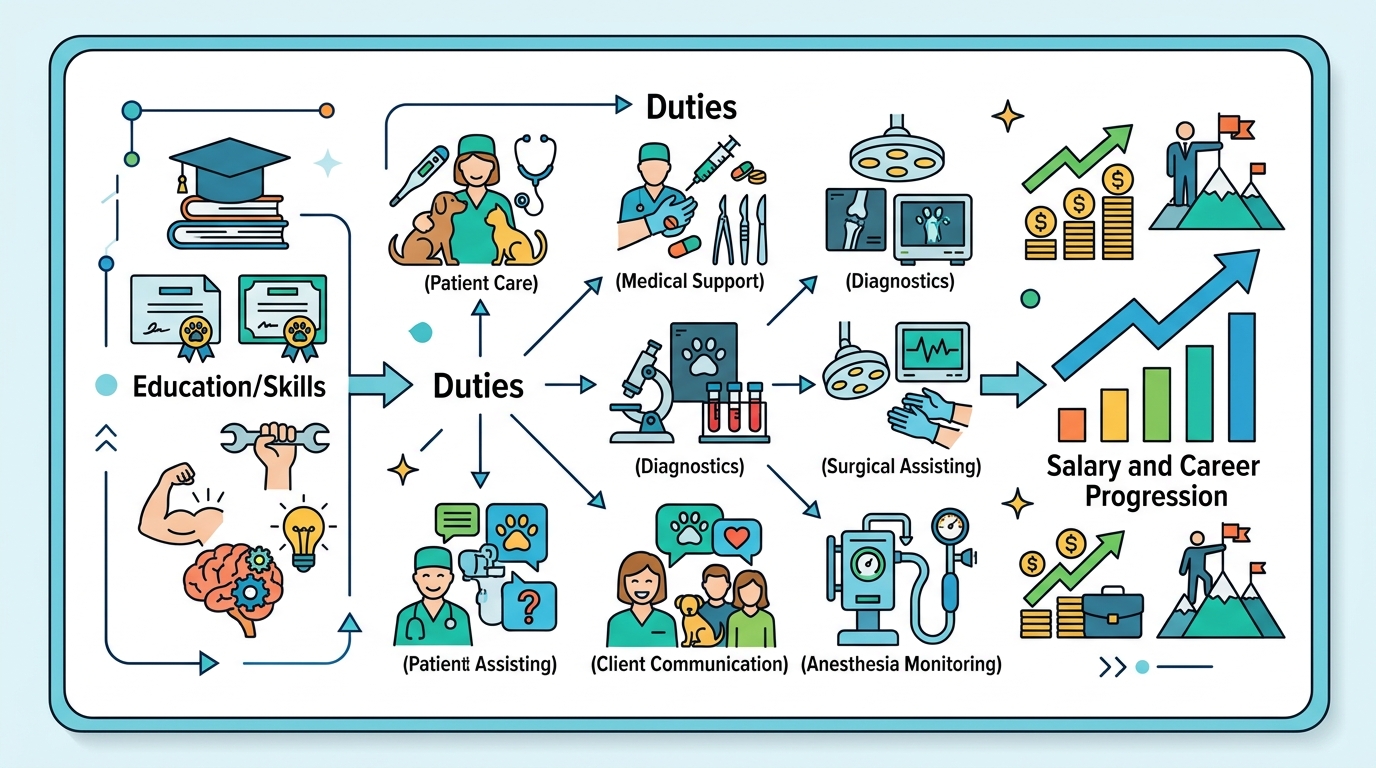
A veterinary technologist or technician is the clinical support behind a veterinarian: you restrain and handle patients, draw blood, take radiographs, give and monitor anesthesia, prepare surgical instruments, and explain home care to owners. Most of the job is hands-on animal work in a clinic, plus a steady amount of charting in practice management software.
Entry usually takes a 2-year associate's degree followed by a credentialing exam, and median pay was $47,380 a year in May 2025 (U.S. Bureau of Labor Statistics, 2025). The tradeoff is physical: the occupation has one of the highest injury and illness rates of all occupations (U.S. Bureau of Labor Statistics, 2025).
What This Job Involves Day to Day
A typical general-practice shift starts around 7:30 a.m. with treatment rounds: you check overnight hospitalized patients, record temperature, pulse and respiration, refill fluid lines, and log everything in the practice's management software — AVImark is one of the systems listed for this occupation, and most clinics run some veterinary practice management system (PMS) for records, billing and reminders (O*NET OnLine, U.S. Department of Labor, 2026).
By 8:30 a.m. appointments begin. You weigh patients, take histories from owners, restrain animals for examination, collect blood and fecal samples, and run in-house lab work. Mid-morning often means radiographs: positioning a patient on the x-ray table, setting the technique, and taking and developing diagnostic images with the x-ray equipment (O*NET OnLine, U.S. Department of Labor, 2026).
Surgery usually fills the middle of the day. You place an intravenous catheter, induce and administer anesthesia, then watch the multiparameter monitor and anesthesia machine for pulse oximetry, capnography and blood pressure while the veterinarian operates, adjusting the vaporizer as needed. Administering anesthesia and monitoring animals' responses, along with preparing animals and instruments for surgery, are core listed duties (U.S. Bureau of Labor Statistics, 2025).
Afternoons bring dental cleanings, bandage changes, discharge calls, autoclaving instrument packs and restocking. Closing shifts can run into the evening, and clinics with hospitalized patients or emergency caseloads also need weekend and holiday cover (U.S. Bureau of Labor Statistics, 2025).
Common Tasks and Responsibilities
- Restrain and position animals safely for examination, sample collection and imaging, using species-appropriate handling.
- Administer anesthesia and monitor the patient's responses throughout a procedure (U.S. Bureau of Labor Statistics, 2025).
- Prepare animals and surgical instruments for surgery, including clipping, scrubbing and packing sterile instrument trays (U.S. Bureau of Labor Statistics, 2025).
- Take and develop diagnostic radiographs using x-ray equipment (O*NET OnLine, U.S. Department of Labor, 2026).
- Draw blood, place intravenous catheters and run in-house laboratory tests such as blood counts and urinalysis.
- Perform dental scaling and polishing under veterinary supervision, charting findings tooth by tooth.
- Calculate and administer medications by injection, mouth or topical route, and record doses in the practice management software (O*NET OnLine, U.S. Department of Labor, 2026).
- Nurse hospitalized patients: feeding, wound and bandage care, fluid therapy and recovery monitoring.
- Coach owners through discharge instructions, medication schedules and at-home care before they leave.
Salary and Job Outlook by Experience Level
Pay is almost always an hourly wage in private practice, sometimes with shift differentials for evenings, weekends or emergency cover, and occasionally with a small bonus for holding a specialty credential. The figures below are national; state and metropolitan pay differ substantially, so check current local rates before you judge an offer.
| Experience level | Years of experience | Typical annual pay (national) |
|---|---|---|
| Entry-level | 0-2 years, newly credentialed | Toward the lower end of the range; the lowest 10 percent earned less than $35,710 |
| Mid-career | Roughly 3-7 years | Around the median of $47,380 |
| Experienced / senior | 8+ years, lead tech or specialty credential | Toward the upper end; the highest 10 percent earned more than $63,180 |
Figures: U.S. Bureau of Labor Statistics, May 2025 wage data for veterinary technologists and technicians. Experience bands are an illustration of where pay tends to sit within that published range, not separate published figures.
Industry matters too. In May 2025, median annual wages were $52,200 in educational services, $47,170 in veterinary services, $45,970 in social advocacy organizations and $44,730 in other personal services (U.S. Bureau of Labor Statistics, 2025). Veterinary services accounted for 89 percent of employment among the largest employers (U.S. Bureau of Labor Statistics, 2025).
On outlook: the occupation held about 131,400 jobs in 2025 and employment is projected to grow 9 percent from 2025 to 2035 — much faster than the average for all occupations — adding about 12,300 jobs with roughly 13,400 openings projected each year (U.S. Bureau of Labor Statistics, 2025).
Skills and Traits That Fit This Work
- Physical strength — you need to be able to manage and lift animals (U.S. Bureau of Labor Statistics, 2025), which in practice means hoisting a sedated large-breed dog onto a table with one other person.
- Manual dexterity — a steady hand matters for intricate tasks such as dental work, giving anesthesia and taking x-rays (U.S. Bureau of Labor Statistics, 2025), including placing a catheter in a small vein.
- Animal-reading instinct — you notice the ear position and weight shift that say a cat is about to bite before it does, and change your hold.
- Arithmetic under pressure — you recalculate a fluid rate or a milligram-per-kilogram dose correctly while a patient is on the table.
- Sustained attention — during a 90-minute procedure you keep watching the anesthesia monitor's trends rather than only its alarms.
- Clear, unhurried communication — you explain a tapering medication schedule to a worried owner so they can repeat it back accurately.
- Emotional steadiness — you assist with euthanasia appointments and then return to a routine vaccine visit in the next room.
How to Get Started
- Finish a veterinary technology program. Technicians typically need a 2-year associate's degree; technologists usually need a 4-year bachelor's degree (U.S. Bureau of Labor Statistics, 2025). The occupation sits in ONET Job Zone Three, 'Medium Preparation Needed,' which covers vocational training, related on-the-job experience or an associate's degree (ONET OnLine, U.S. Department of Labor, 2026). Programs include supervised clinical hours, so expect clinic placements during the two years.
- Check your VTNE eligibility pathway. Before applying for the Veterinary Technician National Examination, candidates must review their eligibility pathway with the American Association of Veterinary State Boards (AAVSB). Do this while you are still enrolled, so you know which route your program qualifies you under.
- Apply for and sit the VTNE. The AAVSB process has three steps: apply to take the VTNE, schedule and take the VTNE, then receive your score report. Passing a credentialing exam is typically what makes you registered, licensed or certified, and the exact title and requirements depend on your state (U.S. Bureau of Labor Statistics, 2025).
- Apply through veterinary practices first. Veterinary services account for 89 percent of employment among the largest employers (U.S. Bureau of Labor Statistics, 2025), so general practices, emergency hospitals and specialty referral centers are the main entry channel; many hire assistants and students into credentialed roles after graduation. University and research settings fall under educational services, which posted the highest industry median in May 2025 (U.S. Bureau of Labor Statistics, 2025).
- Add a specialty credential later. BLS points to CareerOneStop's certification finder for certifications available in this occupation (U.S. Bureau of Labor Statistics, 2025); use it to identify credentials in areas such as anesthesia, dentistry or emergency and critical care once you have clinic experience.
Frequently asked questions
How long does the education take, and do I need a bachelor's degree?
Most people enter as technicians with a 2-year associate's degree, the typical entry-level education for the occupation (U.S. Bureau of Labor Statistics, 2025). Technologists usually complete a 4-year bachelor's degree instead. Both routes normally end with a credentialing exam for state registration, licensure or certification. The bachelor's route is more common for research, teaching and some specialty hospital roles.
How does pay progress over a career?
Progression is mostly incremental hourly raises rather than large jumps. Nationally the median was $47,380 in May 2025, while the lowest 10 percent earned under $35,710 and the highest 10 percent over $63,180 (U.S. Bureau of Labor Statistics, 2025). Moving into lead technician work, a specialty credential, or educational services, which had a $52,200 median that month, tends to lift earnings.
What are the physical and schedule demands?
You spend most of the day standing, lifting and restraining animals, and physical strength to manage and lift patients is listed as an important quality (U.S. Bureau of Labor Statistics, 2025). The occupation has one of the highest injury and illness rates of all occupations, including bites, scratches and kicks. Evening, weekend and holiday shifts are common, especially in hospitals with inpatients.
Is demand for vet techs growing?
Yes. Employment is projected to grow 9 percent from 2025 to 2035, much faster than the average for all occupations, a change of about 12,300 jobs from the roughly 131,400 held in 2025 (U.S. Bureau of Labor Statistics, 2025). Around 13,400 openings are projected each year over that period, many of them replacing workers who leave the occupation.
Where do most vet techs work?
Veterinary services made up 89 percent of employment among the largest employers of this occupation (U.S. Bureau of Labor Statistics, 2025), meaning general practices, emergency clinics and referral hospitals. Smaller numbers work in educational services, social advocacy organizations such as shelters, and other personal services. Each setting changes the caseload: shelters lean toward preventive and surgical volume, referral centers toward critical care.
What is the difference between a technologist and a technician?
The distinction is mainly education. Technologists usually hold a 4-year bachelor's degree and technicians a 2-year associate's degree, and both typically must pass a credentialing exam to become registered, licensed or certified depending on the state (U.S. Bureau of Labor Statistics, 2025). Wage data is published for the two together, so job titles and duties often overlap in day-to-day clinic work.
Sources
- U.S. Bureau of Labor Statistics — Veterinary Technologists and Technicians : Occupational Outlook Handbook (2025)
- O*NET OnLine (U.S. Department of Labor) — 29-2056.00 - Veterinary Technologists and Technicians (2026)

Written by
Marisol steers Jobladderhq's coverage of hiring trends and the strange rituals of modern recruiting. She's drawn to the gap between what job ads promise and what the work actually feels like. Her editing hand favors clarity over jargon, always.