UX Designer Job Description: Duties, Skills, and Salary
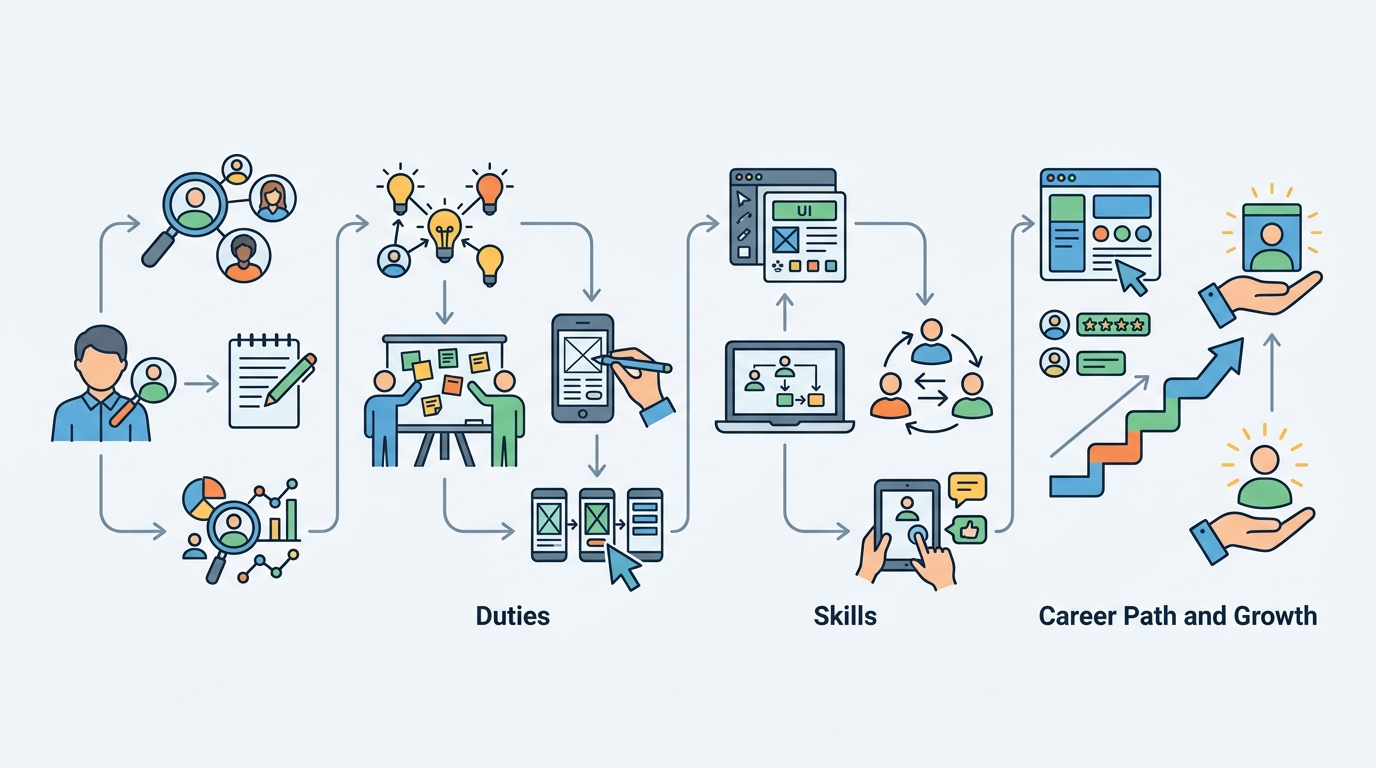
The role maps to the federal job title Web and Digital Interface Designers, and the work mixes user research, prototyping, testing and handoff to engineers.
Quick answer
- Typical entry-level education is a bachelor's degree, and employers often ask for work experience in a related occupation (U.S. Bureau of Labor Statistics, 2025).
- Adobe Creative Cloud and Adobe Illustrator are listed as in-demand hot technologies for this occupation (O*NET OnLine, undated).
- Median annual wage and 2025–35 outlook figures are published by BLS and O*NET — read the current numbers there before you negotiate.
A UX designer works out how a website, app or internal tool should behave so people can finish what they came to do, then proves it with research and testing before engineers build it. In U.S. federal data the role usually sits under Web and Digital Interface Designers (SOC 15-1255.00), grouped with web developers and digital designers by the Bureau of Labor Statistics.
Day to day it is a mix of talking to users and stakeholders, drawing interfaces in Figma or Adobe tools, running usability tests and documenting decisions. A bachelor's degree is the typical entry-level education for this occupation (U.S. Bureau of Labor Statistics, 2025), but portfolios carry heavy weight in hiring.
What a UX Designer Does
A UX designer owns the structure and behavior of a digital product: what screens exist, what order they come in, what each control does, and whether people can finish the task without help. The work starts with a question about users — why they abandon a checkout, why support keeps getting the same call — and ends with a tested design engineers can build.
The job cycles through four things: meeting with clients and stakeholders to agree what is being built, creating prototypes and mockups, testing interfaces and navigation menus, and identifying problems from testing or customer feedback (U.S. Bureau of Labor Statistics, 2025; O*NET OnLine, undated). Some designers also write front-end code or integrate graphics, audio and video, depending on how the team divides the work.
These roles sit in software and SaaS companies, digital agencies and consultancies, banks and insurers, hospital IT departments, e-commerce retailers, universities, government digital services, and inside manufacturers and logistics firms building internal tools.
Entry-level designers work on defined pieces — one flow, a form, a set of components — with a senior reviewing the output. Experienced designers scope the problem themselves, decide what research is needed, negotiate trade-offs with engineering and product, and own a whole product area. Workers with a bachelor's degree in this occupation may advance to become project managers (U.S. Bureau of Labor Statistics, 2025).
A Typical Day
- Reviews overnight analytics and session recordings, noting where users drop out of a flow, and flags the worst step for investigation.
- Runs a moderated usability session over video against a written script, recording where participants hesitate or pick the wrong control.
- Meets the product manager and stakeholders or clients to agree scope and constraints for the next release.
- Sketches flows and builds interactive prototypes in Figma, using Adobe Creative Cloud tools such as Illustrator for icons and assets — both listed as in-demand hot technologies for this occupation (O*NET OnLine, undated).
- Updates shared design-system components and documents each state (empty, loading, error, success) so engineers are not guessing.
- Runs an accessibility pass: keyboard-only navigation, focus order and color-contrast checks against WCAG criteria.
- Walks engineers through the prototype at handoff, then logs design tickets and acceptance notes in Jira or the team's tracker.
- Performs site or app tests on a planned schedule and writes findings into the research repository with a recommended change (O*NET OnLine, undated).
Salary and Job Outlook
Pay is usually a base salary, sometimes with a bonus or equity at product companies, and an hourly or day rate on contract and freelance work. It varies by state, metro area, industry and employer size — agency and public-sector roles are often lower than in-house product roles in high-cost tech markets. Figures move each year, so read them from the sources below.
| Experience level | What the work usually covers | Where to check the current pay figure |
|---|---|---|
| Entry (0–2 years) | Single flows, components, research note-taking, work reviewed by a senior | BLS Occupational Employment and Wage Statistics percentile table for Web and Digital Interface Designers (May 2025) |
| Mid (2–5 years) | Owns a feature end to end, runs own usability tests, writes specs for engineers | O*NET OnLine profile for SOC 15-1255.00, wage section (2025) |
| Experienced (5+ years) | Sets research strategy, owns a product area, mentors, may move into project management | BLS Occupational Outlook Handbook, Web Developers and Digital Designers (2025) |
| National median | All levels combined | BLS publishes a median annual wage for web and digital interface designers (May 2025); O*NET reports a median for SOC 15-1255.00 (2025) |
For demand, BLS publishes a 2025–35 job outlook and an employment count for web developers and digital designers combined; O*NET publishes a separate employment figure and projected 2025–2035 openings for web and digital interface designers.
Skills and Qualifications
Hard skills and credentials you can obtain or prove:
- A bachelor's degree, the typical entry-level education for this occupation (U.S. Bureau of Labor Statistics, 2025); O*NET also publishes an employer survey on the education needed for new hires in this role.
- Work experience in a related occupation — front-end development, graphic design, content design or support — which BLS lists as commonly required (2025).
- Figma or an equivalent interface design tool to production standard: components, variants, auto-layout, prototyping.
- Adobe Creative Cloud, including Illustrator, listed as in-demand hot technology for this occupation (O*NET OnLine, undated).
- Reading-level HTML and CSS, enough to maintain pages with authoring or scripting languages and discuss feasibility with engineers (O*NET OnLine, undated).
- Usability testing method: writing a task-based script, recruiting participants, moderating without leading, reporting findings.
- WCAG accessibility criteria, including contrast, focus order and screen-reader labels.
- Optional certification: the Nielsen Norman Group UX Certification, or the NN/g UX Master Certification for a specialism — check NN/g for current requirements, time commitment and cost.
Soft skills:
- Explaining a design decision to engineers and executives in their terms, including saying no with evidence.
- Taking critique without defending the work reflexively.
- Interviewing users without putting words in their mouths.
- Writing clearly — much UX output is labels, error messages and research summaries.
How to Get Started
- Pick your foundation (1–4 years). A bachelor's degree is the typical entry-level education for this occupation (U.S. Bureau of Labor Statistics, 2025); design, human-computer interaction, psychology and computer science all appear in practice. If you already hold a degree in something else, go to step 2.
- Learn the tool stack (2–3 months). Get fluent in Figma, then Adobe Creative Cloud and Illustrator, both listed as in-demand hot technologies for the role (O*NET OnLine, undated). Add basic HTML and CSS.
- Run three real projects (3–6 months). Redesign a flow for a local nonprofit, small business or campus service. Interview at least five users, test a prototype, and change the design based on what broke.
- Build three case studies. Each states the problem, the research you ran, what you tested, what you changed and what happened.
- Get related experience if you lack it (6–18 months). BLS notes work experience in a related occupation is commonly required (2025); front-end development, graphic design, QA, content and support roles all count.
- Apply under several titles. Search UX designer, product designer, interaction designer and the federal title Web and Digital Interface Designers, and tailor each application to the product the team ships. Consider the Nielsen Norman Group UX Certification once you have practice — check NN/g for current exam requirements and fees.
Frequently asked questions
Do you need a degree to be a UX designer?
A bachelor's degree is the typical entry-level education for web developers and digital designers (U.S. Bureau of Labor Statistics, 2025), and O*NET publishes an employer survey on the education needed for new hires in this occupation. Many teams will still interview candidates without a design degree if the portfolio shows tested work and related experience in development, graphic design or support. Degree requirements are stricter in government and large enterprise hiring than at startups and agencies.
Is being a UX designer stressful?
The pressure comes from fixed release deadlines and from stakeholders who disagree about what should be built, not from physical demands — the work is desk-based and most people in this occupation work full time (U.S. Bureau of Labor Statistics, 2025). Your work is also critiqued in open reviews, which some people find draining. Agency and contract roles add client billing pressure and several projects at once.
What is the difference between a UX designer and a UI designer?
UX covers structure and behavior — what the flow is, what happens when something fails, and whether testing shows people can complete the task. UI covers the visual layer: type, color, spacing, components and states. Many postings merge them, so read the duties list rather than the title and check whether research is part of the job.
Is UX design a growing field?
The Bureau of Labor Statistics publishes a 2025–35 job outlook for web developers and digital designers, and O*NET publishes projected openings for web and digital interface designers for 2025–2035. Read both figures on the current BLS Occupational Outlook Handbook and O*NET pages before judging demand. Check your state labor department too, since local projections differ sharply from the national picture.
Can UX designers work remotely?
Many do, since prototyping, usability sessions and handoff run through design tools, video calls and issue trackers. Employers vary: some product companies run fully distributed design teams, while agencies with on-site client work and government contracts often require in-office days. Remote policy is set by the employer, so confirm it in writing before you accept.
Sources
- U.S. Bureau of Labor Statistics — Web Developers and Digital Designers : Occupational Outlook Handbook (2025-05)
- O*NET OnLine — 15-1255.00 - Web and Digital Interface Designers (2025)

Written by
Noor writes personal essays and interviews about career changes, burnout, and starting over. She's interested in the stories people tell themselves about what a job is supposed to mean.