How to Switch Careers to Software Developer Without a Degree
A bachelor's is the typical entry route for this work, but not a legal requirement — here is what employers accept instead and how to assemble it.
Quick answer
- No state licenses software developers (CareerOneStop, U.S. Dept. of Labor), so the barrier is employer preference, not law — but a bachelor's remains the typical entry-level education (U.S. Bureau of Labor Statistics, 2025).
- Plan on 12 to 24 months of part-time study and project work before you are competitive, or the full registered length of an apprenticeship listed on Apprenticeship.gov, which pays you while you train.
- IT help desk and support work transfers well, because you already debug systems under time pressure; web developer roles also sit in a lower O*NET Job Zone, where vocational training or an associate's degree is typical (O*NET OnLine, U.S. Dept. of Labor).
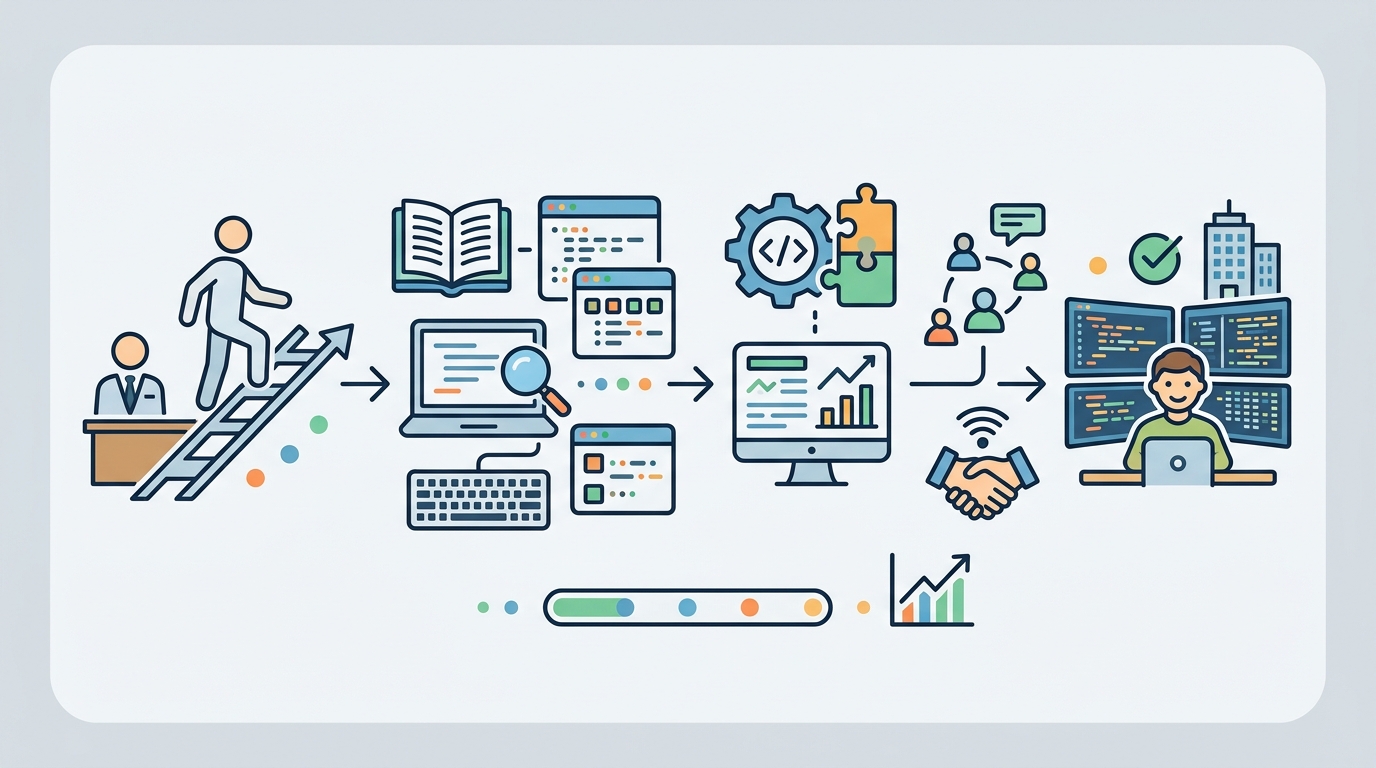
You can move into software development without a degree, but you have to replace what a degree signals: that you can learn a technical subject in a structured way and finish things. The U.S. Bureau of Labor Statistics lists a bachelor's degree as the typical entry-level education for software developers, QA analysts and testers (2025), and some employers prefer a master's on top of that (U.S. Bureau of Labor Statistics, 2025) — but CareerOneStop (U.S. Dept. of Labor) lists no licensing requirement for the occupation, so nothing legally blocks a self-taught or apprenticeship-trained candidate.
The realistic routes are a U.S. Department of Labor Registered Apprenticeship, entry through an adjacent role such as QA testing or web development, or a portfolio-plus-certification route. All three take months to years, not weeks.
Who Successfully Makes This Transition
IT support and help desk technicians. This is the most common bridge, because the daily skill is the one development interviews test: take a vague complaint, reproduce it, isolate the cause, confirm the fix. Support work also gives you production systems, ticketing workflows and user empathy that a computer science graduate usually has not seen. If you have written PowerShell or Bash scripts to automate ticket triage, you already have a portfolio — you just have not called it one.
Operations, finance and data roles that outgrew spreadsheets. Analysts, accountants, logistics planners and lab technicians who taught themselves SQL, VBA or Python to kill a repetitive task transfer well, because they can show a business problem, a built solution and a measurable result. Domain knowledge compounds: a developer who understands claims processing, freight routing or clinical records is useful to employers in those industries from week one.
QA testers and web developers. The U.S. Bureau of Labor Statistics groups software developers, quality assurance analysts and testers in one occupation (2025), and web developers sit in a lower ONET Job Zone, where vocational school training, related on-the-job experience or an associate's degree is typical (ONET OnLine, U.S. Dept. of Labor). Either role is a legitimate front door: you are paid, you read other people's code daily, and an internal move asks the employer to re-grade someone they already trust.
Traditional Path vs. Alternative Path
| Factor | Degree-based path | Alternative path (apprenticeship or portfolio) |
|---|---|---|
| Time to Entry | Four years full-time for a bachelor's — O*NET OnLine places Software Developers in Job Zone Four, where most occupations require a four-year degree, though some do not — plus a job search after graduation. | The registered length published on the Apprenticeship.gov listing you are accepted into; or 12 to 24 months of part-time study and project work alongside a current job. |
| Upfront Cost | Tuition for the specific institution, driven by public in-state versus private status, credits transferred and part-time study. Check the school's published per-credit schedule. | Registered Apprenticeships combine paid on-the-job training with classroom lessons (CareerOneStop, U.S. Dept. of Labor), so the cost is mainly time. Self-study costs are exam fees such as CompTIA Tech+ plus community college credits priced by your state system. |
| Credential Required | A bachelor's is the typical entry-level education (U.S. Bureau of Labor Statistics, 2025), and some employers prefer a master's as well; no state license exists (CareerOneStop). | No license either. Employers substitute an apprenticeship completion certificate approved by the U.S. Department of Labor, certifications, and reviewable code. |
| Typical Starting Pay | Salaried base pay, plus bonus or equity at larger firms. Look up the current median wage for the occupation in the BLS Occupational Outlook Handbook (2025) and on O*NET OnLine, and expect entry roles to start below that median. | Apprenticeships pay a progressive training wage that steps up as you complete competencies; the schedule is in the standards you sign. Portfolio hires sit on the same salary bands as degree hires once they clear the same interview loop — check current figures by state on CareerOneStop. |
Step-by-Step Alternative Path
- Confirm the rules before you spend anything. Read the Software Developers profile on O*NET OnLine and the occupational profile in the BLS Occupational Outlook Handbook. Note that CareerOneStop lists no licensing requirement, and that the BLS 2025–35 job outlook is published there, so you can judge demand without trusting a sales page.
- Build base vocabulary with a low-cost credential. CompTIA names certifications that help someone get started toward a software developer career, and CompTIA Tech+ covers programming concepts and software development and database fundamentals. It will not get you hired alone, but it gives a career changer a syllabus and a pass/fail checkpoint within weeks.
- Pick one language and finish three real projects. Choose Python, JavaScript or Java and stay with it for at least six months. Build a command-line tool you use, a small web application with a database behind it, and one project solving a problem from your current job. Each needs a public Git repository, a README explaining the trade-offs, automated tests, and a deployed version a hiring manager can click.
- Apply to Registered Apprenticeships. Use the apprenticeship finder on Apprenticeship.gov. O*NET OnLine publishes example Registered Apprenticeship titles vetted by industry and approved by the U.S. Department of Labor for this occupation — search those exact titles. Apprenti (apprenticareers.org) runs occupations registered and approved by the Department of Labor, including a Software Developer track.
- Use public training money and advisers. Search the CareerOneStop training finder and ask your local American Job Center what funding you qualify for in your state. State sites such as Texas Career Check publish the certifications associated with the Software Developers occupation, drawn from O*NET data.
- Take the adjacent job if it comes first. QA tester, support engineer and web developer roles put you in a codebase on payroll, and web development sits in a lower O*NET Job Zone, which makes it a realistic first offer. Ask in your first month what an internal move to a developer title requires, and get the answer in writing.
- Interview like a developer, not a student. Practise explaining one project in five minutes — problem, approach, what broke, what you would change — and rehearse writing code while talking. Apply to employer types that hire on demonstrated skill: government contractors with apprenticeship programs, insurance and healthcare IT departments, and small software firms.
What to Have Ready Instead of a Degree
- A public code profile with commit history over at least six months, showing steady work rather than one weekend burst.
- Three named portfolio projects, each with a README stating the problem, the stack, the trade-offs, and a link to the running version.
- Tests in at least one repository. Writing tests separates hobbyists from hireable juniors faster than any extra feature.
- A documented automation from your current job — the report you stopped running by hand — with the before-and-after time saved.
- CompTIA Tech+ or another certification CompTIA names as a starting point, plus any certifications your state's career site, such as Texas Career Check, lists for this occupation.
- Apprenticeship paperwork if you go that route: the registered standards, logged on-the-job hours, completed competencies, and the completion certificate approved by the U.S. Department of Labor.
- Two references who have seen you debug something, ideally a supervisor from support, QA or operations.
- A one-page résumé that leads with projects and shipped work, with the career change explained in one line rather than apologised for.
- A short, factual answer to "why no degree" — no state licenses this occupation, and you chose a route that produced working software earlier.
Frequently asked questions
Will employers actually interview me without a degree?
Some will screen you out automatically, particularly large employers whose applicant systems filter on education. Others — smaller software firms, IT departments in healthcare, insurance and logistics, and organisations running Department of Labor Registered Apprenticeships — decide on demonstrated skill. Expect a lower response rate per application and aim at the employer types that have already made a degree optional.
Does an apprenticeship lead to the same work as a degree route?
Yes, because the registered standards define competencies vetted by industry and approved by the U.S. Department of Labor, and you finish with production experience a new graduate does not have. The trade-off is that one employer's technology stack shapes your training. Read and build outside work so your skills stay portable.
How much less will I earn starting out than someone with a computer science degree?
Once you are through the hiring decision, pay is normally set by the role's band and your interview performance rather than your education, though your first title may be a step lower. The gap that matters sits before your first job, not after it. Check current wage figures for software developers on CareerOneStop and in the BLS Occupational Outlook Handbook for your state before accepting an offer.
Is it still worth switching given automation and hiring swings?
The Bureau of Labor Statistics publishes a 2025–35 outlook and employment figures for this occupation, and reading those directly beats any claim from a training provider. Entry-level competition is the real pressure point, which is why apprenticeships and adjacent QA or web roles matter. Base the decision on published figures for your state rather than general enthusiasm.
Sources
- U.S. Bureau of Labor Statistics — Software Developers, Quality Assurance Analysts, and Testers : Occupational Outlook Handbook (2025)
- O*NET OnLine (U.S. Dept. of Labor) — 15-1252.00 - Software Developers (2025)

Written by
Noor writes personal essays and interviews about career changes, burnout, and starting over. She's interested in the stories people tell themselves about what a job is supposed to mean.