How to Get Your Phlebotomy Technician Certification
Training usually runs under a year at a community college, and most of getting certified is paperwork, logged practice draws and one scheduled exam.
Quick answer
- Typical entry-level education is a postsecondary nondegree award — a phlebotomy certificate that usually takes less than 1 year at a community college, vocational school or technical school (U.S. Bureau of Labor Statistics, 2025).
- Certification is offered by professional organizations, and requirements vary by organization but may include education, clinical experience, an exam and a practical component such as drawing blood (U.S. Bureau of Labor Statistics, 2025).
- Requirements are partly state-specific: states may require an accredited program, a license or certification, and the U.S. Bureau of Labor Statistics (2025) directs candidates to contact their state licensing agency for specifics.
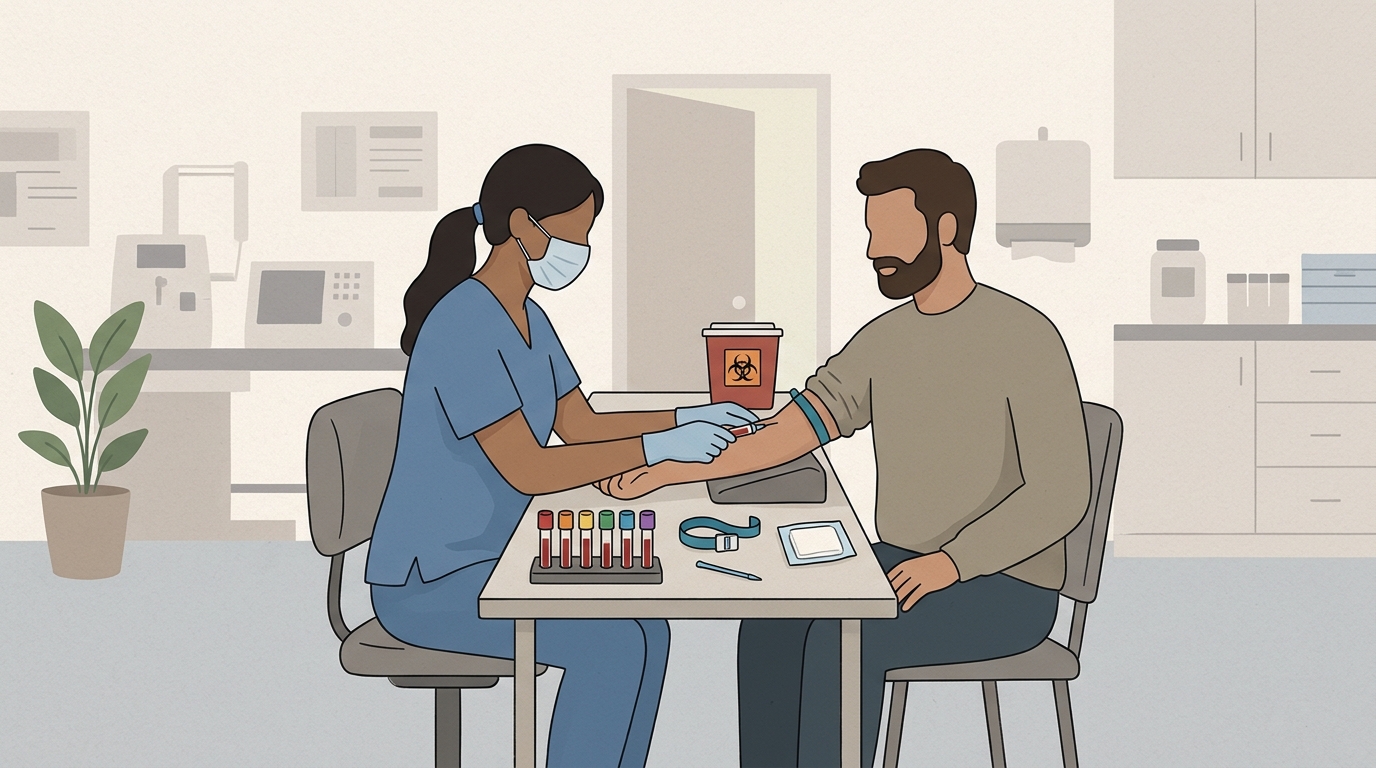
To work as a phlebotomy technician you usually need a certificate from a postsecondary phlebotomy program, though some people qualify with a high school diploma plus on-the-job training, and employers may prefer candidates who hold professional certification (U.S. Bureau of Labor Statistics, 2025). Those programs run at community colleges, vocational schools and technical schools and usually take less than 1 year, covering anatomy, physiology, medical terminology and laboratory work (U.S. Bureau of Labor Statistics, 2025).
Some states also require an accredited training program, a license or certification, so your first task is finding out what your own state expects (U.S. Bureau of Labor Statistics, 2025).
Why This Credential Matters
Phlebotomy is one of the few clinical jobs you can enter without a degree, so the credential does much of the work of proving you are safe around patients and specimens. The U.S. Bureau of Labor Statistics (2025) reports that some employers prefer to hire phlebotomists who have earned professional certification from a professional organization, and that states may separately require an accredited training program, a license or certification.
There is no single national licensing board for phlebotomy. Two things can apply to you at once:
- A state requirement, administered by your state licensing agency. The U.S. Bureau of Labor Statistics (2025) tells candidates to contact that agency directly. ONET OnLine, published by the U.S. Department of Labor, lists phlebotomists under ONET-SOC code 31-9097.00 and links to state licenses by state, which is a practical way to find the right agency.
- A voluntary professional certification, issued by a certifying organization rather than a government body. O*NET OnLine also links to certifications available nationwide for code 31-9097.00, so you can compare organizations before paying anyone.
To a hiring manager, the certificate plus the credential says you have been taught anatomy, physiology and medical terminology, that you have drawn blood under supervision, and that you understand the parts of the job that cause harm when done badly — verifying patient identity, labeling samples and maintaining sterile equipment (U.S. Bureau of Labor Statistics, 2025).
The heaviest hirers are hospitals (state, local and private), medical and diagnostic laboratories, ambulatory healthcare services, and offices of physicians (U.S. Bureau of Labor Statistics, 2025). Hospitals and reference laboratories tend to be strictest about documented certification; small physician offices more often train on the job. Employment is projected to grow much faster than the average for all occupations from 2025 to 2035 (U.S. Bureau of Labor Statistics, 2025), but a projection is not a job offer.
Step-by-Step Path to Certification
- Check your state's rules first. Use the ONET OnLine page for phlebotomists (ONET-SOC code 31-9097.00) to reach the state licenses list, then contact your state licensing agency as the U.S. Bureau of Labor Statistics (2025) advises. Ask whether a license is required, whether your training must be accredited, and which certifying organizations the state accepts. Doing this before you enroll stops you paying for a program your state will not count.
- Enroll in a postsecondary phlebotomy program. The typical entry-level education is a postsecondary nondegree award (U.S. Bureau of Labor Statistics, 2025), earned at a community college, vocational school or technical school in less than 1 year, with instruction in anatomy, physiology, medical terminology and laboratory work. If you would rather earn while training, phlebotomist is an apprenticeship occupation title vetted by industry and approved by the U.S. Department of Labor for a Registered Apprenticeship Program (O*NET OnLine), so ask local hospitals and laboratories whether they sponsor one.
- Complete and document your clinical hours. Certifying organizations may require education and clinical experience plus practical components such as drawing blood (U.S. Bureau of Labor Statistics, 2025). Keep a log of supervised venipunctures and capillary sticks, countersigned by your clinical instructor, and get a copy before you leave the site.
- Add Basic Life Support certification and, if relevant, a driver's license. Phlebotomists also may need Basic Life Support certification, and those who transport samples may need a driver's license (U.S. Bureau of Labor Statistics, 2025). If your program does not arrange the course, book it separately so the card is active when you start applying.
- Choose a certifying organization and confirm your eligibility route. Requirements vary by organization (U.S. Bureau of Labor Statistics, 2025), so compare the certifications listed for code 31-9097.00 on O*NET OnLine against what your state agency and target employers accept. Download the current candidate handbook and read the eligibility routes — there is usually one for program graduates and one based on documented work experience.
- Apply, pay the published fee and schedule the exam. Send the transcript or completion letter, your clinical log and any Basic Life Support card, pay the fee stated in the handbook, then book a date at an authorized testing center or through remote proctoring if offered.
- Pass the exam, then activate and protect the credential. Apply for the state license if your state requires one, save the certificate and credential number as a PDF for applications, and diary the renewal date and continuing education requirement the day it is issued.
Exam and License Details
Question counts, passing scores and fees are set by the individual certifying organization and change between editions of its candidate handbook, so confirm each figure in the current handbook before you pay.
| Detail | Specification |
|---|---|
| Exam name | The phlebotomy technician certification exam of the organization you select from the certifications listed for ONET-SOC code 31-9097.00 on ONET OnLine; requirements vary by organization (U.S. Bureau of Labor Statistics, 2025) |
| Prerequisite education | Postsecondary nondegree award is typical; some qualify with a high school diploma and on-the-job training (U.S. Bureau of Labor Statistics, 2025) |
| Number of questions | Fixed by the certifying organization and printed in its candidate handbook alongside the exam duration in minutes; confirm the count for the edition you sit |
| Passing score | Set by the certifying organization, usually as a scaled score rather than a raw percentage; take the number from the handbook, not from forums |
| Practical component | May include drawing blood and documented clinical experience, depending on the organization (U.S. Bureau of Labor Statistics, 2025) |
| Fee amount | Application and exam fees are published as dollar figures by each certifying organization; budget separately for tuition, Basic Life Support certification and any state license fee |
| Retake policy | Set by the certifying organization: expect a stated waiting period in days or weeks between attempts and a cap on attempts per application window |
| Renewal requirement | Certifications renew on a cycle stated in years, with continuing education and a renewal fee; state licenses renew on the schedule your state licensing agency sets (U.S. Bureau of Labor Statistics, 2025) |
| Other requirements | Basic Life Support certification may be required; a driver's license may be required if you transport samples (U.S. Bureau of Labor Statistics, 2025) |
Realistic Timeline
This assumes a certificate program rather than an apprenticeship. Community college and technical school terms usually start in fall, spring and summer, so your real start date may push everything back by 1 to 4 months.
- Month 1: Contact your state licensing agency and read the state and certification links on the O*NET OnLine page for code 31-9097.00. Decide whether you need a license, a certification, or both, and shortlist programs that meet any accreditation requirement.
- Months 1–2: Apply to a community college, vocational school or technical school program and complete admissions paperwork, immunization records and any background check.
- Months 2–9: Complete coursework in anatomy, physiology, medical terminology and laboratory work (U.S. Bureau of Labor Statistics, 2025). Most programs finish in under 1 year, so this block may be as short as 4 months or as long as 11.
- Months 6–9: Do your clinical rotation, log every supervised venipuncture and capillary stick, and collect signed documentation before the placement ends. Schedule Basic Life Support certification in this window.
- Months 9–10: Request your transcript or completion letter, submit the certification application with your clinical log, pay the fee and book the exam date.
- Months 10–11: Study from the organization's official content outline, then sit the exam. Build in 4 to 8 weeks of slack in case you need a retake after the stated waiting period.
- Months 11–12: Receive the credential, file the state license application if required, and apply to hospitals, medical and diagnostic laboratories, ambulatory healthcare services and offices of physicians — the largest employers of phlebotomists (U.S. Bureau of Labor Statistics, 2025).
- Ongoing from Month 12: Track continuing education hours and the renewal date from the day the credential is issued.
Frequently asked questions
Does my certification transfer if I move to another state?
A certification issued by a national professional organization travels with you, because it is not tied to one state's government. What may not travel is any state-level license or state-approved training requirement, since states set those individually (U.S. Bureau of Labor Statistics, 2025). Contact the licensing agency in the destination state and ask what it accepts from out-of-state applicants.
What will the whole process cost me?
Plan for four line items: tuition at the school, the certifying organization's application and exam charge, Basic Life Support certification, and any state license charge. Each school and organization publishes its own dollar amount, so build the total from their current fee schedules. Ask your school whether a first attempt is bundled into tuition, as some programs include it.
Can my employer pay for the exam?
Hospitals and medical and diagnostic laboratories sometimes reimburse exam and renewal costs for staff already on payroll, often after a set number of months of employment. If you are hired with a high school diploma and trained on the job, raise tuition assistance and reimbursement during the offer conversation. Get the terms in writing, including any repayment clause if you leave early.
What happens if my credential lapses?
Most certifying organizations offer reinstatement for a stated number of months after expiry, usually requiring back continuing education plus a reinstatement charge; past that window you may have to sit the exam again. Check the handbook as soon as you realise you have missed a deadline. If you also hold a state license, notify that agency separately, since its rules run independently.
Sources
- U.S. Bureau of Labor Statistics — Occupational Outlook Handbook: Phlebotomists — How to Become One (2025)
- O*NET OnLine (U.S. Department of Labor) — O*NET OnLine Summary Report for Phlebotomists (31-9097.00)

Written by
Priya tracks wages, layoffs, and the slow shifts in what counts as a stable job. She writes for readers trying to make sense of numbers that rarely match their own experience.