How to Become an HVAC Technician
HVAC work runs on EPA refrigerant rules and state-by-state licensing, and most people start through a trade school certificate or a paid apprenticeship.
Quick answer
- The minimum education is a high school diploma or GED; the U.S. Bureau of Labor Statistics (2025) lists a postsecondary nondegree award as the typical entry-level education and no related work experience as the usual requirement before entry.
- EPA Section 608 certification is mandatory, not optional, for technicians who handle refrigerants, though the EPA (2026) exempts apprentices working under the direct supervision of a certified technician.
- The quickest route is a trade school or community college HVACR certificate — commonly under a year of full-time study — followed by a helper or apprentice job, with O*NET OnLine (2026) describing one to two years of on-the-job and informal training as typical for this occupation.
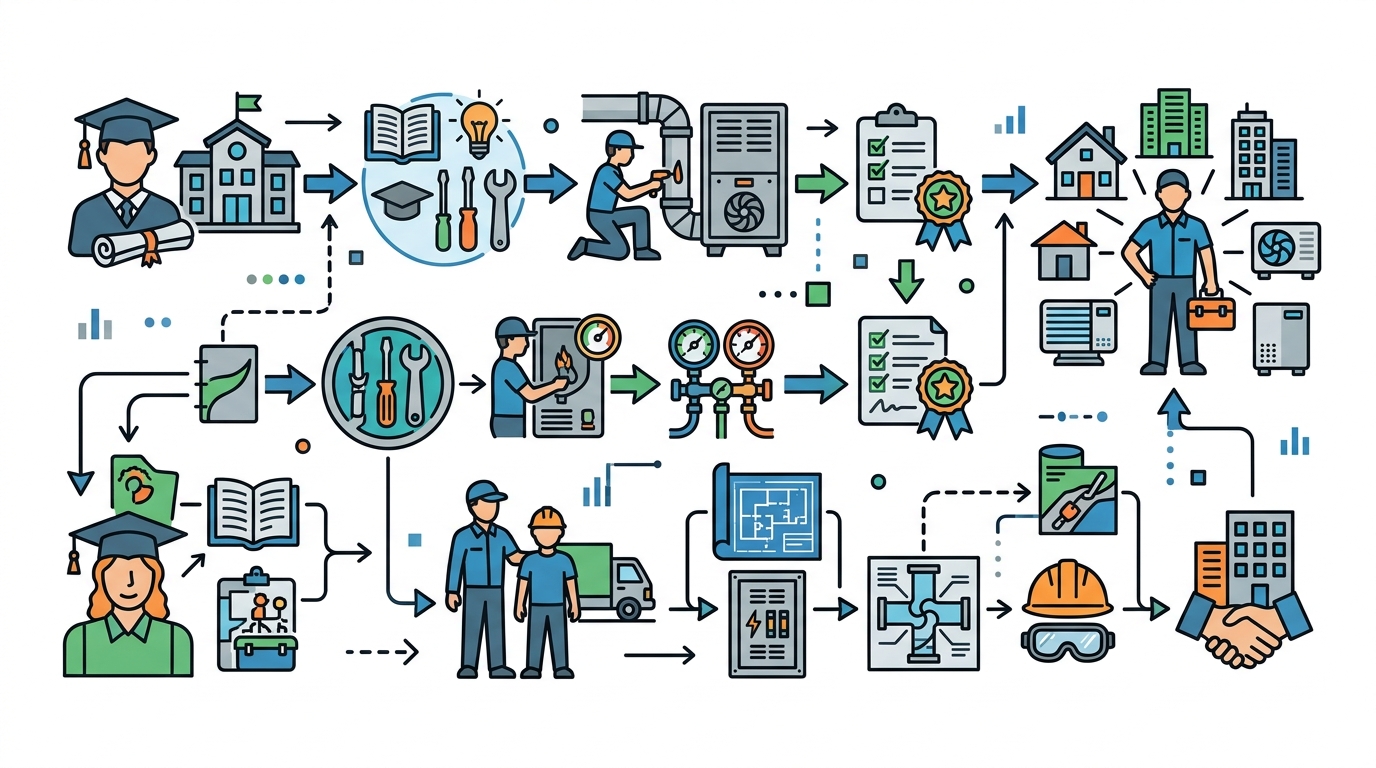
Becoming an HVAC technician usually means finishing high school, completing either a postsecondary HVACR program or a registered apprenticeship, passing the EPA Section 608 refrigerant exam, and then learning the rest on the job. The U.S. Bureau of Labor Statistics (2025) lists a postsecondary nondegree award as the typical entry-level education and says no prior work experience in a related occupation is required.
The credential that is not optional is EPA Section 608 certification, which federal rules require for anyone who maintains, services, repairs or disposes of equipment containing refrigerants. State and local licensing is separate, and the Bureau of Labor Statistics (2025) notes it differs by location, so you check that with your own state board rather than assuming.
What This Job Involves Day to Day
You install, maintain and repair heating, ventilation, air conditioning and refrigeration systems (U.S. Bureau of Labor Statistics, 2025). A residential service day often runs as four to eight calls: diagnosing why a furnace short-cycles, replacing a capacitor or blower motor, cleaning condenser coils, and changing filters and belts on a maintenance agreement visit.
Electrical troubleshooting is a daily task. You put a multimeter on contactors, thermostats, limit switches and compressor windings, read wiring diagrams, and decide whether the fault is the control board, the sensor or the load it feeds. On refrigeration side work you connect gauges, check superheat and subcooling, find leaks, and recover refrigerant into an approved cylinder — the work that makes EPA Section 608 certification a legal requirement rather than a resume extra.
Paperwork follows every call. You log refrigerant added or recovered, write up the diagnosis, quote repair options, and collect payment or a signature on a tablet. Installation crews work differently: a changeout day is mostly lifting equipment, cutting and hanging duct, brazing line sets, setting condensers on pads or rooftops, and pulling a vacuum before charging.
The setting is rarely a desk. Expect attics, crawlspaces, mechanical rooms, flat roofs and customer driveways, in summer heat and winter cold, with ladder work and equipment that regularly weighs more than one person can lift. Most technicians work for plumbing, heating and air-conditioning contractors, the largest employer category in the occupation (U.S. Bureau of Labor Statistics, 2025); others work in-house for school districts, hospitals, manufacturers and property management companies. Overtime and on-call rotations cluster around the first heat wave and the first hard freeze.
Step-by-Step Path to Get Started
- Finish high school or earn a GED (4 years, or several weeks to several months of GED prep). Take algebra, physics, shop and any electrical or welding electives offered. Your state's GED or HiSET administrator publishes test fees and testing center locations if you are completing it later.
- Pick your route: school first or earn-while-you-learn (decide within a few weeks). A postsecondary HVACR program at a technical school or community college leads to a certificate or an associate degree (U.S. Bureau of Labor Statistics, 2025); certificates commonly take under a year of full-time study and associate degrees about two years. A registered apprenticeship combines paid work with classroom instruction and runs several years — search sponsors and their published program lengths on apprenticeship.gov, the U.S. Department of Labor's apprenticeship finder.
- Enroll and complete the program (under a year to two years, depending on certificate versus degree). Prioritize programs with lab hours on live equipment, brazing practice, and a refrigerant recovery machine you actually operate. Ask the admissions office whether EPA 608 testing is built into the curriculum.
- Get a driver's license and clear the pre-employment screens (1 to 4 weeks). Service contractors assign company vans, so a valid license and an acceptable motor vehicle record matter as much as technical skill. Most employers also run a criminal background check and a drug screen before you enter customers' homes.
- Pass the EPA Section 608 exam (study for a few weeks; one testing session). You take a Core section plus Type I for small appliances, Type II for high-pressure systems, Type III for low-pressure systems, or all of them for Universal certification (U.S. Environmental Protection Agency, 2026). The test is administered by EPA-approved certifying organizations, frequently at the trade school or community college itself (U.S. Bureau of Labor Statistics, 2025), and Type II, Type III and Universal exams must be proctored. Section 608 certification does not expire once earned.
- Start as an apprentice, helper or installer and log time (1 to 2 years). Expect long-term on-the-job training after hiring (U.S. Bureau of Labor Statistics, 2025); O*NET OnLine (2026) places the occupation in Job Zone 3, where one to two years of combined on-the-job experience and informal training with experienced workers is typical. If you are an apprentice working under the direct supervision of a certified technician, the EPA (2026) exempts you from holding your own certification while you train — but employers still prefer you have it.
- Check state and local licensing before you call yourself a technician (2 to 8 weeks to process). Licensing requirements differ by state and locality (U.S. Bureau of Labor Statistics, 2025). Contact your state contractor licensing board or the city building department for the trade license categories, documented hours of experience, and exam they require.
- Apply to HVAC contractors and facilities departments (2 to 6 weeks of applications). Target residential and commercial mechanical contractors, hospital and university facilities teams, school district maintenance shops, and property management firms. Put your EPA 608 type and certification number at the top of your resume.
Education, Certification, and Cost Requirements
| Requirement | Where to Get It | Typical Cost | Typical Time |
|---|---|---|---|
| High school diploma or GED | Public high school, or your state's GED/HiSET testing administrator | Free at a public high school; state GED programs publish a per-subject test fee that differs by state and whether fee vouchers are offered | 4 years, or several weeks to several months of GED prep |
| HVACR certificate or associate degree | Community college or technical/trade school with an HVACR program (U.S. Bureau of Labor Statistics, 2025) | Per-credit tuition plus tools and lab fees, published on the college's tuition page; the total turns on in-district versus out-of-district residency, certificate versus degree credit count, and whether a tool kit is included | Under a year full-time for a certificate; about 2 years for an associate degree |
| Registered apprenticeship | Sponsors listed on apprenticeship.gov (U.S. Department of Labor), including contractor associations and individual mechanical contractors | You are paid while you train; sponsors publish any books, tools or class fees you owe | Several years, with structured raises; check the sponsor's published term |
| EPA Section 608 certification (Core plus Type I, II, III or Universal) | An EPA-approved certifying organization; often administered at the trade school or community college (U.S. Bureau of Labor Statistics, 2025) | A per-exam fee set by the certifying organization, plus an optional study manual; the fee depends on how many types you sit and whether proctoring is in person or online | A study period of a few weeks, then one testing session; certification does not expire (U.S. Environmental Protection Agency, 2026) |
| State or local HVAC/mechanical license | Your state contractor licensing board or city building department | Application, exam and license fees from the board's published fee schedule; amounts and renewal cycles differ by state and locality | 2 to 8 weeks to process after you meet the experience and exam requirements |
| Driver's license and clean driving record | State DMV | DMV-published license and record-check fees | Same day to a few weeks |
Before You Apply
Have these ready before you send the first application:
- Your EPA Section 608 card and certification number, with the type (I, II, III or Universal) written on your resume, not buried in a skills list.
- A one-page, reverse-chronological resume that names the equipment you have worked on: split systems, packaged rooftop units, gas furnaces, heat pumps, mini-splits, walk-in coolers.
- A skills line listing tools you own — gauges, vacuum pump, recovery machine, multimeter, torch set — because service contractors ask on the first call.
- Copies of your certificate, diploma or transcript from the HVACR program, plus the program's lab hour count if it is published.
- Photos of completed work, such as a line set, a condensate layout or a duct run, saved to your phone for the interview.
- A valid driver's license and a current motor vehicle record you have already pulled from your state DMV, since vans are assigned on day one.
- Willingness to pass a background check and drug screen, standard for in-home service work.
- Your state board's licensing page bookmarked, with a note on which license category your target job requires.
- Two references with phone numbers — a program instructor and a crew lead or site supervisor are stronger than character references.
- An honest answer on physical requirements: ladders, attics, crawlspaces, rooftop access and lifting equipment with a partner.
- Current wage data for your metro area from the U.S. Bureau of Labor Statistics, which publishes the median wage and the 10th and 90th percentile wages for heating, air conditioning and refrigeration mechanics and installers (2025), so you negotiate from published figures rather than guesses.
Frequently asked questions
Can I get hired without going to trade school first?
Yes — many contractors hire helpers or installers' assistants with a high school diploma and train them on the job, which is why the Bureau of Labor Statistics (2025) lists no prior related work experience as a requirement for entry. The trade-off is slower progression: you learn the systems your employer happens to service rather than a full curriculum. If you take this route, ask in the interview whether the company pays for your EPA 608 exam and classroom hours.
How soon can I be earning on my own service truck?
Most people run solo calls after one to two years of supervised work, matching the on-the-job training level O*NET OnLine (2026) describes for this occupation. Residential service tends to release technicians to solo work sooner than commercial refrigeration, where the equipment and liability are larger. Your employer sets the threshold, usually a mix of completed ride-alongs, callback rate and a diagnostic test.
Which EPA 608 type should I sit for?
Universal covers all three types and spares you from retesting when you change job types, which is why schools often package it. If you are already hired into residential work, Type II alone covers the high-pressure split systems you will see every day. The EPA (2026) requires proctoring for Type II, Type III and Universal, so budget for a scheduled testing session rather than an at-home attempt.
What are the main costs to plan for in the first year?
Tuition or program fees, the EPA exam fee set by your certifying organization, a starter tool kit, work boots, and any state license application fee once you qualify. Apprenticeships shift most of the tuition burden to the sponsor because you are paid while training. Check the college's published tuition schedule and your state board's fee page for current amounts before you commit.
Is the field still hiring?
The Bureau of Labor Statistics (2025) publishes a ten-year employment projection for 2025-35 for heating, air conditioning and refrigeration mechanics and installers, along with projected average annual openings, in the Occupational Outlook Handbook. Openings come from both growth and replacement as experienced technicians retire. Check the Handbook entry and your state workforce agency's local projections before choosing a program.
Sources
- U.S. Bureau of Labor Statistics — Heating, Air Conditioning, and Refrigeration Mechanics and Installers (2025)
- U.S. Environmental Protection Agency — Section 608 Technician Certification Requirements (2026-07-15)

Written by
Wyatt covers work outside the office: construction, logistics, repair, and the people who keep things running. He's skeptical of career advice that assumes everyone sits at a desk.