How to Become an Electrician
Apprenticeship or technical school, an aptitude test, thousands of supervised hours and a code-based exam — here is the order those pieces usually come in.
Quick answer
- The usual fastest route is a registered apprenticeship straight out of high school: 2,000 hours of paid on-the-job training per year for four or five years, plus technical instruction (U.S. Bureau of Labor Statistics, 2025).
- The minimum education is a high school diploma or equivalent; of surveyed respondents on education needed for new electrician hires, 62% said a post-secondary certificate is required and 31% said a high school diploma or equivalent (U.S. Bureau of Labor Statistics, 2025; O*NET OnLine, 2026).
- Licensing is mandatory, not optional, in most states: you pass a test covering the National Electrical Code plus state and local codes, and may need continuing education to keep it (U.S. Bureau of Labor Statistics, 2025).
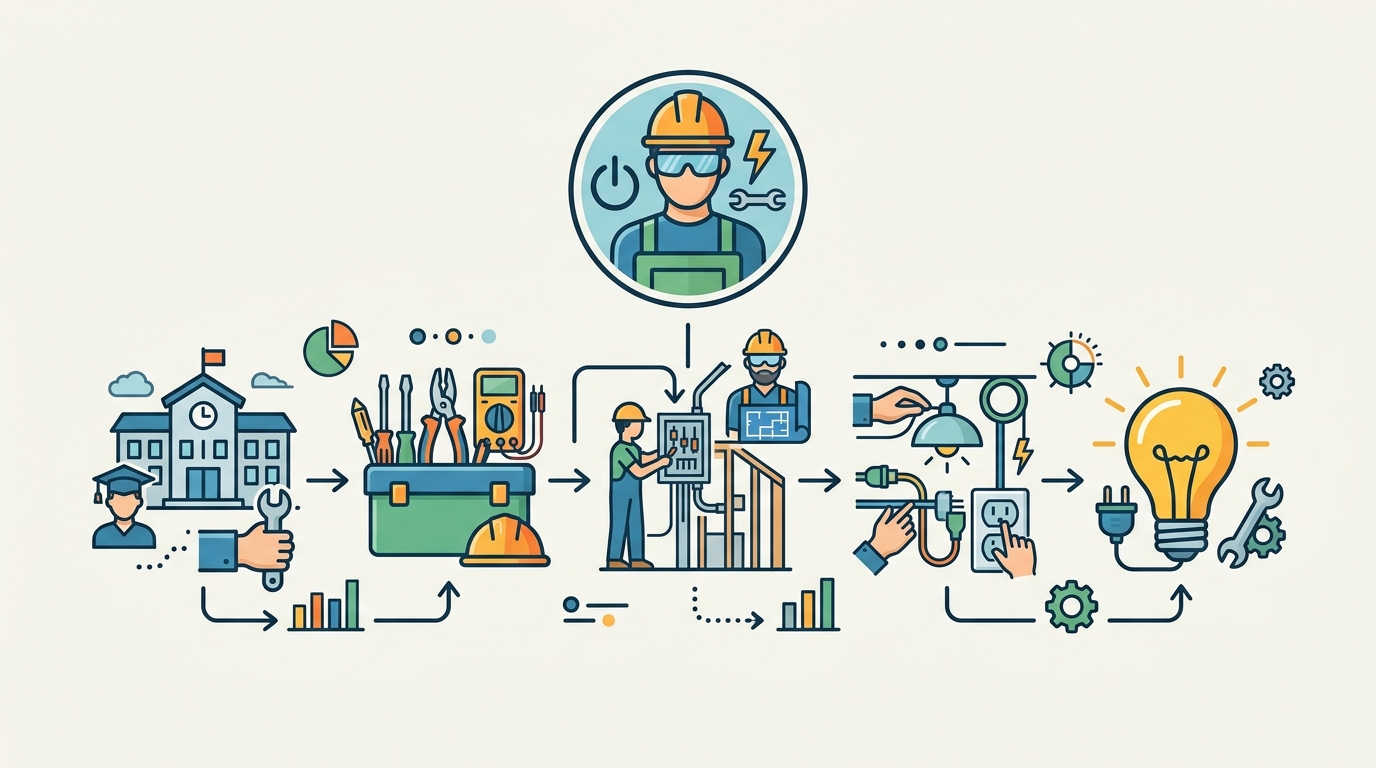
Most people become an electrician by getting into a paid apprenticeship after high school, working 2,000 hours a year on the job alongside classroom instruction, then passing a state licensing exam to work as a journey worker (U.S. Bureau of Labor Statistics, 2025). That route normally runs four or five years, and some people start instead at a technical school (U.S. Bureau of Labor Statistics, 2025).
The entry bar is a high school diploma or equivalent and no prior work experience, so the real gatekeepers are the apprenticeship application and, in most states, the license exam (CareerOneStop, undated; U.S. Bureau of Labor Statistics, 2025).
What This Job Involves Day to Day
A workday is built around wiring, inspection and troubleshooting tasks that repeat across jobs:
- Reading the drawings first. Electricians read blueprints or technical diagrams, and often prepare their own sketches, to work out where wiring, panels and equipment go (U.S. Bureau of Labor Statistics, 2025; O*NET OnLine, 2026).
- Running conduit and pulling wire. Much new-construction work is placing conduit and pulling insulated wires or cables through it to complete circuits, then installing and maintaining control and lighting systems (O*NET OnLine, 2026; U.S. Bureau of Labor Statistics, 2025).
- Testing and fault-finding. You inspect electrical components, identify problems with testing devices, and repair or replace wiring and fixtures using hand tools and power tools (U.S. Bureau of Labor Statistics, 2025).
- Working to code and directing others. Installations follow state and local rules based on the National Electrical Code, and experienced electricians direct and train apprentices and helpers on site (U.S. Bureau of Labor Statistics, 2025).
The setting is hands-on, not desk-based. Of surveyed electricians, 96% said they use their hands to handle, control or feel objects, tools or controls continually or almost continually, and 95% said they wear common protective or safety equipment every day (O*NET OnLine, 2026). Almost all electricians work full time, schedules can include evenings and weekends, and overtime is common (U.S. Bureau of Labor Statistics, 2025).
Step-by-Step Path to Get Started
- Finish a high school diploma or equivalent (4 years of high school, or equivalency testing through your state's adult education agency). A diploma or its equivalent is required to become an electrician (U.S. Bureau of Labor Statistics, 2025).
- Get your algebra solid (plan on 4 to 8 weeks if you are rusty). Technical instruction covers electrical theory, blueprint reading, mathematics, code requirements, and safety and first-aid practices (U.S. Bureau of Labor Statistics, 2025). The North Texas Electrical Joint Apprenticeship and Training Committee includes an 8-week math refresher class in its term (North Texas Electrical JATC, undated).
- Choose an apprenticeship or a technical school start (decide within days). Most electricians learn through an apprenticeship, though some attend a technical school first (U.S. Bureau of Labor Statistics, 2025). Use CareerOneStop's apprenticeship search and your state apprenticeship agency to find registered programs, including joint apprenticeship and training committees run by NECA and the IBEW.
- Apply to a joint apprenticeship and training committee and pass the aptitude test (allow 1 to 6 months from applying to a start date). The North Texas Electrical JATC requires a score of 5 or higher on the NJATC Aptitude Test and charges a $20.00 fee on all applications (North Texas Electrical JATC, undated). Expect an interview and proof of your diploma.
- Ask about advanced standing during the application if you have military or construction electrical experience. Those workers may qualify for a shortened apprenticeship based on experience and testing (U.S. Bureau of Labor Statistics, 2025).
- Complete the apprenticeship (4 or 5 years). The NECA/IBEW inside wireman apprenticeship requires a minimum of 8,000 hours of on-the-job training under a journeyman's supervision plus 900 hours of classroom instruction over five years, with class one day every two weeks (NECA-IBEW Electrical JATC, undated). The North Texas Electrical JATC divides the same 8,000 hours over 4 years with 180 classroom hours a year (North Texas Electrical JATC, undated).
- Pass your state or local licensing exam (study over 2 to 6 months; the exam is a single sitting). The test covers the National Electrical Code and state and local codes (U.S. Bureau of Labor Statistics, 2025). After the apprenticeship you are a journey worker and may work on your own, subject to those requirements, and may later add certifications in solar photovoltaic, electrical generating or lighting systems or advance to master electrician (U.S. Bureau of Labor Statistics, 2025).
Education, Certification, and Cost Requirements
Three bodies set the dollar amounts: your state's adult education agency, the apprenticeship sponsor or college, and your state or local electrical licensing board. Each publishes a current fee schedule.
| Requirement | Where to Get It | Typical Cost | Typical Time |
|---|---|---|---|
| High school diploma or equivalent | Public high school; state adult education agency for equivalency testing | No tuition at a public high school; equivalency fee set by your state agency's published list | 4 years, or 3 to 6 months of equivalency prep |
| Apprenticeship application and NJATC Aptitude Test | Local joint apprenticeship and training committee, via CareerOneStop or your state apprenticeship agency | $20.00 per application at the North Texas Electrical JATC; other sponsors publish their own (North Texas Electrical JATC, undated) | Application window of a few weeks, then 1 to 6 months to a class start |
| Math refresher class | Apprenticeship sponsor | Included in the term where the sponsor provides it | 8 weeks (North Texas Electrical JATC, undated) |
| Registered apprenticeship, on-the-job hours | NECA/IBEW and other registered sponsors | Paid training, not tuition (U.S. Bureau of Labor Statistics, 2025) | 8,000 hours over 4 or 5 years (NECA-IBEW Electrical JATC; North Texas Electrical JATC, undated) |
| Classroom instruction | Apprenticeship school or partner community college | Books and course fees billed by the sponsor; ask for the per-year schedule | 900 hours over 5 years, or 180 hours a year over 4 |
| Technical school certificate (alternative start) | Community or technical college electrical program | Tuition per credit hour on the college's cost-of-attendance page | 1 to 2 years full time |
| Journey-level and master licenses | State or local electrical licensing board | Application, exam and renewal fees set by the board | Exam booked within weeks of eligibility; master status after additional years of qualified work |
| Continuing education and specialty certification | Board-approved providers, manufacturers, specialty certifying bodies | Per-course or per-exam fee set by the provider | Hours per renewal cycle set by your board; days to weeks per credential |
Before You Apply
Have these in hand before you submit an apprenticeship application or answer a contractor's posting:
- Proof of a high school diploma or equivalency credential, plus an official transcript showing the algebra course you completed — programs ask for the transcript, not just the diploma.
- Your NJATC Aptitude Test result where your local committee uses it, with a score of 5 or higher if that is the published cut-off (North Texas Electrical JATC, undated).
- The $20.00 application fee ready at submission at the North Texas Electrical JATC, or the comparable sponsor-set fee elsewhere (North Texas Electrical JATC, undated).
- A valid driver's license and reliable transport, since you are assigned to job sites rather than one building.
- Documentation of military or construction electrical experience — DD-214, training certificates, or a log of hours — if you want a shortened apprenticeship considered (U.S. Bureau of Labor Statistics, 2025).
- A one-page chronological resume listing physical and tool-based work first, with any safety or first-aid training named outright.
- Consent for a background check and drug screening, commonly required before site access.
- Basic hand tools and personal protective equipment, since 95% of surveyed electricians wear protective or safety equipment every day (O*NET OnLine, 2026).
- Your license or registration number once you hold one, plus a record of continuing education hours in the current renewal cycle.
Frequently asked questions
Can I skip the apprenticeship and just go to technical school?
Technical school is a recognised starting point, but it generally feeds into rather than replaces supervised hours, because most electricians still learn the trade through a four- or five-year apprenticeship (U.S. Bureau of Labor Statistics, 2025). Coursework can make you a stronger applicant, so ask the committee in writing which credits it accepts before enrolling.
How long until I can work unsupervised?
Journey-worker status comes at the end of the apprenticeship, when you may perform duties on your own subject to local or state licensing rules (U.S. Bureau of Labor Statistics, 2025). From a high school diploma that is typically four to five years if you are accepted on your first application cycle. Waiting for the next intake can add several months before the clock starts.
Is a license required everywhere in the United States?
Most states require electricians to be licensed (U.S. Bureau of Labor Statistics, 2025). Because the requirement sits with state and sometimes city authorities, which credential you need and whether it transfers when you move are questions for the board where you intend to work. Check that board's current application, exam and renewal fees before you budget.
What ongoing costs should I budget for after licensing?
Expect renewal fees and continuing education, which electricians may be required to take to maintain a license — usually safety practices, code changes, and manufacturer training on specific products (U.S. Bureau of Labor Statistics, 2025). Tool replacement and protective equipment are recurring too. Your board lists required hours per cycle and approved providers.
Is it worth entering the trade now?
Employment of electricians is projected to grow 9 percent from 2025 to 2035, much faster than the average for all occupations, with about 72,700 openings projected each year on average (U.S. Bureau of Labor Statistics, 2025). Openings sit with construction contractors, maintenance departments and specialty firms, so your local market matters more than the national figure. Apprentice pay is usually structured as a percentage of the journey-worker rate that steps up with completed hours — ask the sponsor for its wage schedule.
Sources
- U.S. Bureau of Labor Statistics — Electricians : Occupational Outlook Handbook (2025)
- O*NET OnLine — 47-2111.00 - Electricians (2026)

Written by
Marisol steers Jobladderhq's coverage of hiring trends and the strange rituals of modern recruiting. She's drawn to the gap between what job ads promise and what the work actually feels like. Her editing hand favors clarity over jargon, always.