How to Become a Truck Driver With No Experience
Federal training rules, a learner's permit, a medical card and a road test stand between you and a Class A licence — here is the order they come in.
Quick answer
- No degree is required: most heavy and tractor-trailer drivers hold a high school diploma, attend a truck driving school and must obtain a CDL (U.S. Bureau of Labor Statistics, 2025).
- Before taking the CDL skills test, first-time Class A or B applicants must complete training with a provider listed on FMCSA's Training Provider Registry (Federal Motor Carrier Safety Administration).
- Delivery driving, warehouse and forklift work, and military motor transport all transfer well, because they show a clean driving record and shift reliability rather than classroom credentials.
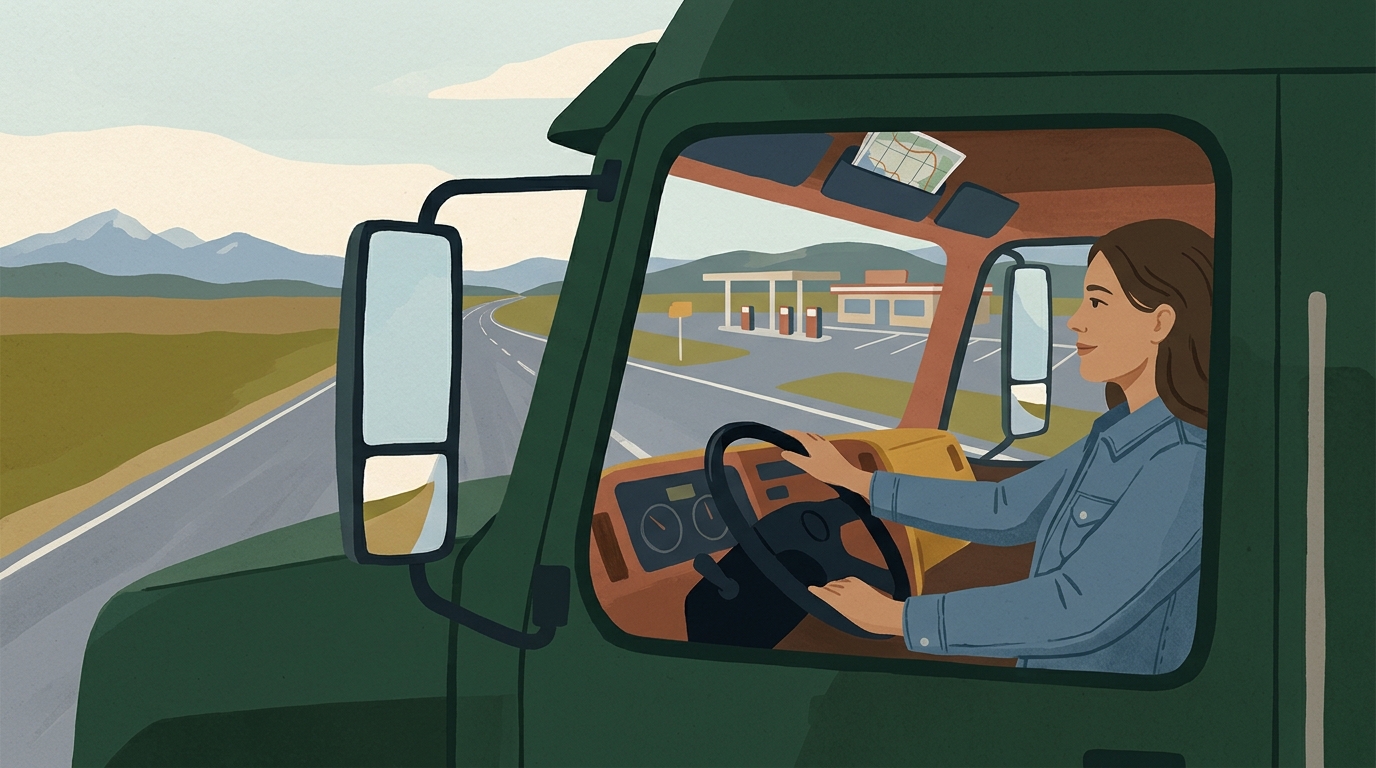
You do not need a college degree to drive a tractor-trailer. Most heavy and tractor-trailer drivers have a high school diploma, attend a professional truck driving school, and must hold a commercial driver's license, or CDL (U.S. Bureau of Labor Statistics, 2025). The route in is a defined sequence: a medical exam, a Commercial Learner's Permit, federally mandated entry-level driver training, then the CDL skills test.
The main variables are your age and your state. The minimum age for a CDL is 18 in every state except Hawaii, but holders under 21 may only drive inside their state of residence until they turn 21 (World Population Review, 2026).
Who Successfully Makes This Transition
Local delivery and box-truck drivers. If you have run a parcel, food service or furniture route, you already know load securement, customer sites, dock etiquette and driving a full day without incident. Carriers care most about your motor vehicle record and your ability to arrive on time, and a delivery history is direct evidence of both. The step up is vehicle size and overnight hours, which the required behind-the-wheel training covers.
Warehouse, dock and forklift workers. Freight handlers understand pallets, weights, bills of lading and the pace of a shipping operation. Many carriers and private fleets recruit internally from their own docks precisely because the person already knows the terminal, the customers and the paperwork. Some distribution employers will sponsor CDL training for existing staff — ask your own operations manager before you pay tuition anywhere.
Military motor transport operators and equipment operators. Service members who drove tactical vehicles, plus civilian heavy equipment and farm equipment operators, come in with hours behind large diesel vehicles, pre-trip inspection habits and comfort with maintenance reporting. Most states offer a military skills test waiver route for qualifying veterans — check with your state driver licensing agency, since the terms differ state by state.
Employers accept these backgrounds in place of a degree because the legally binding qualifications here are a licence and a medical certificate, not a diploma. The U.S. Bureau of Labor Statistics (2025) notes that new drivers typically receive on-the-job training after hire, so carriers expect to finish your training themselves.
Traditional Path vs. Alternative Path
There is no degree that licenses you to drive a truck. The "traditional" comparison is a transport, logistics or diesel technology college program taken before entering the industry — useful for dispatch, safety or management roles later, but not a substitute for the CDL.
| Factor | Degree-first route (associate or bachelor's in logistics or diesel technology) | Alternative route (ELDT plus CDL) |
|---|---|---|
| Time to Entry | 2 years for an associate degree, 4 years for a bachelor's, plus the CDL steps afterwards | Measured in weeks to a few months: Commercial Learner's Permit, then theory and behind-the-wheel training until the provider judges you proficient (Sage Truck Driving Schools) |
| Upfront Cost | Published per-credit tuition plus fees at the college; compare your state community college's current rates before enrolling | Driving school tuition, DOT physical fee and state licensing fees; carrier-sponsored and registered apprenticeship routes shift most of the cost to the employer in exchange for a work commitment (U.S. Department of Labor) |
| Credential Required | The degree confers no driving privileges; you still need a CDL | Class A or B CDL with any needed endorsements, plus a current medical examiner's certificate (Federal Motor Carrier Safety Administration) |
| Typical Starting Pay | Paid as a salary in office-based logistics and safety roles, not as driver pay | Usually cents-per-mile for over-the-road work, hourly for local and dedicated runs, or a percentage of the load for some owner-operator arrangements; look up the 2025 median pay for heavy and tractor-trailer truck drivers in the BLS Occupational Outlook Handbook and your local figures on CareerOneStop |
Pay differences between the two routes are mostly differences of job, not of schooling: route type, home-time pattern, freight hauled, endorsements held and the state you run in drive driver earnings far more than any classroom credential.
Step-by-Step Alternative Path
- Check the age rules that apply to you. Confirm your state's minimum CDL age with your state driver licensing agency. If you are 18 to 20, you can generally hold an intrastate CDL only until you turn 21 (World Population Review, 2026), because FMCSA requires drivers to be 21 or older to drive in interstate commerce or haul placarded hazardous materials. FMCSA's Safe Driver Apprenticeship Pilot Program, launched 14 January 2022, lets apprentices aged 18 to 20 with an intrastate CDL run interstate under an experienced driver until they complete two probationary periods totalling at least 400 hours of on-duty time — check FMCSA's SDAP page for the current application deadline before relying on it.
- Pass the DOT physical. A certified medical examiner must examine you before you can be qualified to drive (Fortis College). Book with an examiner listed on FMCSA's National Registry and sort out any vision, blood pressure or sleep apnea issue early — this is the step that ends the plan for some people, so do it first.
- Pull your own driving record and study for the knowledge tests. Order your motor vehicle record from your state DMV so you see what a recruiter will see. Then download your state's free CDL manual from the same agency and study general knowledge, air brakes and combination vehicles.
- Get your Commercial Learner's Permit. You must obtain a CLP and pass the knowledge test before you can take the CDL skills test (Schneider). Keep the permit in hand throughout training.
- Choose a training provider listed on FMCSA's Training Provider Registry. Anyone obtaining a Class A or B CDL for the first time, upgrading Class B to Class A, or seeking an S, P or H endorsement for the first time must complete entry-level driver training from a registered provider (Federal Motor Carrier Safety Administration). Compare three provider types: community college CDL programs, carrier-sponsored schools, and registered apprenticeships — the Commercial Vehicle Training Association holds Department of Labor approval as a National Standard Registered Apprenticeship Program for professional truck drivers (FleetOwner), and you can search registered programs through the Department of Labor's Apprenticeship.gov finder.
- Complete theory and behind-the-wheel training. There are no federally fixed hours: you must be trained in more than 30 theory topics and receive behind-the-wheel training until the provider determines you are proficient (Sage Truck Driving Schools). Ask any provider for its pass rate and its average time to test before you sign.
- Pass the CDL skills test, then take a first job with a finishing program. The skills test covers pre-trip inspection, basic control skills and the road drive at your state licensing agency. Apply to carriers that pair new CDL holders with a trainer, since BLS (2025) notes on-the-job training is typical after hire; use carrier career sites, your state's American Job Center, and the CareerOneStop job finder to locate openings, and check the BLS Occupational Outlook Handbook for projected openings through 2035.
What to Have Ready Instead of a Degree
- A Class A CDL (or Class B, if you are aiming at straight trucks and local work), with endorsements that match your target freight — tanker, doubles/triples, hazardous materials or passenger.
- Your entry-level driver training completion record from a provider on FMCSA's Training Provider Registry.
- A current medical examiner's certificate from the DOT physical, and a note of its expiry date.
- A printed motor vehicle record covering the last three to ten years, plus a short written explanation of any violation or accident on it.
- A clean result on the DOT pre-employment drug test your carrier arranges.
- Evidence of any logged behind-the-wheel or apprenticeship hours, such as SDAP on-duty time or registered apprenticeship records.
- The ability to perform a full pre-trip inspection out loud, in order — recruiters and trainers test this informally.
- Two or three work references who can speak to attendance and reliability: a dispatcher, shift supervisor, dock manager or former driving school instructor.
- A one-page work history with no unexplained gaps; carriers verify employment history and will ask about each one.
- Basic familiarity with electronic logging devices and hours-of-service limits, so your first week is not spent learning the tablet.
Frequently asked questions
Will carriers hold the lack of a degree against me?
No. The qualification employers check is your licence, medical card and driving record, and the U.S. Bureau of Labor Statistics (2025) reports that a high school diploma plus a truck driving school is the usual background for this occupation. What does get scrutinised is your motor vehicle record and your employment history.
Is carrier-sponsored training worth it compared with paying for school myself?
Sponsored training lowers what you pay at the start, but it normally comes with a contract committing you to the carrier for a set period, with repayment owed if you leave early. Read the term length and the repayment schedule before signing, and compare it against tuition at a community college program listed on FMCSA's Training Provider Registry. Registered apprenticeships are a third option, since Department of Labor trucking apprenticeships are designed to provide paid on-the-job training before independent driving.
Does a new driver earn less than someone with a logistics degree?
They are usually paid on different systems rather than different levels — driver pay is tied to miles, hours or load percentage, while office logistics roles are salaried. Within driving, your earnings move with freight type, endorsements, home-time pattern and region, not with schooling. Check the current median for the occupation in the BLS Occupational Outlook Handbook and your state figures on CareerOneStop before accepting an offer.
I held a CDL years ago. Do I have to redo the federal training?
The entry-level driver training requirements are not retroactive for CDLs or endorsements issued before the rule took effect (Federal Motor Carrier Safety Administration). If your licence has lapsed or you are upgrading from Class B to Class A, or adding an S, P or H endorsement for the first time, the training rule does apply. Your state driver licensing agency can tell you which category your situation falls into.
Can I start at 18, or should I wait until 21?
You can obtain a CDL at 18 in most states, but you will be limited to driving within your home state until you turn 21, which rules out most long-haul work. FMCSA's Safe Driver Apprenticeship Pilot Program is the exception, allowing supervised interstate driving for apprentices aged 18 to 20 who complete the required probationary on-duty hours. Many 18-to-20-year-olds spend those years on local, intrastate or dedicated routes and move to interstate freight at 21.
Sources
- U.S. Bureau of Labor Statistics — Heavy and Tractor-Trailer Truck Drivers : Occupational Outlook Handbook (2025)
- CareerOneStop (U.S. Department of Labor) — Occupation Profile for Heavy and Tractor-Trailer Truck Drivers

Written by
Marisol steers Jobladderhq's coverage of hiring trends and the strange rituals of modern recruiting. She's drawn to the gap between what job ads promise and what the work actually feels like. Her editing hand favors clarity over jargon, always.