How to Become a Phlebotomist Without Experience
Phlebotomy is one of the few clinical roles that lists no prior work experience for entry — here is what the job involves and which training routes count.
Quick answer
- Fastest common route: a phlebotomy certificate program — one hospital-based program runs about seven weeks (WellSpan Health, undated) — then a certification exam such as the NHA Certified Phlebotomy Technician, which costs $129 (National Healthcareer Association via Vivian Health, undated).
- Typical timeline from start to first job: a few months to under a year, since certificate programs usually take less than 1 year (U.S. Bureau of Labor Statistics, 2026-09-14).
- Minimum credential in most cases: a high school diploma or GED plus a phlebotomy training program; some states require an accredited program, license or certification, so contact your state licensing agency (U.S. Bureau of Labor Statistics, 2026-09-14).
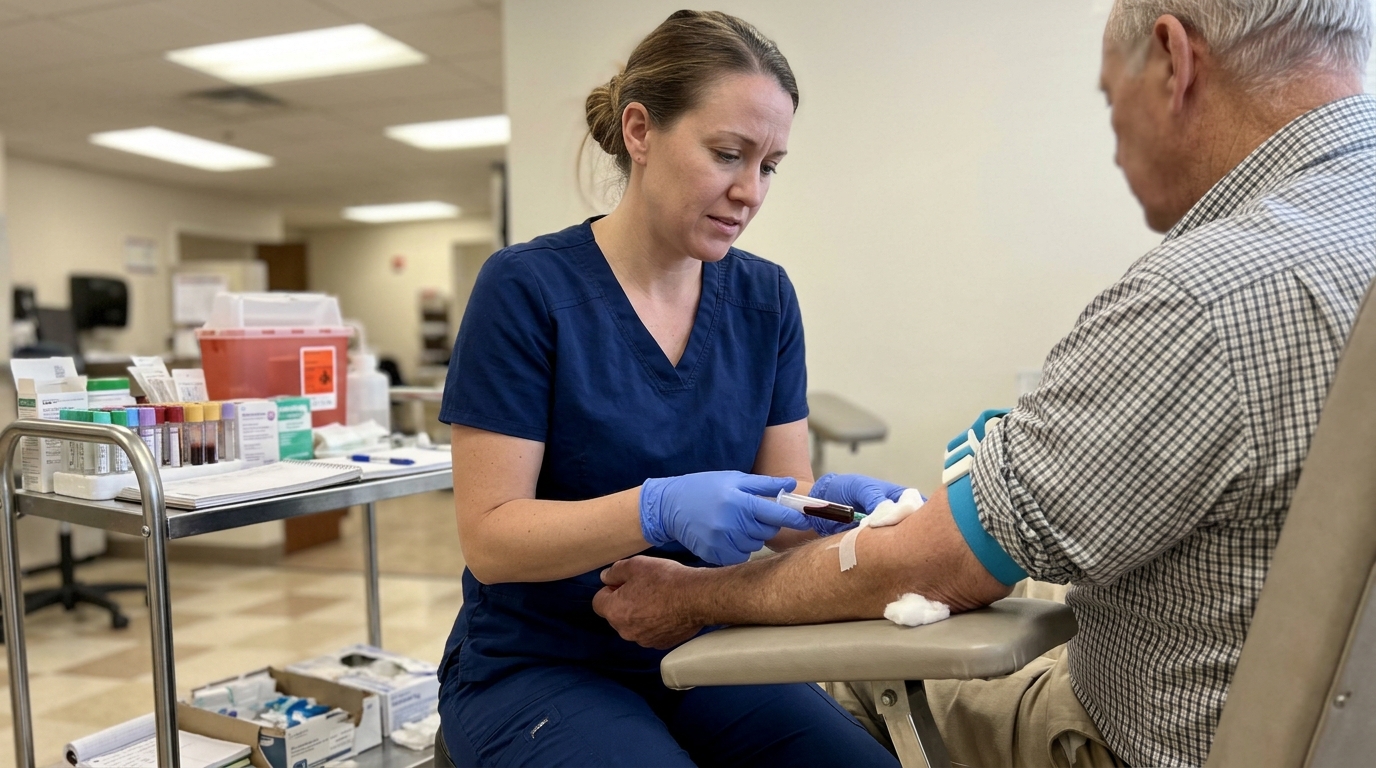
You can enter phlebotomy without having worked in healthcare before. The U.S. Bureau of Labor Statistics (2026-09-14) lists the typical entry-level education for phlebotomists as a postsecondary nondegree award, with both prior work experience in a related occupation and on-the-job training listed as "None" for typical entry. Most people get in by finishing a phlebotomy certificate program at a community college, vocational school or technical school, which usually takes less than one year (U.S. Bureau of Labor Statistics, 2026-09-14).
Requirements are set state by state and employer by employer. Some states require an accredited training program, a license or certification; some employers hire high school graduates and train them on the job (U.S. Bureau of Labor Statistics, 2026-09-14).
Is This Career Right for You?
Before you enroll, weigh the physical and scheduling realities. Phlebotomists may be required to stand for long periods, most work full time, and those in hospitals and laboratories may need to work nights, weekends and holidays (U.S. Bureau of Labor Statistics, 2026-09-14). If you need predictable daytime hours, an outpatient clinic or physician's office fits better than a hospital night rotation.
The work is close-contact and repetitive by design. You draw blood from patients or donors, verify patient identity, label samples, enter sample information into a database, and assemble, maintain and dispose of needles, test tubes and vials (U.S. Bureau of Labor Statistics, 2026-09-14). That takes steady hands, careful cross-checking of names against labels, and composure while a patient is frightened of needles or feeling faint.
Some roles travel. Phlebotomists who collect blood donations sometimes travel to set up mobile donation centers, and some travel to long-term care centers or patients' homes (U.S. Bureau of Labor Statistics, 2026-09-14) — which is why those who transport samples may need a driver's license.
It suits people who are comfortable with blood and needles, can stand through a full shift, and like short tasks done the same way every time. It suits you less if you cannot stand for hours, need fixed weekday hours, or dislike brief, high-volume patient contact where you meet dozens of people a day for a few minutes each. On demand: employment of phlebotomists is projected to grow much faster than the average for all occupations from 2025 to 2035, with about 18,000 openings projected each year on average over the decade (U.S. Bureau of Labor Statistics, 2026-09-14).
Steps to Becoming a Phlebotomist
- Finish high school or earn a GED (time: varies). Both the ASCP Phlebotomy Technician route and the NHA Certified Phlebotomy Technician exam require high school graduation or the equivalent (ASCP Board of Certification, undated; National Healthcareer Association via Vivian Health, undated).
- Check your state's rules before you pay for anything (time: an afternoon). States may require an accredited training program, a license or certification, and the U.S. Bureau of Labor Statistics (2026-09-14) advises contacting your state licensing agency. In California, a basic Certified Phlebotomy Technician I program is structured as 288 total hours — 74 theory, 54 in-class practicum and 160 clinical rotation (Kaiser Permanente School of Allied Health Sciences, undated).
- Enroll in a phlebotomy certificate program (time: usually less than 1 year). These come from community colleges, vocational schools and technical schools (U.S. Bureau of Labor Statistics, 2026-09-14). For ASCP Route 1, choose a NAACLS-approved program; the education is accepted within 5 years of completion (ASCP Board of Certification, undated). Ask admissions for current tuition plus lab fees, immunization and background-check costs.
- Or look for an employer-run program (time: about seven weeks in one hospital-based example). That program ends in a certificate of completion and eligibility to sit the ASCP phlebotomy technician exam (WellSpan Health, undated). Some employers also hire high school graduates and train them on the job (U.S. Bureau of Labor Statistics, 2026-09-14).
- Log your supervised sticks (time: built into your program). ASCP Route 2 accepts 40 clock hours of classroom training plus 100 clock hours of clinical training with a minimum of 100 successful unaided venipunctures (ASCP Board of Certification, undated). The NHA CPT requires proof of at least 30 venipunctures and 10 capillary/finger sticks on live people (National Healthcareer Association via Vivian Health, undated).
- Add Basic Life Support certification, and a driver's license if you will transport samples (time: about a day for BLS). Both may be required (U.S. Bureau of Labor Statistics, 2026-09-14).
- Sit a national certification exam (time: 2 hours for the NHA CPT; cost: $129). The NHA exam includes 100 scored questions plus 20 unscored pretest questions covering Safety and Compliance, Patient Preparation, Routine Blood Collection, Special Collection and Processing (National Healthcareer Association via Vivian Health, undated). Alternatives are the PBT(ASCP), which carries an application fee (ASCP Board of Certification, undated), and the AMT Registered Phlebotomy Technician (U.S. Department of Defense COOL, undated). Some employers prefer certified applicants (U.S. Bureau of Labor Statistics, 2026-09-14).
- Start entry level, then advance and renew (time: first 6–12 months, then ongoing). New phlebotomists usually run routine venipuncture and capillary collection, labeling and data entry under close supervision; experienced phlebotomists take pediatric, geriatric and difficult-vein draws, special collections, mobile donation setups, and train newer staff. NHA CPT renews every 2 years with continuing education credits and a fee, with reinstatement possible within 1 year (National Healthcareer Association via Vivian Health, undated); the AMT RPT renews every 3 years (U.S. Department of Defense COOL, undated).
Education and Certification Options
| Path | Time | Approximate cost | Required or preferred |
|---|---|---|---|
| Certificate from a community college, vocational or technical school | Usually less than 1 year (U.S. Bureau of Labor Statistics, 2026-09-14) | Tuition varies by school and state — confirm with admissions | Typical entry route; required where the state mandates an accredited program |
| NAACLS-approved program (ASCP Route 1) | Varies; education accepted within 5 years of completion (ASCP Board of Certification, undated) | Tuition plus the ASCP application fee (ASCP Board of Certification, undated) | Required for ASCP eligibility by Route 1 |
| Structured program (ASCP Route 2) | 40 classroom hours plus 100 clinical hours, with 100 unaided venipunctures (ASCP Board of Certification, undated) | Varies by provider | An alternative exam-eligibility route, not a separate employer requirement |
| State-specific program (California CPT I basic) | 288 hours — 74 theory, 54 practicum, 160 clinical rotation (Kaiser Permanente School of Allied Health Sciences, undated) | Varies by school | Required where the state mandates it; check with your state licensing agency |
| Hospital-based training program | About seven weeks, ending in ASCP exam eligibility (WellSpan Health, undated) | Varies; some are employer-funded | Employer-specific; check the job posting |
| High school diploma plus on-the-job training | Varies by employer | Usually none to the trainee | Accepted by some employers (U.S. Bureau of Labor Statistics, 2026-09-14) |
Where to Find Phlebotomist Jobs
- Hospital careers pages and internal transfer boards. Hospitals held about 36% of the 143,900 phlebotomist jobs in 2025, the largest single share (U.S. Bureau of Labor Statistics, 2026-09-14), and many run their own training programs, so one site may list trainee and certified roles together.
- Medical and diagnostic laboratories. The second-largest employer group, about 33% of jobs (U.S. Bureau of Labor Statistics, 2026-09-14), including patient service centers where routine venipuncture, labeling and database entry are the whole job.
- Blood donation organizations and mobile collection teams. Donor-collection phlebotomists sometimes travel to set up mobile donation centers (U.S. Bureau of Labor Statistics, 2026-09-14); expect early starts and a driver's license requirement.
- The NAACLS program directory. Use it to find approved programs for ASCP Route 1 eligibility (ASCP Board of Certification, undated); those programs also place students into clinical rotations, which is where many first jobs come from.
- ASCP Board of Certification and the National Healthcareer Association. Check PBT(ASCP) eligibility routes and the application fee, or register for the Certified Phlebotomy Technician exam ($129, 2 hours) and track its 2-year renewal (ASCP Board of Certification, undated; National Healthcareer Association via Vivian Health, undated).
- American Medical Technologists. Issues the Registered Phlebotomy Technician (RPT), a national credential with a 3-year renewal period that is also linked to the Army's 68K Medical Laboratory Specialist occupation for credentialing (U.S. Department of Defense COOL, undated).
- Physician offices, outpatient care centers and other ambulatory healthcare services. Other ambulatory healthcare services accounted for about 16% of jobs, offices of physicians about 9% and outpatient care centers about 2% in 2025 (U.S. Bureau of Labor Statistics, 2026-09-14) — generally where to look for daytime hours.
Frequently asked questions
Can I really get hired with no healthcare experience?
Entry to the occupation does not assume it: the U.S. Bureau of Labor Statistics (2026-09-14) lists both related work experience and on-the-job training as "None" for typical entry, with a postsecondary nondegree award as the typical education. What you still need is training that produces documented sticks — the NHA CPT exam requires proof of at least 30 venipunctures and 10 capillary/finger sticks on live people (National Healthcareer Association via Vivian Health, undated). If you are already drawing blood at work, ASCP Route 3 accepts one year of full-time clinical experience, counted as 35 hours per week, within the last five years (ASCP Board of Certification, undated). No program can guarantee a job offer.
How much does it cost to get started?
Training and the exam are separate costs. The NHA Certified Phlebotomy Technician exam costs $129 (National Healthcareer Association via Vivian Health, undated), and ASCP lists an application fee for the PBT(ASCP) exam (ASCP Board of Certification, undated). Program tuition varies by school and state, so ask the community college, vocational school or technical school directly, and budget separately for Basic Life Support certification, which phlebotomists may also need (U.S. Bureau of Labor Statistics, 2026-09-14).
How long does training take?
Phlebotomy certificate programs usually take less than 1 year (U.S. Bureau of Labor Statistics, 2026-09-14). One hospital-based program runs about seven weeks before trainees become eligible for the ASCP exam (WellSpan Health, undated), while a California CPT I basic program totals 288 hours of theory, practicum and clinical rotation (Kaiser Permanente School of Allied Health Sciences, undated). Add exam scheduling time; the NHA CPT itself takes 2 hours (National Healthcareer Association via Vivian Health, undated).
Do I need a license, or is certification enough?
It depends on your state. States may require phlebotomists to complete an accredited training program, hold a license or certification, or meet other requirements, and the U.S. Bureau of Labor Statistics (2026-09-14) directs people to their state licensing agency for specifics. Separately, some employers prefer certification from a professional organization, with requirements that may include education, clinical experience, an exam and a practical blood-draw component.
What else do employers check before I start?
Expect the credentials named in your state's rules plus employer onboarding. Basic Life Support certification may be required, and a driver's license may be needed if you transport samples or work on mobile donation teams (U.S. Bureau of Labor Statistics, 2026-09-14). Clinical placements commonly add immunization records and background screening, which are usually paid separately from tuition — ask your program before you enroll.
Sources
- U.S. Bureau of Labor Statistics — Phlebotomists : Occupational Outlook Handbook (2026-09-14)
- American Society for Clinical Pathology (ASCP) Board of Certification — Technician Certification (PBT, HT, MLT, DPT, MLA) Route Requirements

Written by
Desmond writes about the mechanics of job searching: resumes, interviews, the long silence after applying. He's fascinated by how much of getting hired depends on luck dressed up as skill.