How to Become a Phlebotomist
Blood draws, patient ID checks and labeling are the job; a short accredited program plus a documented externship is the route in, in order.
Quick answer
- The fastest route is a 4-to-8-week hospital-based or online-plus-externship phlebotomy program followed by a national certification exam; a community college certificate instead runs one semester, about 15 to 16 weeks (healthcareercerts.org, 2026).
- The minimum education is a high school diploma or equivalent (U.S. Bureau of Labor Statistics, 2025); California also accepts a passing GED, HiSET or CHSPE result, or college transcripts showing general education credit (California Department of Public Health, undated).
- National certification is voluntary in most states but commonly required by hospital and laboratory employers, while California, Washington, Nevada and Louisiana require a state-issued phlebotomy certification in addition to any national credential (PhleboPrep, undated).
Phlebotomy is one of the shorter routes into clinical work. The U.S. Bureau of Labor Statistics (2025) lists a high school diploma or equivalent as the typical entry-level education for phlebotomists, and training programs run from 4 to 8 weeks for online-plus-externship and hospital-based courses up to one semester of about 15 weeks at a community college (healthcareercerts.org, 2026).
What sets your personal timeline is the number of documented blood draws your certification route demands, and whether your state adds its own certificate on top of a national credential.
What This Job Involves Day to Day
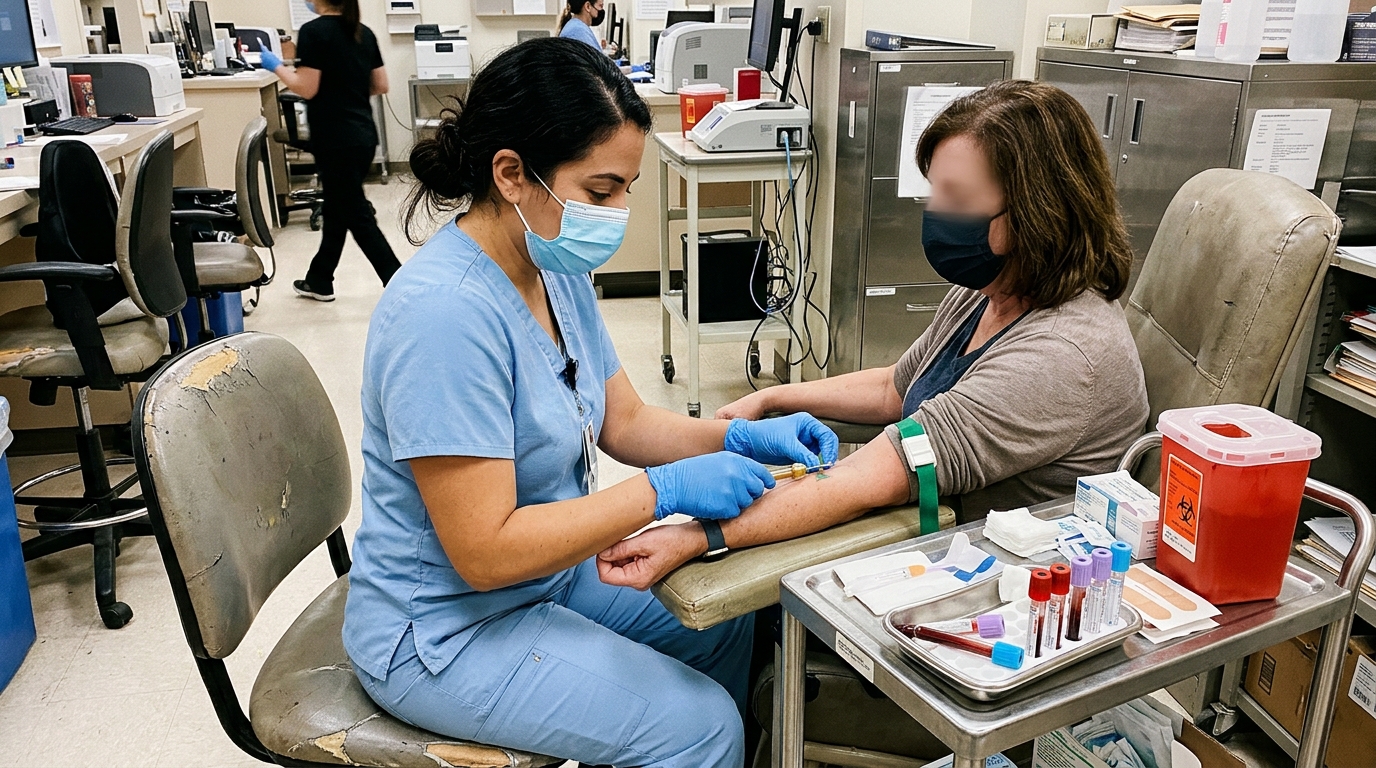
You draw blood from patients and donors, verify each person's identity before the needle goes in, label the drawn blood for testing, and enter patient information into a database (U.S. Bureau of Labor Statistics, 2025). Identity verification is not a formality — O*NET OnLine (2026) lists confirming patient identities and matching laboratory requisition forms to specimen tubes as core tasks, because that is the control stopping a result reaching the wrong chart.
A typical shift also includes capillary work: ONET OnLine (2026) lists drawing blood from capillaries by dermal puncture methods, used for infants, for patients with difficult veins, and for small-volume tests. You assemble and maintain your own instruments — needles, test tubes, blood vials — and keep your work area and instruments clean and sanitary to avoid causing infections or other complications (U.S. Bureau of Labor Statistics, 2025). Contaminated sharps go into the sharps container in accordance with applicable laws and standards (ONET OnLine, 2026).
The setting depends on employer type. The Bureau of Labor Statistics (2025) lists hospitals, medical and diagnostic laboratories, blood donor centers, and physicians' offices. A hospital floor round means walking to the patient, often starting early for fasting draws; an outpatient draw station or donor center means patients come to you, back to back. You are on your feet and talking to nervous people most of the shift. Postings may read Phlebotomy Technician, Registered Phlebotomist, or Patient Service Technician (PST), all reported for this occupation by O*NET OnLine (2026).
Step-by-Step Path to Get Started
- Finish high school or an equivalent. The Bureau of Labor Statistics (2025) lists a high school diploma or equivalent as the typical entry-level education. If you do not have a diploma, California accepts a passing GED, HiSET or CHSPE result instead (California Department of Public Health, undated), and most programs elsewhere apply a similar standard. Allow for one test sitting per subject.
- Get a CPR card before you enroll. Book a BLS Provider course with an American Heart Association training center or a CPR/AED course with the American Red Cross, both of which run as a single session. CPR certification is part of ASCP Phlebotomy Technician (PBT) eligibility (Stepful, undated), and clinical sites rarely place a student without one.
- Choose an accredited phlebotomy training program. Online-plus-externship programs and hospital-based programs typically run 4 to 8 weeks; a community college certificate runs one semester of about 15 to 16 weeks and commonly includes a 40-hour skills lab plus a 100-hour externship at a partner hospital (healthcareercerts.org, 2026). Confirm in writing that the program arranges an externship — without one you cannot meet the eligibility rules in step 5.
- Clear health and background requirements during enrollment. Expect proof of up-to-date immunization, which ASCP requires for PBT eligibility (Stepful, undated), plus the criminal background check and drug screen the clinical site demands. Start these in the weeks before your course begins; titer results come back by mail or portal and can hold up a placement.
- Log your draws during the externship. Keep a count signed by your preceptor. The NHA Certified Phlebotomy Technician (CPT) route requires an accredited program documenting at least 30 successful venipunctures and 10 capillary sticks, or evidence of 1 year of supervised work experience as a phlebotomy technician (Stepful, undated). The ASCP PBT route requires a documented externship, typically 100-plus successful venipunctures (Stepful, undated).
- Sit a national certification exam. The NHA CPT exam has 120 questions — 100 scored and 20 unscored pretest items — in a linear fixed-sequence format with a 2-hour limit (PhleboPrep, undated). The ASCP Board of Certification PBT exam has 80 computer-adaptive questions with a 2-hour-15-minute limit (PhleboPrep, undated). Pick the credential your target employers name in their postings.
- Apply for a state certificate if your state requires one. California, Washington, Nevada and Louisiana require a state-issued phlebotomy certification as well as a national credential (PhleboPrep, undated). The California Department of Public Health (undated) issues three levels: Limited Phlebotomy Technician (LPT) for skin puncture only, Certified Phlebotomy Technician I (CPT I) for skin puncture and venipuncture, and Certified Phlebotomy Technician II (CPT II), which adds arterial puncture.
- Apply to the four employer types that hire most phlebotomists. Hospitals, medical and diagnostic laboratories, blood donor centers and physicians' offices (U.S. Bureau of Labor Statistics, 2025) all post through their own career portals. Ask your externship preceptor whether the site is hiring — they have already watched you draw.
Education, Certification, and Cost Requirements
Each line below is priced by a different body: the college district or private provider sets tuition, the National Healthcareer Association and the ASCP Board of Certification each set their own exam fee, and state boards set application fees independently. Read the current fee straight from the provider's own fee page before you budget, and ask schools for an itemized quote that includes scrubs, textbook and supplies.
| Requirement | Where to Get It | Typical Cost | Typical Time |
|---|---|---|---|
| High school diploma or equivalent | Public high school, or GED, HiSET or CHSPE testing centers (California Department of Public Health, undated) | Per-subject test fee set by your state's testing contractor and published on its site | Four years of high school; equivalency testing is booked subject by subject |
| CPR / BLS Provider card | American Heart Association or American Red Cross training centers | Course fee set by the individual training center | One session, scheduled before your program start date |
| Community college phlebotomy certificate, including 40-hour skills lab and 100-hour externship | Community colleges | In-district tuition and fees published on the college's tuition page | One semester, about 15 to 16 weeks (healthcareercerts.org, 2026) |
| Online-plus-externship or hospital-based program | Private training providers; hospital education departments | Tuition quoted by the provider; ask what supplies are included | 4 to 8 weeks (healthcareercerts.org, 2026) |
| Immunizations, titers and TB screening | Primary care provider, pharmacy or college health center | Billed by the provider; often partly covered by health insurance | Booked during enrollment, before your first clinical day |
| Criminal background check and drug screen | The vendor named by your school or clinical site | Vendor fee, usually passed on to the student | Results returned within days of submission |
| NHA Certified Phlebotomy Technician (CPT) exam | National Healthcareer Association | Exam fee published by the NHA | 2-hour exam, 120 questions (PhleboPrep, undated) |
| ASCP Phlebotomy Technician (PBT) exam | ASCP Board of Certification | Application fee published by the ASCP Board of Certification | 2 hours 15 minutes, 80 adaptive questions (PhleboPrep, undated) |
| State phlebotomy certificate (LPT, CPT I or CPT II) | California Department of Public Health; state programs in Washington, Nevada and Louisiana (PhleboPrep, undated) | Application fee set by each state board | Processing time quoted by the board after a complete application |
Before You Apply
Have these ready before you open a single application:
- Your certification number and issue date from the NHA Certified Phlebotomy Technician (CPT) or ASCP Phlebotomy Technician (PBT) credential, typed into the certifications field of the application rather than buried in an attachment — many hospital systems screen on that field.
- Your state certificate number if you are applying in California, Washington, Nevada or Louisiana (PhleboPrep, undated), and, in California, the level you hold: LPT, CPT I or CPT II determines whether you may perform venipuncture or arterial puncture (California Department of Public Health, undated).
- A signed draw log showing your venipuncture and capillary stick counts from the externship. Interviewers ask for the number; 30 venipunctures and 10 capillary sticks or 100-plus venipunctures (Stepful, undated) reads very differently from "a lot."
- A current BLS Provider or CPR/AED card with the expiry date visible, renewed if it lapses soon.
- An immunization and TB screening record as a single PDF, since up-to-date immunization is an eligibility condition for the ASCP PBT (Stepful, undated).
- Background check clearance you can reference, plus a frank account of anything on it — hospitals and blood donor centers run their own checks regardless.
- A one-page chronological resume naming the equipment and systems you used: evacuated tube systems, butterfly sets, dermal puncture devices, and the database or EHR you entered patient information into (U.S. Bureau of Labor Statistics, 2025).
- Two clinical references, ideally your externship preceptor and your program's clinical coordinator.
- Pay and demand data you have actually looked up, from the 2025 median pay and projected annual job openings for phlebotomists in the Bureau of Labor Statistics Occupational Outlook Handbook (2025), plus your state labor department for local figures.
Frequently asked questions
How long does it take to become a phlebotomist from scratch?
With a diploma already in hand, most people move from first class to credential in a few months, since the course itself is the shortest part. The bottleneck is usually administrative: eligibility review, test-center availability and, in regulated states, board processing all sit after your last clinical day. If you need an equivalency test first, add the weeks it takes to prepare for and book each subject.
Do I need certification to work as a phlebotomist?
Most states do not license the occupation, so a national credential is legally optional — but hospital and reference-laboratory postings frequently list it as a minimum, which makes it practically necessary there. Physicians' offices and smaller clinics are the likeliest to train and certify someone after hiring. Four states are the exception, as noted above, and in those a state certificate must be in hand.
Which certification should I choose, NHA or ASCP?
Read the postings for three or four employers you actually want to work for and choose the credential they name. The practical difference is the clinical bar: the ASCP route expects a far higher documented venipuncture count than the NHA route (Stepful, undated), so if your externship is short, the NHA path is the one you will qualify for sooner. The NHA route also accepts supervised work experience instead of a program, which suits someone already drawing blood in a clinic.
Can I train entirely online?
No. Coursework on anatomy, order of draw, safety and labeling can be delivered online, but every national route requires hands-on hours, which is why online programs still include a skills lab and an externship (healthcareercerts.org, 2026). Before you pay, ask in writing which clinical site you will be placed at and who arranges it — programs that leave students to find their own site add weeks to the timeline.
What is the cheapest way to get trained?
Hospital-based training is often the lowest net cost, because some health systems train phlebotomists they intend to hire and absorb part of the tuition in exchange for an employment commitment. In-district community college tuition is usually the next lowest, and certificate programs there may be eligible for federal aid or state workforce funding. Ask your state workforce agency or a local American Job Center whether phlebotomy appears on its eligible training provider list.
Sources
- U.S. Bureau of Labor Statistics — Phlebotomists : Occupational Outlook Handbook (2025)
- O*NET OnLine — 31-9097.00 - Phlebotomists (2026)

Written by
Noor writes personal essays and interviews about career changes, burnout, and starting over. She's interested in the stories people tell themselves about what a job is supposed to mean.