How to Become a Medical Assistant Without a Degree
Most states let you train on the job, but state rules, certification eligibility and employer preference decide how far a high school diploma will carry you.
Quick answer
- A degree is not universally required: BLS (2025) says some workers enter medical assisting with a high school diploma and learn through on-the-job training, though some states require graduation from an accredited program, licensure or certification.
- Realistic timeline for the no-degree route: on-the-job training "may take several months" (BLS, 2025), and the NHA's CCMA work-experience pathway asks for at least one year of supervised work experience within the last three years, or two years within the last five.
- Military medical services training transfers directly: NHA's CCMA Pathway 1 accepts medical services training from a branch of the U.S. military, a U.S. Department of Labor-registered apprenticeship, or a health field training program completed within the past five years.
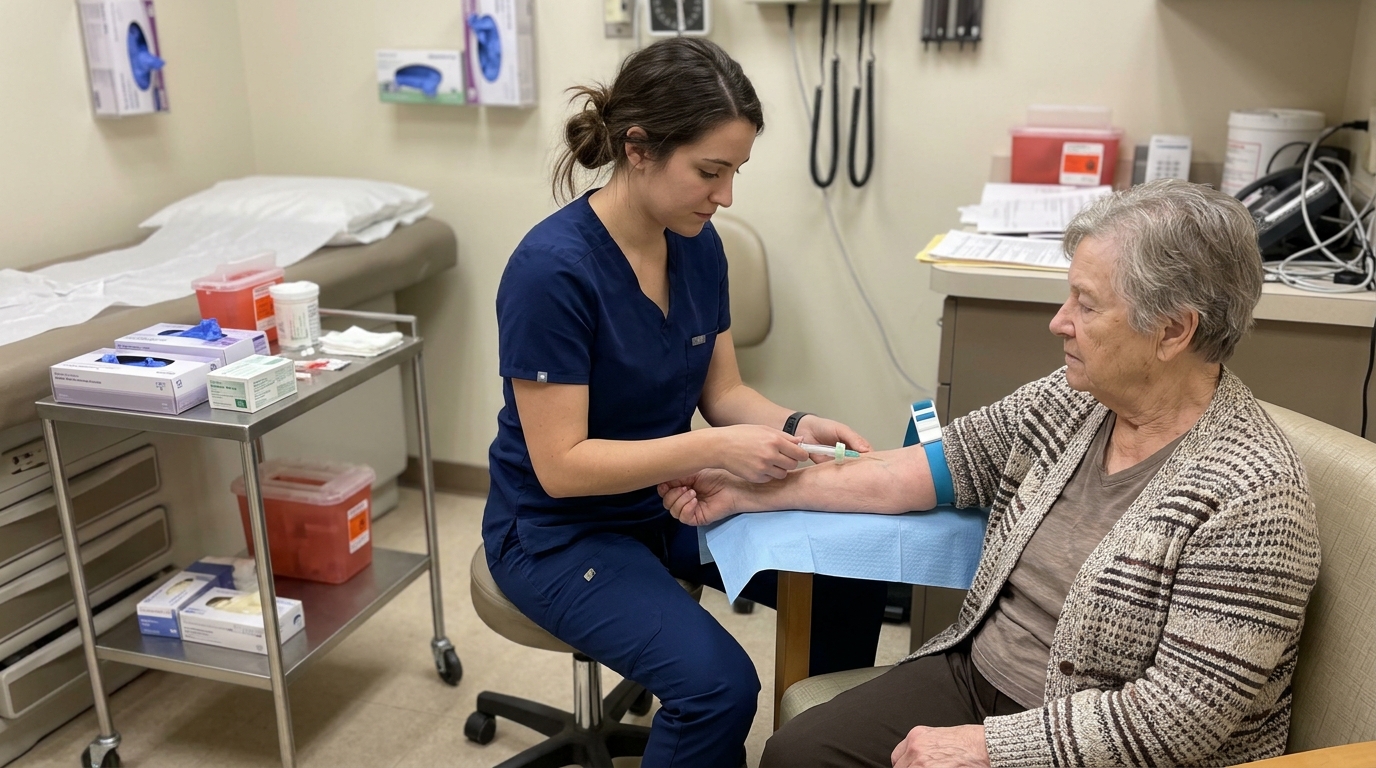
You can enter medical assisting without a college degree. The U.S. Bureau of Labor Statistics (2025) states plainly that some workers enter the occupation with a high school diploma and learn through on-the-job training, and that medical assistants without postsecondary education may learn skills through on-the-job training or an apprenticeship taught by physicians or other medical assistants — training that, per BLS, "may take several months" depending on the facility.
The catch is credentialing and state law. Some states require medical assistants to graduate from an accredited program, be licensed or certified, or meet other prerequisites; most states do not require certification, but employers may prefer or require it, and some require Basic Life Support (BLS) certification (U.S. Bureau of Labor Statistics, 2025).
Who Successfully Makes This Transition
Nursing assistants, home health aides and patient care technicians. You already take vital signs, position and transfer patients, document in an electronic record, and work inside infection-control rules. Clinics hiring without a certificate are looking for someone who can be trained quickly by a physician or an experienced medical assistant, which is exactly how BLS (2025) describes the no-degree route. ONET places medical assisting in Job Zone Three, "Medium Preparation Needed," where related on-the-job experience substitutes for formal schooling and employees usually need one or two years of training combining on-the-job experience with informal training from experienced workers (ONET OnLine, National Center for O*NET Development). Direct patient-care hours count toward that expectation.
Military medics and corpsmen. This is the cleanest transfer of all, because it is written into a credential's eligibility rules: the National Healthcareer Association allows CCMA candidates to qualify through medical services training from a branch of the U.S. military completed within the past five years (NHA requirements, reproduced by Department of Defense DOD COOL). You can sit a nationally recognised medical assisting exam on the strength of service training alone, with no civilian program.
Pharmacy technicians, dental assistants, phlebotomists and veterinary assistants. Employers accept these backgrounds because the hardest parts of medical assisting to teach are judgement and habit: sterile technique, dosage and labelling accuracy, patient identification, scheduling and insurance workflow, and staying calm with distressed people. A clinic manager can teach injections and EKG leads in weeks; they cannot teach reliability. Front-desk and medical records experience in a physician's office is also a common inside track, because the practice already knows your attendance record and your charting.
What all three groups share is supervised, documentable healthcare hours. That paperwork is what later unlocks certification without a degree.
Traditional Path vs. Alternative Path
| Factor | Accredited program path | On-the-job / no-degree path |
|---|---|---|
| Time to Entry | Postsecondary certificate or associate's degree programs are offered at community colleges, vocational schools, technical schools and universities (U.S. Bureau of Labor Statistics, 2025); check each program's published length before enrolling. O*NET classifies the occupation in Job Zone Three, where workers usually need one or two years of training. | Hired first with a high school diploma, then trained on the job or through an apprenticeship taught by physicians or other medical assistants; BLS (2025) says this training "may take several months" depending on the facility. Certification eligibility by experience takes one year of supervised work within the last three years, or two years within the last five (NHA requirements via DOD COOL). |
| Upfront Cost | Tuition and fees, set by the institution and by whether you qualify for in-district or in-state rates; add books, uniforms, immunisations and background checks. Ask the college's financial aid office for the per-credit rate and total program cost in writing. | Limited to exam and course fees rather than tuition: the NHA CCMA exam fee, a Basic Life Support (BLS) course fee, and employer-required background check or immunisation costs. Request current fees from the National Healthcareer Association and from whichever BLS course provider your employer accepts. |
| Credential Required | The CMA (AAMA) credential "is the only medical assisting certification that requires graduation from a postsecondary medical assisting program accredited by" a USDE- or CHEA-recognised accrediting body (American Association of Medical Assistants). Required in states that mandate accredited-program graduation or licensure. | Most states do not require certification, but employers may prefer or require it, and some employers require Basic Life Support (BLS) certification (U.S. Bureau of Labor Statistics, 2025). The NHA CCMA is reachable by work experience or by a Department of Labor-registered apprenticeship. |
| Typical Starting Pay | Pay for both paths is usually an hourly rate set by industry, state, employer size and credentials held; BLS publishes a 2025 median annual pay figure for medical assistants and May 2025 median wages by top employing industry. | Same wage structure, with certification and prior clinical hours as the main levers you control. Check the BLS Occupational Outlook Handbook page for medical assistants and CareerOneStop for your state and industry before you accept an offer. |
Step-by-Step Alternative Path
- Finish a high school diploma or GED. This is the floor for the no-degree route, since BLS (2025) describes entrants who start with a high school diploma and learn through on-the-job training. The NHA also sets an education eligibility requirement for CCMA candidates — confirm the current wording in the NHA's CCMA candidate handbook before you plan around it.
- Check your state's rules first. Some states require medical assistants to graduate from an accredited program, be licensed or certified, or meet other prerequisites to practise (U.S. Bureau of Labor Statistics, 2025). Search your state's medical board or department of health site for "medical assistant scope of practice," and use the CareerOneStop certification finder, which BLS directs jobseekers to for information on medical assistant certifications.
- Get Basic Life Support (BLS) certification. Some employers require it (U.S. Bureau of Labor Statistics, 2025), and it is one of the few things you can hold before anyone hires you. Ask target clinics which provider's card they accept, then book that course.
- Target employers that train. Apply to physician offices, outpatient care centers and hospital clinics — the industries where BLS reports the largest share of medical assistant employment — and say in your cover letter that you are seeking on-the-job training. Separately, search apprenticeship.gov for U.S. Department of Labor-registered apprenticeships in medical assisting, because NHA's CCMA Pathway 1 accepts a registered apprenticeship completed within the past five years.
- Log every supervised hour from day one. Keep dates, supervising clinician, setting and the specific skills performed. The NHA work-experience pathway requires at least one year of supervised work experience within the last three years, or two years within the last five, in the medical assisting field covered by the exam.
- Sit the Certified Clinical Medical Assistant (CCMA) exam through the National Healthcareer Association once you qualify by work experience, registered apprenticeship, or military medical services training.
- If your state or employer requires the CMA (AAMA), plan an accredited postsecondary program, because that credential requires graduation from a program accredited by a USDE- or CHEA-recognised accrediting body (American Association of Medical Assistants).
What to Have Ready Instead of a Degree
- High school diploma or GED certificate, scanned and ready to attach to an NHA application.
- A current Basic Life Support (BLS) card from a provider your target employers accept.
- A signed supervised-hours log listing dates, employer, supervising physician or medical assistant, and hours, formatted to match the NHA's one-year-in-three or two-years-in-five work-experience pathway.
- A clinical skills checklist, initialled by your supervisor, covering vital signs, injections and vaccine administration, venipuncture, EKG setup, specimen handling, sterilisation and autoclave use, and rooming patients.
- Evidence of documentation ability: the electronic health record systems you have used, and the tasks you performed in them (scheduling, prior authorisations, refill requests, intake histories).
- A completion certificate from a U.S. Department of Labor-registered apprenticeship, or military medical services training records, if either applies — both are accepted routes under NHA's CCMA Pathway 1.
- Two references who can speak to clinical reliability: a supervising physician or nurse manager, and a medical assistant preceptor who trained you.
- Your state's requirements printed out, including anything your state's medical board says about accredited-program graduation, licensure or certification, plus the CareerOneStop certification finder results for your state.
- Immunisation records, TB screening and a clean background check, which most clinical employers verify before your start date.
Frequently asked questions
Will clinics actually hire someone with no medical assisting program on their résumé?
Some will and some will not, and the split is driven by state rules and by each practice's own hiring policy rather than by the profession as a whole. BLS (2025) recognises entrants who begin with a high school diploma and are trained by physicians or other medical assistants, so the route exists — but a practice in a state that mandates accredited-program graduation cannot make an exception for you. Ask in the first phone screen whether the employer trains internally, and move on quickly if they do not.
Does the on-the-job route pay less than coming in with a certificate?
Pay is set by industry, geography, employer size and the credentials you hold, not by how you learned the job, so two people doing identical work in the same clinic are usually on the same scale. The practical difference is that certificate graduates often arrive credentialed and skip the lower-skilled first months. Look up the BLS median figures for medical assistants and the May 2025 medians by top employing industry before you negotiate.
Is the CCMA viewed as equivalent to the CMA (AAMA)?
They are different credentials with different gatekeeping: the CMA (AAMA) is the only medical assisting certification that requires graduation from an accredited postsecondary program, which is why some employers and some states specify it by name. The CCMA is nationally recognised and reachable through work experience, a registered apprenticeship or military training. Read a dozen job postings in your area and note which credential they name — that tells you which one is worth your exam fee.
Is this a stable occupation to move into without a degree?
Medical assisting is a large occupation and BLS publishes both a current employment count and a projected 2025–35 growth rate in its Occupational Outlook Handbook, which is the figure to check for your own planning. Stability at the individual level depends more on whether you certify and whether your state restricts uncertified practice. Treat certification as the thing that protects you if local rules tighten.
Sources
- U.S. Bureau of Labor Statistics — Medical Assistants : Occupational Outlook Handbook (2025)
- O*NET OnLine (National Center for O*NET Development) — 31-9092.00 - Medical Assistants

Written by
Wyatt covers work outside the office: construction, logistics, repair, and the people who keep things running. He's skeptical of career advice that assumes everyone sits at a desk.