How to Become a Licensed Real Estate Agent
Licensing is handled state by state, so the course hours, fees and passing marks you face depend on where you plan to sell — here is how the process runs.
Quick answer
- Typical entry-level education is a high school diploma or equivalent, with no college degree required (U.S. Bureau of Labor Statistics, undated).
- California candidates sit the Department of Real Estate salesperson examination: 150 multiple-choice questions in 3 hours, with 105 correct answers (70%) needed to pass (RealEstateU, undated); Florida requires at least 75% (Colibri Real Estate, undated).
- Licenses are state-specific and generally not transferable, and renew every 2 to 4 years with continuing education in most states (U.S. Bureau of Labor Statistics, undated).
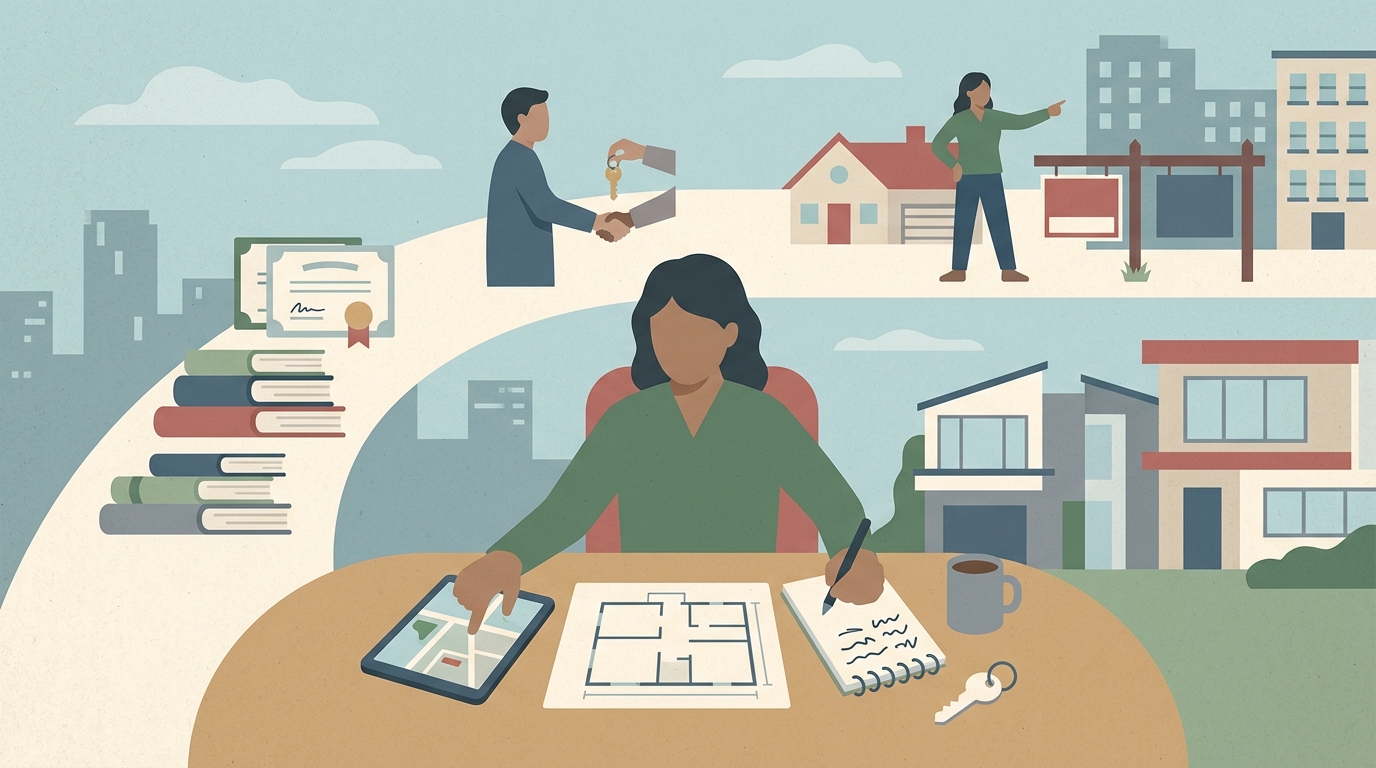
Every state requires real estate sales agents to be licensed, and the route is broadly the same: meet basic eligibility, finish approved prelicensing courses, pass your state's exam, clear a background check, then hang your license with a broker. The U.S. Bureau of Labor Statistics (undated) says minimum requirements vary by state but typically include being at least 18, holding a high school diploma or equivalent, completing prelicensing courses and passing an exam.
What varies most is the classroom hours — from about 40 hours in Massachusetts and Michigan up to 180 hours in Texas, with 60 to 90 most common (PrepPass, 2026). Plan on months, not weeks.
Why This Credential Matters
You cannot legally represent a buyer or seller for compensation without a license. All states require real estate brokers and sales agents to be licensed (U.S. Bureau of Labor Statistics, undated), and the license comes from a state agency — the California Department of Real Estate (DRE), the Florida Real Estate Commission (FREC). There is no national real estate license.
So the credential is not a résumé enhancement. It is the thing that lets a brokerage legally pay you. In many states, agents must be sponsored by, or work under, a licensed broker both during licensure and afterward (U.S. Bureau of Labor Statistics, undated), so the conversation with a brokerage is usually about whether you are license-ready, not whether you have sales experience.
Two things get confused with the license itself:
- REALTOR® is a membership designation, not a license. It identifies a licensed agent or broker who has joined the National Association of REALTORS® (NAR), agreed to its Code of Ethics and pays dues to use the trademarked title (National Association of REALTORS®, undated).
- Broker licensure is a separate, later step. States typically require a set number of years as a licensed sales agent — most require at least 2 — plus further formal training (U.S. Bureau of Labor Statistics, undated).
Agents are usually paid through a commission split negotiated with the sponsoring broker rather than an hourly wage, sometimes with desk or franchise fees deducted. Check the U.S. Bureau of Labor Statistics Occupational Outlook Handbook entry for real estate brokers and sales agents for current earnings figures before you spend money on coursework.
Step-by-Step Path to Certification
- Confirm eligibility with your state agency. Requirements typically include being at least 18 and holding a high school diploma or equivalent (U.S. Bureau of Labor Statistics, undated). Read the salesperson or sales associate requirements page on your own agency's site — the California DRE or FREC, for example — before buying a course, because the agency, not the school, defines what counts.
- Complete approved prelicensing education. California requires 135 hours across three courses before you can sit the salesperson exam (Kaplan Real Estate Education, undated); Florida requires 63 hours (Colibri Real Estate, undated). Only courses on your agency's approved-provider list count.
- Submit fingerprints and clear the background check. California applicants must submit fingerprints and complete a background check, with residents paying a $49 processing fee directly to the Live Scan provider (California Department of Real Estate, undated). Do this early, since results must be on file before a license is issued.
- File the exam and license application with fees. In California the original examination fee is $100 and the original license fee is $350; the combined application, Form RE 435, totals $450 (California Department of Real Estate, undated). Budget carefully — DRE fees are nonrefundable under Business and Professions Code Section 10207, including for applicants who fail (California Department of Real Estate, undated).
- Schedule and pass the state exam. The California Real Estate Salesperson Examination is 150 multiple-choice questions in a 3-hour session, needing at least 70%, or 105 correct answers, to pass (RealEstateU, undated). Florida's threshold is 75% (Colibri Real Estate, undated).
- Sign with a sponsoring broker and activate the license. Interview at least three brokerages and compare commission split, desk and franchise fees, training and lead supply. In many states you must work under a licensed broker to practice at all (U.S. Bureau of Labor Statistics, undated).
- Calendar post-licensing and renewal duties now. Florida requires a 45-hour post-licensing course before first renewal (Colibri Real Estate, undated); California requires 45 hours of DRE-approved continuing education in the four years preceding renewal (Empire Learning, undated).
Exam and License Details
Figures are California unless noted, because the DRE publishes a clear fee and exam schedule. Your state's numbers will differ — check your own agency's current fee schedule before paying anything.
| Detail | Specification |
|---|---|
| Exam name | California Real Estate Salesperson Examination, administered by the California Department of Real Estate (RealEstateU, undated) |
| Number of questions | 150 multiple-choice questions in a single 3-hour session (RealEstateU, undated) |
| Passing score | 70%, meaning 105 correct answers, in California (RealEstateU, undated); at least 75% in Florida (Colibri Real Estate, undated) |
| Examination fee | $100 salesperson original examination fee (California Department of Real Estate, undated) |
| License fee | $350 original license fee; $450 for the combined Form RE 435 exam-and-license application (California Department of Real Estate, undated) |
| Background check | Fingerprints required; $49 Live Scan fee paid directly to the provider by California residents (California Department of Real Estate, undated) |
| Retake and reschedule policy | $40 for a first rescheduled salesperson exam and $40 for each subsequent reschedule; all fees nonrefundable under Business and Professions Code Section 10207, including for applicants who fail (California Department of Real Estate, undated) |
| Renewal period | Every 4 years with the California DRE (Empire Learning, undated); state licenses generally renew every 2 to 4 years (U.S. Bureau of Labor Statistics, undated) |
| Renewal education | 45 hours of DRE-approved continuing education in the four years before renewal (Empire Learning, undated). A first California renewal must include four 3-hour mandatory courses — ethics, agency, trust fund handling, risk management — plus a 3-hour fair housing course, 2-hour implicit bias training and at least 18 hours of consumer protection coursework (Allied Schools, undated) |
| Reciprocity | California has no formal reciprocity with any other state (Kaplan Real Estate Education, undated); some states have agreements that streamline licensure elsewhere (U.S. Bureau of Labor Statistics, undated) |
Realistic Timeline
This assumes part-time study alongside a job, in a state requiring 60 to 135 hours. Texas, at 180 hours (PrepPass, 2026), sits at the long end.
- Month 1: Confirm eligibility on your state agency's site, pick an approved provider from its list, enrol and start course one.
- Month 1-3: Work through the hours. At 10-12 study hours a week, 135 hours takes roughly 11-13 weeks; 63 hours takes about 5-6 weeks.
- Month 3: Submit fingerprints so background results are on file ahead of licensure — in California, the $49 Live Scan fee is paid here (California Department of Real Estate, undated).
- Month 3-4: File the exam and license application with fees, such as California's $450 Form RE 435 (California Department of Real Estate, undated).
- Month 4-5: Receive your exam eligibility notice, book the earliest seat, and spend 3-6 weeks on practice questions.
- Month 5: Sit the exam. If you do not pass first time, allow 4-8 weeks to re-study and re-sit.
- Month 5-6: License issued. Interview brokerages, sign with a sponsoring broker, and decide whether to join a local board and the National Association of REALTORS® to use the REALTOR® title (National Association of REALTORS®, undated).
- Month 12-24: In Florida, finish the 45-hour post-licensing course before first renewal (Colibri Real Estate, undated), then 14 hours of FREC-approved continuing education each two-year period after (Florida Realtors, undated).
- Year 2 onward: If you want your own brokerage, start logging the sales agent experience most states require — at least 2 years in most cases (U.S. Bureau of Labor Statistics, undated).
Frequently asked questions
If I move to another state, do I have to start over?
Usually you repeat at least part of the process, because licenses typically are not transferable between states, though some states have agreements that streamline getting licensed elsewhere (U.S. Bureau of Labor Statistics, undated). California is strict: out-of-state credentials or experience cannot be waived in (Kaplan Real Estate Education, undated). Ask the agency in your destination state what it will accept before you relocate.
What should I budget beyond the state fees?
Add your approved education provider's tuition, any exam prep material, and, once you are working, brokerage desk or franchise deductions plus local board and National Association of REALTORS® dues if you take the REALTOR® designation (National Association of REALTORS®, undated). Ask prospective brokerages for a written list of monthly charges before signing.
Can I get licensed without joining a brokerage first?
In many states you can pass and be issued a license, but you must work under a licensed broker to actually practice (U.S. Bureau of Labor Statistics, undated), so the license may sit inactive until you affiliate. Confirm your agency's rule on inactive status, since some require a sponsoring broker on file before issuing at all.
Sources
- U.S. Bureau of Labor Statistics — Real Estate Brokers and Sales Agents: Occupational Outlook Handbook
- RealEstateU — California real estate exam: format, content domains, and prep course

Written by
Desmond writes about the mechanics of job searching: resumes, interviews, the long silence after applying. He's fascinated by how much of getting hired depends on luck dressed up as skill.