How to Become a Dental Hygienist
All 50 states license hygienists, so the route runs through an accredited program, a national written board, and a clinical exam before you can treat patients.
Quick answer
- The minimum education is an associate's degree in dental hygiene from a CODA-accredited program, which usually takes three years (U.S. Bureau of Labor Statistics, undated).
- Licensure is mandatory, not optional: all states require dental hygienists to be licensed, and requirements vary by state (U.S. Bureau of Labor Statistics, undated).
- Counting prerequisite science courses, most people need roughly 3 to 4 years from first college class to first licensed job, and 94% of hygienists worked in offices of dentists in 2024 (U.S. Bureau of Labor Statistics, undated).
Becoming a dental hygienist means graduating from a dental hygiene program accredited by the American Dental Association's Commission on Dental Accreditation (CODA), passing the written National Board Dental Hygiene Examination, passing a state or regional clinical exam, and getting licensed in the state where you want to work (American Dental Hygienists' Association, undated). Most people enter with an associate's degree, which usually takes three years to complete (U.S. Bureau of Labor Statistics, undated).
You do not need prior clinical work experience to start: people entering this career usually have an associate's degree, no work experience and no on-the-job training (CareerOneStop / U.S. Department of Labor, undated). The gatekeepers are program admission and the two exams.
What This Job Involves Day to Day
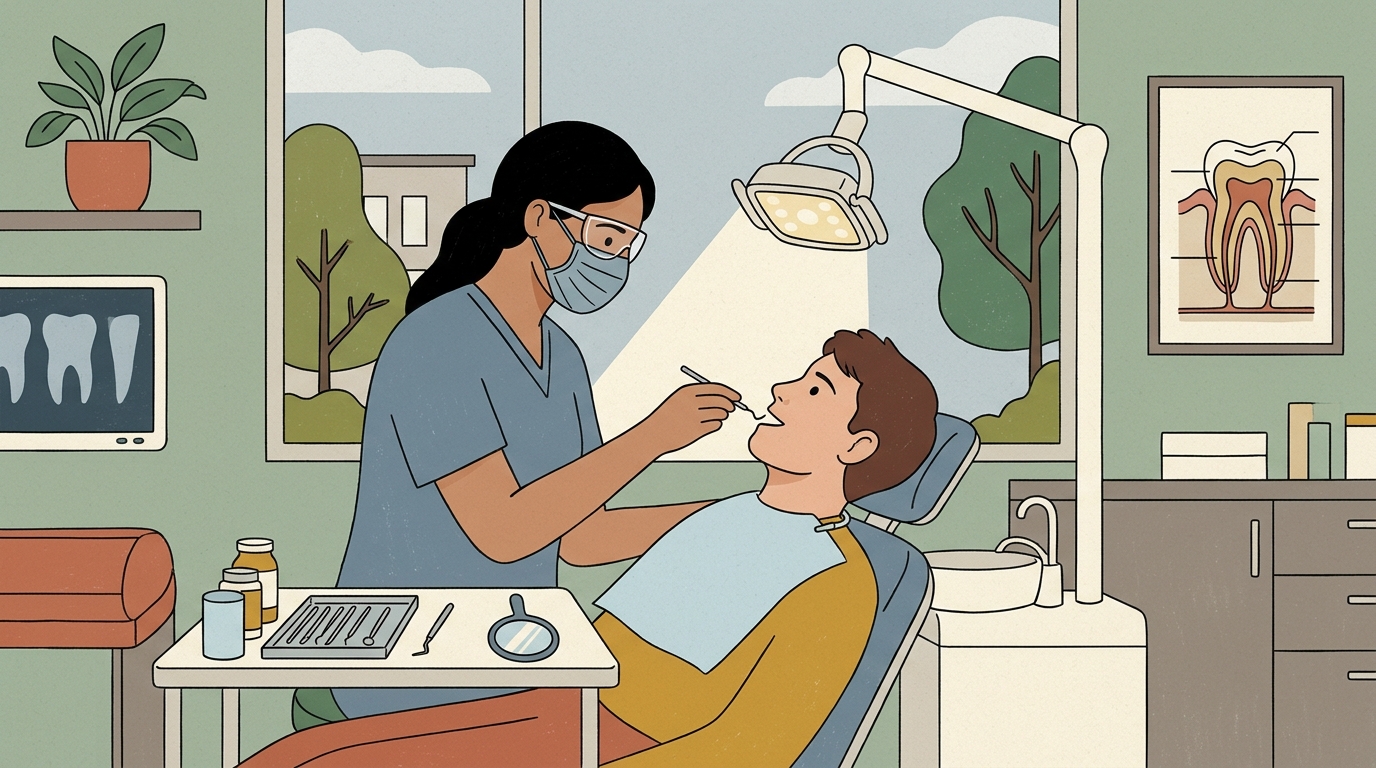
You work chairside in a treatment operatory, seeing scheduled patients in roughly 40- to 60-minute appointments through a full clinical day. Almost all of that happens in general dental practices: offices of dentists employed 94% of dental hygienists in 2024, and the occupation held about 221,600 jobs that year (U.S. Bureau of Labor Statistics, undated).
The core clinical tasks repeat with every patient:
- Removing tartar, stains and plaque from teeth with hand instruments and ultrasonic scalers (U.S. Bureau of Labor Statistics, undated).
- Applying sealants, fluorides and other cavity-preventing agents to help protect teeth (U.S. Bureau of Labor Statistics, undated; O*NET OnLine, undated).
- Taking dental x-rays, including exposing and developing x-ray film (U.S. Bureau of Labor Statistics, undated; O*NET OnLine, undated).
- Charting conditions of decay and disease so the dentist can diagnose and plan treatment (O*NET OnLine, undated).
You also explain findings to patients — why a pocket depth changed, how to clean around a bridge — at nearly every appointment. Scope is set by your state: a few states allow hygienists with additional training, sometimes called dental therapists, to provide some restorative services such as extracting primary teeth and placing temporary crowns (U.S. Bureau of Labor Statistics, undated). ONET places the occupation in Job Zone Three, "Medium Preparation Needed" (ONET OnLine, undated).
Step-by-Step Path to Get Started
- Finish high school or earn a GED. This is the stated first step on the path (American Dental Hygienists' Association, 2025-03). Take biology and chemistry if you still have the choice. Time: through grade 12, or 3 to 12 months for a GED.
- Complete the prerequisite college science courses. Most CODA-accredited programs require anatomy and physiology, microbiology, chemistry and English or psychology before you can be considered. Community colleges are the usual route. Time: 1 to 2 semesters, or 8 to 12 months part time.
- Apply to a CODA-accredited dental hygiene program. Applicants must graduate from a program accredited by the ADA Commission on Dental Accreditation (American Dental Hygienists' Association, undated). CODA accredits three entry-level program types, and graduates of any of them may sit for licensing exams (American Dental Education Association, undated). Applications usually open 6 to 12 months before a cohort starts; allow 2 to 4 weeks to assemble transcripts and any entrance test scores.
- Complete the degree. An associate's degree in dental hygiene usually takes three years (CareerOneStop / U.S. Department of Labor, undated); the ADHA describes accredited associate programs as 2 to 3 years (American Dental Hygienists' Association, 2025-03). You treat patients in the school clinic and log competencies toward graduation.
- Pass the National Board Dental Hygiene Examination (NBDHE). This written exam is administered by the Joint Commission on National Dental Examinations and must be passed for licensure (American Dental Hygienists' Association, undated). It has 350 multiple-choice items: a 200-item discipline-based component and a 150-item case-based component built around 12 to 15 patient cases (Joint Commission on National Dental Examinations, undated). Most candidates sit it in the final year after 8 to 12 weeks of review.
- Pass a state or regional clinical licensure exam. Licensure requires a clinical examination in addition to the NBDHE (American Dental Hygienists' Association, undated). Your state dental board decides which regional testing agency it accepts, so confirm before registering. Schedule 2 to 4 months ahead; testing takes 1 to 2 days.
- Apply for your state license. You must be licensed in the state where you wish to practice (American Dental Education Association, undated). Expect transcripts, exam scores, a fingerprint-based background check and an application fee. Time: 2 to 8 weeks for board processing.
- Apply for clinical jobs as an RDH. Target general and periodontal practices, community health centers and public school dental programs, using your state dental association's job board, the ADHA's career resources, your program's placement coordinator and the dentists who supervised your school clinic rotations. About 15,300 openings are projected each year on average over 2024-2034, with employment projected to grow 7 percent (U.S. Bureau of Labor Statistics, undated).
Education, Certification, and Cost Requirements
Costs depend on factors you can check in advance: whether the institution is public or private, whether you qualify for in-district or in-state tuition, how many prerequisite credits you need, and your state board's fee schedule. Get current figures from the program's published cost of attendance sheet, the Joint Commission on National Dental Examinations for the NBDHE fee, and your state dental board for licensure and clinical exam fees.
| Requirement | Where to Get It | Typical Cost | Typical Time |
|---|---|---|---|
| High school diploma or GED | Public high school or a state-approved adult education program | No tuition for public high school; GED testing fees are set state by state | Through grade 12, or 3-12 months |
| Prerequisite science courses | Community college or four-year college | Public per-credit tuition, lowest for in-district residents, plus lab fees and textbooks | 1-2 semesters (8-12 months) |
| Associate's degree in dental hygiene | A program accredited by the ADA Commission on Dental Accreditation, based in an institution of higher education | Tuition plus instrument kit, loupes and uniforms; public in-district programs cost far less than private ones | Usually 3 years (U.S. Bureau of Labor Statistics, undated) |
| Bachelor's or master's degree (optional for chairside work) | Degree-completion programs at four-year institutions | Four-year tuition rates; some employers offer tuition assistance | 1-2 years after the associate's |
| National Board Dental Hygiene Examination | Joint Commission on National Dental Examinations | Single examination fee published by the JCNDE | 350 items; 8-12 weeks of review |
| State or regional clinical exam | The regional testing agency your state dental board accepts | Candidate fee set by the testing agency, plus patient or manikin and travel costs | 1-2 testing days |
| State license (RDH) | Your state dental board or board of dental examiners | Application, fingerprinting and initial license fees set by the board | 2-8 weeks to process |
| CPR certification, where required | A provider your program or state board accepts | Course fee plus renewal every 2 years in most states | 1 day initially |
A bachelor's or master's degree usually is required for research, teaching, or clinical practice in public or school health programs, so check before committing to a degree level (U.S. Bureau of Labor Statistics, undated).
Before You Apply
Have these in hand before you send the first application:
- Your license number, issue date and expiration date — practices will look you up on the state board's license search.
- Official NBDHE score report and clinical exam result letter, saved as PDFs you can attach.
- A one-page clinical résumé with "RDH" and your license number in the header, your CODA-accredited program and graduation date, radiography and local anesthesia permissions where your state grants them, and the charting software you have used.
- A competency log from school clinic: patients treated, periodontal cases, sealant and fluoride applications, radiographic series exposed.
- Fingerprint-based background check clearance for your state board, plus any separate clearance a community health center or school program requires.
- Immunization records, including hepatitis B status and tuberculosis screening.
- Your instrument kit and loupes, inventoried and sharpened; many practices expect you to bring your own.
- Two or three references: the clinic faculty who signed your competencies and any dentist who supervised an external rotation.
- A plan for the pay conversation. Hygienist pay is usually an hourly clinical rate, sometimes with daily minimums, production bonuses or per-diem rates for temporary days. The median annual wage was $94,260 in May 2024 (U.S. Bureau of Labor Statistics, 2024-05); check your state and metro figures in the BLS Occupational Employment and Wage Statistics tables first.
Frequently asked questions
How long does the whole path take from my first college class to my first licensed job?
Plan on about three and a half to four and a half years in total: prerequisite sciences, then the program, then board processing after your exams. The two board exams are usually scheduled during the final year, so they rarely add calendar time on their own. The biggest risk to the timeline is program admission, since many colleges start one cohort a year and a missed cycle costs 12 months.
Do I need a bachelor's degree to work chairside?
No. The entry credential for clinical practice is an associate's degree, and graduates of any CODA-accredited entry-level program type can sit for licensing exams (American Dental Education Association, undated). A higher degree matters if you later want to teach, do research, or run clinical services in a public or school health program (U.S. Bureau of Labor Statistics, undated).
What happens if I attend a program that is not CODA-accredited?
You will not be eligible for licensure, because applicants must graduate from a program accredited by the ADA Commission on Dental Accreditation (American Dental Hygienists' Association, undated). Check accreditation on CODA's own program list before paying a deposit, not on the school's marketing page. If a program is on probation or in a teach-out, ask the director in writing what that means for your cohort's exam eligibility.
What costs do people forget to budget for?
The usual surprises beyond tuition are the instrument kit and loupes, uniforms, immunizations, the fingerprint fee, travel and lodging for a regional clinical exam, and reduced earnings during full-time clinical semesters. Ask each program for a line-item cost of attendance that separates fees from tuition. Also ask whether exam fees are billed to students directly or bundled into a final-year charge.
Sources
- U.S. Bureau of Labor Statistics — Dental Hygienists : Occupational Outlook Handbook
- O*NET OnLine / National Center for O*NET Development — 29-1292.00 - Dental Hygienists

Written by
Priya tracks wages, layoffs, and the slow shifts in what counts as a stable job. She writes for readers trying to make sense of numbers that rarely match their own experience.