UX Designer vs. Product Manager: Which Career Path Is Right for You?
One role decides how the screens work; the other decides which screens get built at all — compare entry routes, published pay data and daily work.
Quick answer
- The biggest practical difference is decision rights: a UX designer owns how a flow works, while a product manager owns whether it ships this quarter and what gets dropped to make room — sometimes the designer's own work.
- Product management takes longer to reach: a bachelor's degree (about four years) plus five years or more of work experience in a related occupation, and some employers prefer a graduate degree in computer science, IT or business administration (U.S. Bureau of Labor Statistics, 2025).
- Published national proxies: median annual wages of $104,000 for web and digital interface designers and $175,140 for computer and information systems managers (U.S. Bureau of Labor Statistics, May 2025), with projected employment change from 2025 to 2035 of 6 percent and 16 percent respectively (U.S. Bureau of Labor Statistics, 2025). State and local pay vary.
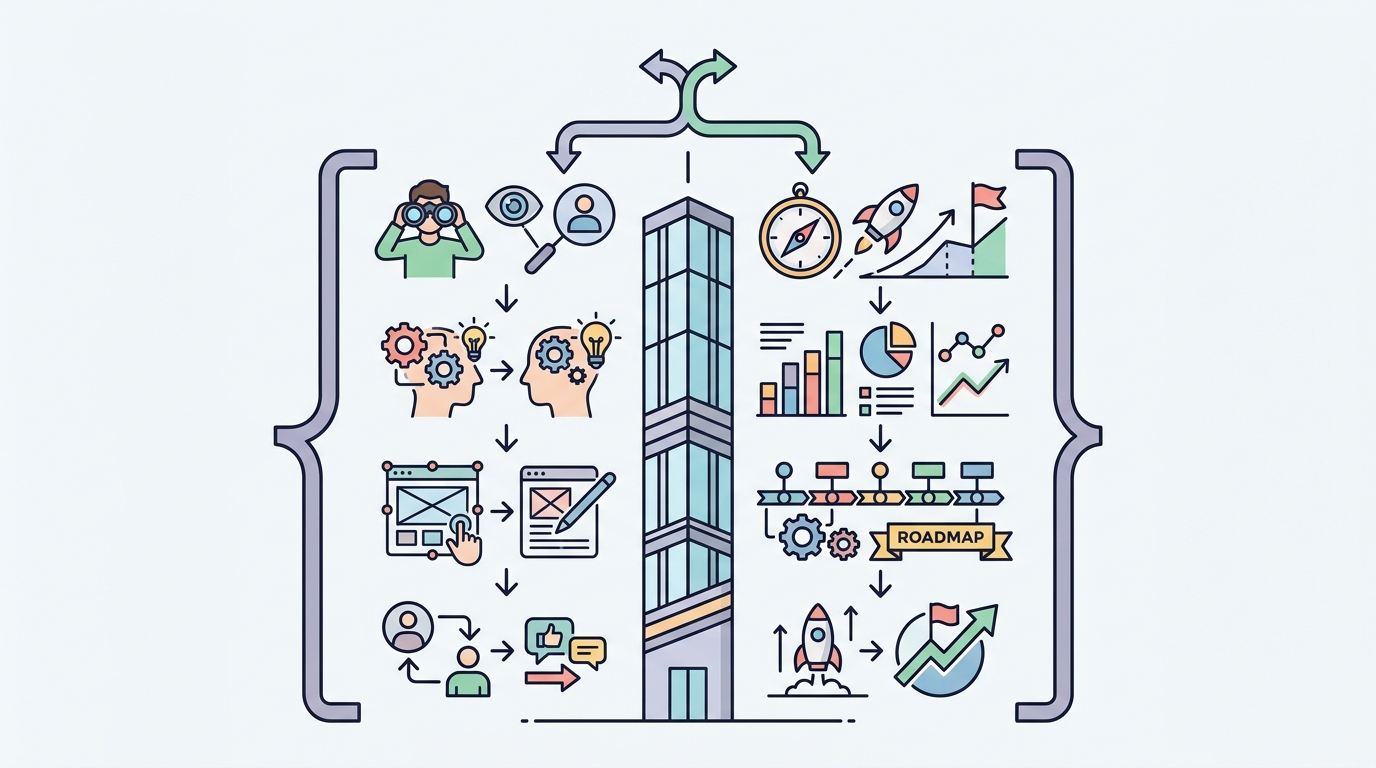
UX design and product management sit next to each other on the same teams, but they are accountable for different things: a UX designer answers for whether the interface works for the person using it, while a product manager answers for what the team builds, in what order, and what gets cut. The design path usually starts with a bachelor's degree and a portfolio; the management path usually asks for a degree plus several years of related work first, which makes it hard to enter straight out of school.
Neither job is published by the U.S. Bureau of Labor Statistics under the title you see in job ads, so the comparison below uses the closest official occupations — web and digital interface designers for UX, and computer and information systems managers for technology management — and says so each time.
Head-to-Head Comparison
The job titles "UX designer" and "product manager" are employer titles, not federal occupation codes. There is no BLS occupation literally called "UX designer"; the closest official match is SOC 15-1255, Web and Digital Interface Designers, profiled jointly with web developers (emilybackes.design, undated; U.S. Bureau of Labor Statistics, 2025). There is no BLS occupation called "product manager" either, so the figures below use computer and information systems managers — the management occupation the Occupational Outlook Handbook links designers to when they advance (U.S. Bureau of Labor Statistics, 2025). Read them as the nearest published benchmark, not as a quote for a specific job ad.
| Dimension | UX designer (web and digital interface designers) | Product manager (computer and information systems managers) |
|---|---|---|
| Typical entry requirement | Typical entry-level education is a bachelor's degree, about four years full time; requirements range from a high school diploma to a bachelor's, and employers of digital designers may prefer a bachelor's in web design, digital design or graphic arts (U.S. Bureau of Labor Statistics, 2025). ONET places the occupation in Job Zone Four, "Considerable Preparation Needed," and its education survey reports 52% of respondents saying a bachelor's degree is required, 30% a post-baccalaureate certificate taken after that degree, and 16% an associate's or other two-year degree (National Center for ONET Development, undated). | A bachelor's degree in computer and information technology or a related field, about four years full time, plus work experience in a related occupation listed as five years or more; some organizations require or prefer a graduate degree in computer science, information technology or business administration, typically one to two years full time (U.S. Bureau of Labor Statistics, 2025). |
| Median pay | $104,000 per year, or $50.00 hourly, for web and digital interface designers (U.S. Bureau of Labor Statistics and National Center for O*NET Development, May 2025); $99,520 for the combined web developers and digital designers category (U.S. Bureau of Labor Statistics, May 2025). National figures. | $175,140 per year for computer and information systems managers (U.S. Bureau of Labor Statistics, May 2025). National figure; state and metro pay differ. Product management pay is also commonly structured as a base salary plus an annual bonus and, at some companies, equity, so posted totals can differ sharply from base pay. |
| Physical and schedule demands | Most web developers and digital designers work full time (U.S. Bureau of Labor Statistics, 2025). The work is seated and screen-heavy, with long stretches in design and prototyping software; the common strain is eyes, wrists and back rather than lifting. | Most computer and information systems managers work full time, some work more than 40 hours per week, and they usually work in an office setting (U.S. Bureau of Labor Statistics, 2025). Expect evening calls around releases and incidents, and a calendar largely filled by other people's meetings. |
| Five-year outlook | BLS does not publish five-year projections. Over the 2025-35 projection decade, employment of web and digital interface designers is projected to change 6 percent, and the combined web developers and digital designers category 5 percent, with about 13,600 openings projected each year (U.S. Bureau of Labor Statistics, 2025). | Over the same 2025-35 projection period, employment of computer and information systems managers is projected to grow 16 percent, much faster than the average for all occupations, with about 53,500 openings projected per year (U.S. Bureau of Labor Statistics, 2025). |
To check what either role pays where you live, look up the occupation code on the BLS Occupational Employment and Wage Statistics (OEWS) state and metropolitan pages, then compare that against current postings in your city — pay varies by employer, state and country, and the national median hides most of that spread.
Day-to-Day Differences
Take the same Tuesday on the same team, rebuilding a checkout flow.
The UX designer joins standup, then runs two moderated usability sessions back to back against a clickable prototype. Each session means watching someone try to pay, resisting the urge to help, and writing down the exact moment they hesitate. By late morning the designer is synthesising both sessions into a short findings note: people miss the shipping-cost line because it loads after the total. The afternoon goes into the prototype itself — adjusting the layout, defining what the screen looks like while payment is processing, writing the wording of the decline message, annotating the keyboard and screen-reader behaviour, and checking colour contrast on the disabled button state. The day ends in a design critique and a handoff conversation with two engineers about which component states are actually built. Building and iterating the prototype screens, and writing the state-by-state annotations engineers construct from, is work a product manager never does.
The product manager's Tuesday starts at the same standup and then goes sideways: one engineer is out for the rest of the sprint. By 10am the PM is in a tradeoff conversation deciding that saved payment methods slips to next quarter so the shipping-cost fix ships on the original date, then writing that decision and its reasoning into the ticket so nobody relitigates it on Thursday. Midday is funnel numbers and a call with a salesperson about a deal lost over invoicing. The afternoon is a draft of the quarterly roadmap update for leadership, a negotiation with legal about how long card data is retained, and acceptance criteria for the release. Owning the go/no-go call on scope and date, and defending the roadmap and its commercial case to the people who hold the budget, is work a UX designer never does.
The tradeoffs follow from that split. Designers regularly watch good research lose to a date, and have to hand the decision to someone else. Product managers carry accountability for outcomes without direct authority over the engineers delivering them, and most of their output is documents and decisions rather than anything they can point at and say they made it.
Who Thrives in Each Path
UX designer
- You have a background that involved interviewing people under pressure — journalism, teaching, nursing intake, frontline support — so you already ask non-leading questions and can sit quietly while a participant struggles with something you designed.
- You have the patience to spend a full morning on error states, spacing and disabled buttons. Employers of digital designers may prefer a bachelor's in web design, digital design or graphic arts (U.S. Bureau of Labor Statistics, 2025), and that craft focus is the reason.
- You already build things for the web, even badly. Because requirements for this group range from a high school diploma to a bachelor's degree (U.S. Bureau of Labor Statistics, 2025), a portfolio of real, working flows often carries as much weight as the credential line.
- You are content being the person who proves the flow is broken rather than the person who signs off on the launch date — and you can live with being overruled when the date wins.
Product manager
- You have worked a role where saying no was part of the job — sales, operations, escalations, scheduling — and you can refuse a request with a reason the other person can repeat back to their own boss.
- You already have several years inside engineering, analytics or technical support. That matters structurally: entry to computer and information systems management typically requires five years or more of work experience in a related occupation on top of a bachelor's degree (U.S. Bureau of Labor Statistics, 2025).
- You can decide with incomplete information and be judged on the result months later, rather than on the quality of the artefact you produced this week.
- You are willing to write and present for a living, and to accept a schedule where some weeks run past 40 hours in an office setting (U.S. Bureau of Labor Statistics, 2025), with release nights and incident calls included.
Frequently asked questions
Can I switch from UX design into product management mid-career?
Yes, and the usual route is internal. The Occupational Outlook Handbook notes designers with a bachelor's degree may advance into management roles (U.S. Bureau of Labor Statistics, 2025). In practice you ask to own one roadmap area, accumulate the five years or more of related work experience BLS lists for computer and information systems managers, and consider a graduate degree in business administration, which some employers prefer.
Can a product manager move the other way, into UX design?
It happens, but you need evidence of craft, not just familiarity with design. Most hiring is portfolio-led: shipped flows, research you personally ran, and prototypes you built. A post-baccalaureate certificate taken after your existing degree is one formal route — 30% of O*NET respondents for this occupation said one is required (National Center for O*NET Development, undated). Expect a title and scope reset.
Do I need a bachelor's degree to work in UX?
Not always. Education for web developers and digital designers ranges from a high school diploma to a bachelor's degree (U.S. Bureau of Labor Statistics, 2025), and O*NET's survey reports 52% of respondents saying a bachelor's is required, 30% a post-baccalaureate certificate and 16% an associate's or other two-year degree (National Center for O*NET Development, undated). Requirements vary by employer and country.
Which path has the stronger hiring outlook?
On published projections, management. Over the 2025-35 period, web and digital interface designers are projected to change 6 percent with about 13,600 annual openings across the combined designer and developer group, while computer and information systems managers are projected to grow 16 percent with about 53,500 annual openings (U.S. Bureau of Labor Statistics, 2025). Those are national projections, not guarantees in your city.
How should I compare pay between the two?
Start with national medians — $104,000 for web and digital interface designers and $175,140 for computer and information systems managers (U.S. Bureau of Labor Statistics, May 2025) — then check your state and metro on the BLS OEWS pages. Management pay often includes bonus and sometimes equity, so compare base pay against base pay when reading job ads.
Sources
- U.S. Bureau of Labor Statistics — Web Developers and Digital Designers (2025-05)
- National Center for O*NET Development — 15-1255.00 - Web and Digital Interface Designers

Written by
Noor writes personal essays and interviews about career changes, burnout, and starting over. She's interested in the stories people tell themselves about what a job is supposed to mean.