Teaching vs. Nursing: Which Career Change Is Right for You
Both paths take career changers with a bachelor's already in hand, but they split sharply on shift work, summers off, and how long retraining takes.
Quick answer
- Teaching wins on speed of entry for degree-holders: all states offer an alternative certification route, and some let you begin teaching immediately under an experienced teacher's supervision (U.S. Bureau of Labor Statistics, 2025).
- Teaching wins on schedule predictability — a traditional 10-month year with a 2-month summer break, versus round-the-clock hospital shifts including nights, weekends and holidays (U.S. Bureau of Labor Statistics, 2025).
- Nursing wins on pay flexibility: hourly work with shift differentials lets you raise earnings by taking nights and weekends, while district teacher pay is usually fixed by a published salary schedule.
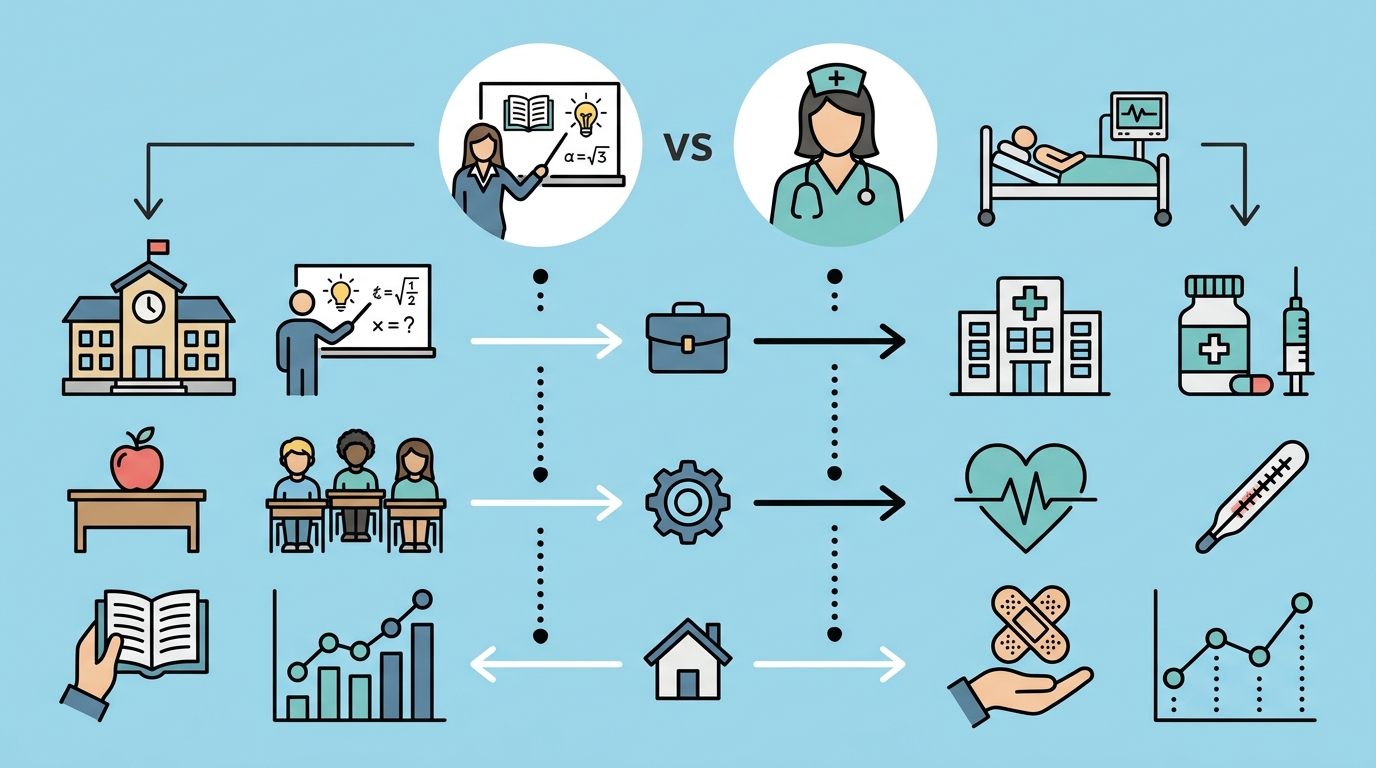
Teaching and nursing both take career changers in their thirties, forties and fifties, and the choice usually turns on schedule and retraining time rather than subject matter. Nursing means finishing an approved program and passing the NCLEX-RN, then working shifts that can include nights, weekends and holidays (U.S. Bureau of Labor Statistics, 2025). Teaching means a bachelor's degree plus state certification, a roughly 10-month school year, and evenings spent grading and planning (U.S. Bureau of Labor Statistics, 2025).
If you already hold a bachelor's degree in another field, both have a side door: accelerated nursing programs for degree-holders, and the alternative certification route every state offers for teaching.
Side-by-Side Comparison
| Dimension | High school teaching | Registered nursing |
|---|---|---|
| Entry education | Bachelor's degree plus a state-issued certification or licence, required by all states for public high school teachers (U.S. Bureau of Labor Statistics, 2025) | A bachelor's in nursing, an associate's in nursing, or a diploma from an approved nursing program (U.S. Bureau of Labor Statistics, 2025) |
| Time to entry from scratch | Four-year bachelor's, a student-teaching placement, a general teaching certification test and a subject-knowledge test; requirements vary by state (U.S. Bureau of Labor Statistics, 2025) | BSN typically 4 years, ADN/ASN typically 4 years, diploma programs typically 2 to 3 years (U.S. Bureau of Labor Statistics, 2025) |
| Fast route for degree-holders | Every state offers an alternative route to certification; some programs let you teach immediately under supervision (U.S. Bureau of Labor Statistics, 2025) | Accelerated programs exist for people who already hold a bachelor's degree in another field (U.S. Bureau of Labor Statistics, 2025) |
| Exam and clearance | General teaching certification test plus a subject test, with a background check (U.S. Bureau of Labor Statistics, 2025) | The National Council Licensure Examination for Registered Nurses, the NCLEX-RN (O*NET OnLine); other requirements such as a criminal background check vary by state (U.S. Bureau of Labor Statistics, 2025) |
| Pay structure | Median annual wage published by the U.S. Bureau of Labor Statistics (2025); public district pay usually follows a salary schedule set by degree level and years served | Median annual wage published by the U.S. Bureau of Labor Statistics (2025); hospital pay is usually hourly, with differentials for nights, weekends and holidays |
| Schedule and physical demand | School hours when students are present, a traditional 10-month year with a 2-month summer break, plus evenings and weekends grading and preparing lessons (U.S. Bureau of Labor Statistics, 2025) | Hospitals and nursing care facilities run shifts for round-the-clock coverage: nights, weekends, holidays and on-call, with long hours on your feet and patient handling (U.S. Bureau of Labor Statistics, 2025) |
| Typical career-changer age | Commonly 30s to 50s, often from corporate or service-industry work via alternative certification | Commonly late 20s to early 50s, often aides, technicians and degree-holders in accelerated programs |
Look up both wage figures in the Bureau of Labor Statistics Occupational Outlook Handbook, then its state and metro tables, before you spend money on a program. A national median tells you little about what one district or hospital system pays.
What Each Job Looks Like Day to Day
A high school teacher's day is built around contact hours. You plan lessons and instruct students in your certified subject, assess what each student can do, grade assignments and exams, and communicate with parents about progress (U.S. Bureau of Labor Statistics, 2025). You also supervise students outside the classroom — hallways, lunch duty, clubs or a sport. The teaching day runs during school hours, but evenings and weekends go to grading and preparation, especially in your first two years when you are writing every lesson for the first time (U.S. Bureau of Labor Statistics, 2025). The compensation is the calendar: a 10-month year with a 2-month summer break.
A registered nurse's day is built around patients. You assess patients' conditions, record medical histories and symptoms, administer medicines and treatments, operate and monitor medical equipment, and teach patients and families how to manage an illness or injury after discharge (U.S. Bureau of Labor Statistics, 2025). In hospitals and nursing care facilities you work shifts so the unit is covered around the clock, which means nights, weekends, holidays and being on call (U.S. Bureau of Labor Statistics, 2025). Shifts are long and largely spent on your feet, with lifting and repositioning. The compensation is the roster: three long shifts can leave four days clear.
Which Fits Your Background
- Certified nursing assistant, home health aide or medical assistant — nursing. You already know bedside work, body mechanics and charting, so an associate's degree or diploma program builds on experience rather than testing whether you can tolerate the work.
- Military medic or corpsman — nursing. Your clinical experience maps onto assessment, medication administration and equipment monitoring; ask programs how they credit prior training, which differs by school and state.
- Corporate trainer, instructional designer or sales trainer — teaching. Lesson planning, assessing what a group already knows and holding a reluctant audience are the same tasks under other names, and every state runs an alternative certification route for degree-holders (U.S. Bureau of Labor Statistics, 2025).
- Engineer, chemist or accountant — teaching, through the subject-knowledge test. Certification requires passing a subject test as well as a general teaching test, and you are already prepared for the maths or science half.
- Retail or restaurant manager — either, so decide on schedule. If closing shifts and holiday coverage never bothered you, nursing shift work will feel familiar; if you want evenings reliably at home, teaching fits better.
- Parent returning to work with school-age children — teaching, if calendar alignment decides it. The 10-month year with a 2-month summer break lines up with your children's year (U.S. Bureau of Labor Statistics, 2025); round-the-clock nursing coverage does not.
How to Decide and Test the Waters
- Price the licence first. For teaching, read your state education agency's alternative certification rules: the minimum bachelor's GPA, which general and subject tests you must pass, and whether you can be hired while finishing coursework (U.S. Bureau of Labor Statistics, 2025). For nursing, list approved programs within commuting distance and their length — diploma programs typically 2 to 3 years, a BSN typically 4 (U.S. Bureau of Labor Statistics, 2025). Add up tuition, exam fees, the background check and supplies so you compare two real numbers.
- Spend a full day in each setting. Ask a local high school about classroom observation and a hospital or nursing home about a shadowing or volunteer shift. A day, not an hour: the question is whether you can stand twelve hours on your feet, or hold thirty teenagers' attention after lunch.
- Take a reversible first step. Substitute teaching needs far less than full certification in most states and pays by the day. On the nursing side, a short certified nursing assistant course gets you paid bedside hours that also strengthen a nursing school application.
- Do one prerequisite part-time while still employed. For nursing, usually anatomy and physiology or microbiology; for teaching, one education course or a practice sitting of the subject test. One course at night tells you whether studying alongside full-time work holds up for the two to four years ahead.
- Plan the income gap in months. Nursing clinicals sit in daytime hours and usually push you below full-time work for roughly the final 12 to 24 months of a program; some alternative teaching programs instead pay you from day one under supervision (U.S. Bureau of Labor Statistics, 2025). Expect roughly 12 to 24 months into teaching with a degree in hand, and 2 to 4 years into nursing.
- Raise the age question with programs, not in your head. Entrants between 45 and 60 often worry about hiring bias, and it does exist in some rooms. Both fields counter it structurally — alternative certification in all states, and accelerated nursing programs built for people who already finished a bachelor's in another field (U.S. Bureau of Labor Statistics, 2025). Ask what share of a cohort came from other careers.
Frequently asked questions
Which career can I enter faster if I already have a bachelor's degree?
Teaching, in most states. All states offer an alternative route to certification for people who hold a bachelor's but lack education coursework, and some let you begin teaching immediately under an experienced teacher's supervision (U.S. Bureau of Labor Statistics, 2025). Nursing has accelerated programs for degree-holders too, but the standard paths are longer — a BSN typically 4 years, an ADN or ASN typically 4 years, a diploma program 2 to 3 years (U.S. Bureau of Labor Statistics, 2025) — and you must still pass the NCLEX-RN.
Which one pays more?
That turns on your state and employer more than the job title. The Bureau of Labor Statistics publishes a median annual wage for both registered nurses and high school teachers (2025); check both for your state. The structure differs more than the median: district teacher pay usually follows a salary schedule for a 10-month year with a 2-month summer break (U.S. Bureau of Labor Statistics, 2025), while nursing is typically hourly across 12 months with night, weekend and holiday differentials.
Am I too old to start either at 50?
Both fields are built to admit people with a previous career: all states run alternative teaching certification for degree-holders, and accelerated nursing programs exist specifically for those who already hold a bachelor's in another field (U.S. Bureau of Labor Statistics, 2025). For the 50-to-60 range the real split is physical — nursing runs round-the-clock shifts with nights, weekends and holidays and long hours standing (U.S. Bureau of Labor Statistics, 2025), while teaching runs school hours on a 10-month calendar.
Can I keep my current job while retraining?
Teaching is the easier of the two to straddle: coursework and the two required tests can often be done evenings, and student teaching is one concentrated block. Nursing places clinicals in daytime hospital shifts, so most students drop below full-time work for roughly the final 12 to 24 months of a 2-to-4-year program. Budget for that gap plus tuition, the NCLEX-RN fee and a background check, whose requirements vary by state (U.S. Bureau of Labor Statistics, 2025).
Sources
- U.S. Bureau of Labor Statistics — Registered Nurses : Occupational Outlook Handbook (2025)
- O*NET OnLine — Certification: National Council Licensure Examination for Registered Nurses (NCLEX-RN)

Written by
Noor writes personal essays and interviews about career changes, burnout, and starting over. She's interested in the stories people tell themselves about what a job is supposed to mean.