So You Want to Become a Therapist After 30
A clear-eyed look at the licensing path, the supervised hours, and the years of reduced income that sit between your current job and a caseload of your own.
Quick answer
- Licensure has four parts in most states: a master's degree, a state-specified number of supervised postdegree hours, a state-recognized exam, and annual continuing education — some states add a jurisprudence exam (U.S. Bureau of Labor Statistics, 2025).
- Budget for 24-48 months of reduced income across practicum and the postdegree supervision period, not just tuition.
- Look up your own state's board rules through CareerOneStop's license finder before you apply anywhere, because requirements differ state by state (U.S. Bureau of Labor Statistics, 2025).
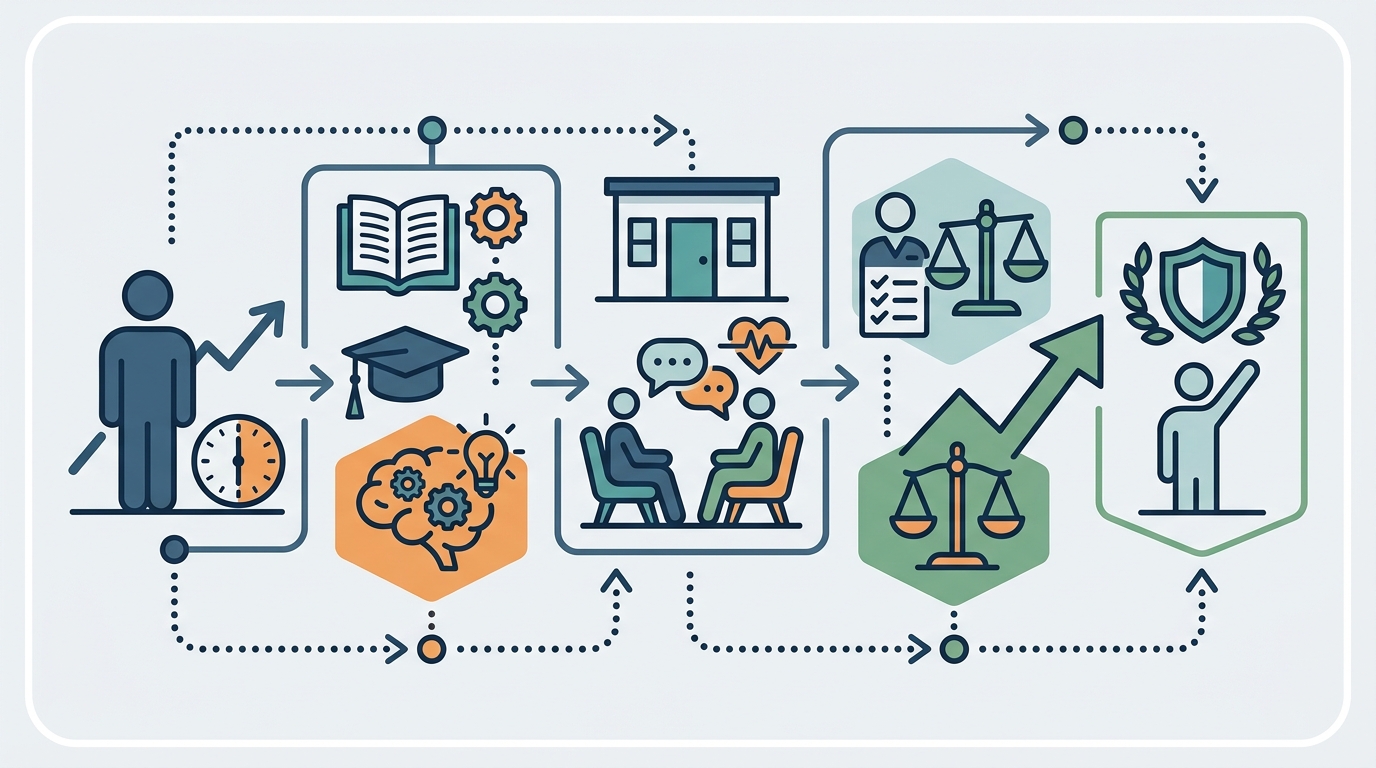
Becoming a therapist in your thirties, forties or fifties is a structured, slow path rather than a leap: a master's degree, a state-specified number of hours of postdegree supervised clinical work under a licensed counselor, a state-recognized exam, and annual continuing education to keep the license (U.S. Bureau of Labor Statistics, 2025). Plan on roughly four to seven years from first inquiry to full licensure, most of it alongside or instead of your current income.
The field rewards what you already have — adult experience of work, families, loss and money — and the U.S. Bureau of Labor Statistics projects employment growth for both marriage and family therapists and mental health counselors over the 2025-35 decade (2025).
What the Work Actually Involves
A licensed therapist's week is built around client hours, and how many of them you carry is the main thing that varies between employers. A full-time agency or group-practice week typically runs 22-28 scheduled sessions of 45-55 minutes, often clustered in late afternoons and evenings because that is when working clients can come. Most therapists work full time, part-time work is common, and some work evenings and weekends (U.S. Bureau of Labor Statistics, 2025).
Around those sessions sit three tasks that surprise people coming from other fields:
- Documentation: 4-8 hours a week. Every session needs a note, and insurance or agency funding usually requires a treatment plan reviewed on a schedule. Assessing clients' needs, creating treatment plans, and referring clients to other specialists or community resources are listed duties of the job (U.S. Bureau of Labor Statistics, 2025).
- Intakes: 60-90 minutes each, one to four a week. History, risk screening, goals, and the decision about whether you are the right clinician at all.
- Supervision and consultation: 1-2 hours a week. Before licensure this is mandatory and logged; afterwards most clinicians keep some consultation going alongside the continuing education their state requires each year (U.S. Bureau of Labor Statistics, 2025).
Then there is the administrative tail — 2-5 hours a week of scheduling, billing questions, chasing a psychiatrist referral or a food bank, and answering the message from someone in crisis between sessions.
Pay is usually structured as a salary at community mental health agencies and hospitals, hourly or a percentage of collected fees in group practice, and per-session fee-for-service in private practice. The U.S. Bureau of Labor Statistics publishes 2025 median annual pay for marriage and family therapists and for substance abuse, behavioral disorder and mental health counselors, plus the lowest and highest ten percent of earners — check those Occupational Outlook Handbook pages before you choose a setting.
Who This Career Change Suits
- Nurses and paramedics — you already carry clinical documentation habits, risk assessment instincts and a tolerance for distress that takes most career changers a year of practicum to build.
- Elementary and secondary teachers — you have run behaviour plans, sat in hard parent meetings and tracked progress toward goals, which is most of what a treatment plan is.
- Human resources managers and workplace investigators — confidentiality discipline, records that may be read by a third party, and conversations where someone is upset with you are daily work in both jobs.
- Clergy and chaplains — you have handled grief and family conflict without a clinical frame; the master's supplies the frame, the assessment tools and the legal scope.
- Retail and restaurant managers — scheduling, de-escalating strangers and absorbing other people's bad days translate directly to a 26-session week.
- Military and law enforcement veterans — credibility with clients other therapists struggle to reach, especially in substance use and trauma settings.
- People with lived experience of recovery or family mental illness — a real asset in substance abuse and behavioral disorder counseling, provided you can hold a boundary when a client's story mirrors your own.
Transferable Skills That Carry Over
| Prior Career | Skill | How It Applies Here |
|---|---|---|
| Registered nurse | Charting under time pressure, risk screening | Session notes and safety assessments follow similar logic; you will finish documentation faster than classmates |
| Elementary teacher | Behaviour plans and progress tracking | Writing measurable treatment goals and reviewing them on schedule, part of assessment and treatment planning (U.S. Bureau of Labor Statistics, 2025) |
| HR manager | Confidential interviewing and record discipline | Intake interviews, mandated reporting decisions, records that may be subpoenaed |
| Retail or restaurant manager | De-escalation and scheduling a full week | Running a 20-plus session caseload, including the evening slots clients actually want |
| Insurance or claims analyst | Reading coverage rules and coding | Billing, prior authorisation and session limits, which decide whether private practice is viable |
| Social services case manager | Knowing the local referral map | Referring clients to other specialists and community resources, a listed duty of the job (U.S. Bureau of Labor Statistics, 2025) |
How to Get Started
- Find out what your state actually licenses. Look up your state board's requirements through CareerOneStop's license finder, referenced by the U.S. Bureau of Labor Statistics (2025). Compare the marriage and family therapist route with your state's counseling license (LPC or LMHC) and clinical social work (LCSW) — the degree, hours, exam and billable scope all differ. Allow a week.
- Read the BLS pages for both occupations. The Occupational Outlook Handbook entries for marriage and family therapists and for substance abuse, behavioral disorder and mental health counselors give 2025 median annual pay, the wage range and the 2025-35 projections (U.S. Bureau of Labor Statistics, 2025). Set your income expectations there, not from a program's marketing.
- Get paid to test the work first. Crisis line volunteering, a behavioral health technician post or a case manager role will tell you within three to six months whether you can sit with distress. Substance abuse and behavioral disorder counselor roles typically need at least a bachelor's degree, though requirements range from a high school diploma to a master's depending on state and employer (U.S. Bureau of Labor Statistics, 2025).
- Audit your transcript and fill prerequisite gaps. Many master's programs expect undergraduate psychology or statistics coursework; community college or a university extension covers that in one or two terms.
- Apply to a master's program your board recognises. Marriage and family therapists typically need a master's degree, and mental health counselors typically need a master's including a clinically supervised internship (U.S. Bureau of Labor Statistics, 2025). Confirm with the board — not the admissions office — that the coursework satisfies your state, and ask how the program places part-time and older students into practicum sites.
- Treat practicum as the real interview. Your internship site is where a first job offer usually comes from, so pick a setting you would genuinely work in and tell your supervisor early that you want to stay.
- Register as a pre-licensed associate and start logging hours. Training is hands-on postdegree supervised clinical work under a licensed counselor (U.S. Bureau of Labor Statistics, 2025). Before accepting the job, confirm whether the employer provides and pays for supervision or whether you will.
- Pass the exams, then keep the license alive — a state-recognized exam, a jurisprudence exam in some states, and annual continuing education (U.S. Bureau of Labor Statistics, 2025).
Costs and Time Commitment
| Item | Typical Cost | Typical Time |
|---|---|---|
| Prerequisite coursework | Per-credit tuition at a community college or extension school — check the published rate | 3-9 months |
| Master's degree (the credential most licenses require) | Varies widely between in-state public and private programs; compare per-credit tuition and total credits before applying | 24-36 months full time, 36-48 part time |
| Practicum or clinical internship (income gap) | Usually unpaid or low-paid while your outside work hours drop | 9-12 months of reduced earnings |
| Postdegree supervised clinical hours | Paid, but at pre-license rates; supervision may be an out-of-pocket hourly fee | A state-set number of hours, commonly 24-36 months |
| Licensing exam, jurisprudence exam where required, board fees | Board-published fee schedules — check your state board's site | 1-3 months of study and processing |
| Total income gap across the transition | Reduced earnings for 24-48 months, deepest during practicum | 4-7 years to full license |
| Continuing education to renew | Annual CE requirement set by your state board (U.S. Bureau of Labor Statistics, 2025) | A few days a year, ongoing |
Frequently asked questions
Am I too old to start at 35, 45 or 52?
Age worry in this field bites hardest in the 50-60 band, where people fear they will not recoup tuition before retirement. Against that, the U.S. Bureau of Labor Statistics projects employment growth for both marriage and family therapists and mental health counselors over the 2025-35 decade, with average annual job openings each year of that period (2025). Finish the license at 52 and you still have 15-20 practising years, with no mandatory retirement date in private practice.
Can I keep my current job while I retrain?
Partly. Coursework can often be spread over 36-48 months part time, but practicum requires daytime clinical hours at a site, which is where most career changers cut to part-time work or step out for 9-12 months. Map the cash needs of that practicum year before you enrol.
Which license should I go for?
That depends on your state: all states require mental health counselors to be licensed, and licensure means passing a national examination plus supervised clinical work under a licensed counselor (U.S. Bureau of Labor Statistics, 2025). Marriage and family therapy, clinical counseling and clinical social work are three separate routes with different degrees and scope. Check all three through CareerOneStop's license finder before spending a dollar on applications.
What will I actually earn compared with my current job?
The U.S. Bureau of Labor Statistics publishes 2025 median annual pay for marriage and family therapists and for substance abuse, behavioral disorder and mental health counselors, along with the lowest and highest ten percent of earners — read those pages for current numbers. Expect your first 24-36 months after graduation, while pre-licensed, to sit well below the occupation's median. Coming from a management salary, plan for a multi-year pay cut rather than a brief one.
Sources
- U.S. Bureau of Labor Statistics — Marriage and Family Therapists : Occupational Outlook Handbook (2025)
- U.S. Bureau of Labor Statistics — Substance Abuse, Behavioral Disorder, and Mental Health Counselors : Occupational Outlook Handbook (2025)

Written by
Wyatt covers work outside the office: construction, logistics, repair, and the people who keep things running. He's skeptical of career advice that assumes everyone sits at a desk.