Nurse vs. Nurse Practitioner: Pay, Duties, and Day-to-Day Differences
Both roles care for patients directly, but only one diagnoses conditions, writes the treatment plan, and needs a graduate degree to do it.
Quick answer
- The core difference is scope: NPs diagnose conditions and develop treatment plans, while RNs assess, monitor, administer medicines and treatments, and contribute to care plans (U.S. Bureau of Labor Statistics, 2025).
- The NP path requires far more upfront schooling — at least a master's degree in an APRN role, state licensure, and a national certification exam, on top of an existing RN license (U.S. Bureau of Labor Statistics, 2025).
- 2025 median annual wages were $97,550 for registered nurses and $134,920 for nurse anesthetists, nurse midwives, and nurse practitioners combined (U.S. Bureau of Labor Statistics, 2025) — national figures, with state and local pay varying; both roles carry real costs, including lifting patients and standing for most of a shift in RN work and nights, weekends, holidays, and on-call for hospital staff in either role (U.S. Bureau of Labor Statistics, 2025).
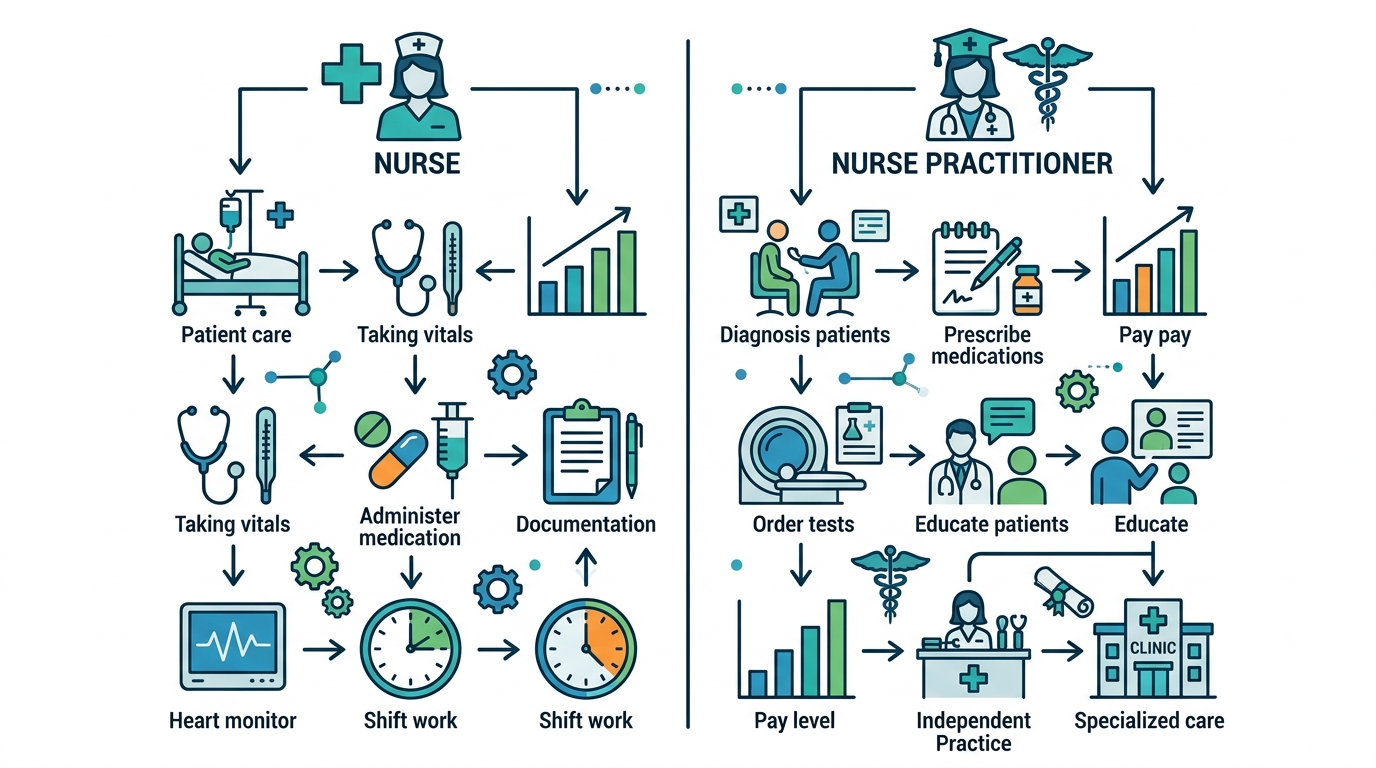
A registered nurse assesses patients, administers medicines and treatments, and carries out and contributes to care plans; a nurse practitioner is an advanced practice registered nurse who diagnoses conditions, develops treatment plans, and delivers primary or specialty care (U.S. Bureau of Labor Statistics, 2025). The biggest practical split is authority and schooling: RNs enter with a bachelor's, associate's, or diploma nursing credential plus licensure, while NPs need at least a master's degree in an APRN role, state licensure, and a national certification exam (U.S. Bureau of Labor Statistics, 2025).
Pay and projected growth also differ sharply. The 2025 median annual wage was $97,550 for registered nurses and $134,920 for the group covering nurse anesthetists, nurse midwives, and nurse practitioners (U.S. Bureau of Labor Statistics, 2025).
Head-to-Head Comparison
| Dimension | Registered nurse (RN) | Nurse practitioner (NP) |
|---|---|---|
| Typical entry requirement | Typical entry-level education is a bachelor's degree, though RNs usually take one of three paths: a bachelor's degree in nursing (about four years), an associate's degree in nursing (about two years), or a diploma from an approved nursing program, and must be licensed (U.S. Bureau of Labor Statistics, 2025). Licensure runs through the NCLEX-RN, open to graduates of an accredited ADN, BSN, or diploma program, with up to 150 items administered over five hours (National Council of State Boards of Nursing, 2023). | Typical entry-level education is a master's degree (U.S. Bureau of Labor Statistics, 2025). Candidates must earn at least a master's degree in one of the APRN roles, be licensed in their state, and pass a national certification exam (U.S. Bureau of Labor Statistics, 2025). AANP states that admission criteria for NP graduate programs should include a BSN, passage of the NCLEX, and an active RN license (American Association of Nurse Practitioners, undated) — so the master's typically sits on top of a four-year BSN. |
| Median pay | $97,550 per year, or $46.90 per hour, in 2025 (U.S. Bureau of Labor Statistics, 2025). National figure; state and local pay vary. | $134,920 per year, or $64.87 per hour, in 2025 for the combined group of nurse anesthetists, nurse midwives, and nurse practitioners (U.S. Bureau of Labor Statistics, 2025). National figure covering three roles, not NPs alone; state and local pay vary. |
| Physical and schedule demands | Should be comfortable performing physical tasks such as lifting patients, and may be on their feet for most of a shift (U.S. Bureau of Labor Statistics, 2025). Those in hospitals and nursing care facilities usually work shifts for round-the-clock coverage and may work nights, weekends, holidays, and be on call (U.S. Bureau of Labor Statistics, 2025). | Most work full time. Those in physicians' offices typically work normal business hours; those in hospitals may work shifts including nights, weekends, and holidays, and some must be on call (U.S. Bureau of Labor Statistics, 2025). Clinic-based NPs generally trade shift work for a caseload and documentation that follow them home. |
| Five-year outlook | BLS publishes a ten-year window rather than a five-year one: employment is projected to grow 6 percent from 2025 to 2035, faster than the average for all occupations, with about 180,800 openings projected each year (U.S. Bureau of Labor Statistics, 2025). The volume of annual openings is the headline number here. | Over the same 2025–2035 projection period, employment is projected to grow 36 percent, much faster than the average for all occupations, with about 32,200 openings projected each year (U.S. Bureau of Labor Statistics, 2025). Faster percentage growth, far fewer total openings. |
Read the pay rows carefully. The RN figure covers registered nurses only; the $134,920 figure covers nurse anesthetists, nurse midwives, and nurse practitioners as one occupational group (U.S. Bureau of Labor Statistics, 2025), so it is not a pure NP number. Check current state and metropolitan figures on the BLS Occupational Employment and Wage Statistics pages and your state board of nursing before you plan around either one.
Day-to-Day Differences
Picture the same Tuesday in the same health system.
The registered nurse starts before the shift formally begins, taking handover on a group of assigned patients. The morning is structured around that group: recording medical information and vital signs, administering medications and monitoring for reactions, and maintaining accurate, detailed reports and records (O*NET OnLine, U.S. Department of Labor). Between those fixed points come assessments of patients' conditions, recording histories and symptoms, delivering treatments, and contributing to each patient's care plan (U.S. Bureau of Labor Statistics, 2025). A patient needs repositioning and a transfer to a chair, so the RN lifts — the role expects comfort with physical tasks such as lifting patients, and standing for most of a shift (U.S. Bureau of Labor Statistics, 2025). At hour nine the RN gives handover to the incoming shift, because hospitals and nursing care facilities staff round the clock and that means nights, weekends, holidays, and on-call rotations (U.S. Bureau of Labor Statistics, 2025). The scheduled medication pass for an assigned patient group and the shift-to-shift handover of those same patients are RN work; an NP running a clinic session does not do them.
The nurse practitioner's Tuesday is built around a schedule of appointments or a consult list rather than a patient group. Work includes developing treatment plans based on scientific rationale and standards of care, and diagnosing or treating complex, unstable, comorbid, episodic, or emergency conditions (ONET OnLine, U.S. Department of Labor). Between visits come primary care procedures: suturing a laceration, splinting a wrist, administering immunizations, debriding a wound (ONET OnLine, U.S. Department of Labor). The NP also coordinates patient care and may provide primary or specialty healthcare (U.S. Bureau of Labor Statistics, 2025). Naming the diagnosis and signing the treatment plan that follows from it is NP work; the RN who sees the same patient assesses, monitors, and carries out the treatment, but does not make that diagnostic call.
The ending differs too. In a physician's office the NP's day finishes near normal business hours (U.S. Bureau of Labor Statistics, 2025), but the charting and result review attached to a full clinic list often stretch past the last appointment. In a hospital the NP may be on shifts including nights, weekends, and holidays, and may be on call (U.S. Bureau of Labor Statistics, 2025) — much like the RN down the hall.
Who Thrives in Each Path
Registered nurse
- You want to be licensed and working sooner: an associate's degree in nursing or an approved diploma program is a recognized entry route alongside the BSN (U.S. Bureau of Labor Statistics, 2025), so the clock to NCLEX-RN eligibility can be roughly two years rather than six.
- You prefer depth with a small group of patients over breadth across a full appointment list — the RN day is organized around assessing, monitoring, and recording observations on assigned patients (U.S. Bureau of Labor Statistics, 2025).
- You come from physically active work — EMS, a CNA or patient care tech role, trades, warehouse, the military — and already know you can lift patients and stay on your feet for most of a shift (U.S. Bureau of Labor Statistics, 2025).
- Shift premiums and rotating schedules suit your life rather than fighting it, since hospital and nursing-facility nursing covers nights, weekends, holidays, and on-call (U.S. Bureau of Labor Statistics, 2025).
Nurse practitioner
- You are already an RN and find yourself most engaged by the diagnostic question — NP work centers on developing treatment plans based on scientific rationale and standards of care (O*NET OnLine, U.S. Department of Labor).
- You tolerate sustained academic work: the role requires at least a master's degree in an APRN role, state licensure, and a national certification exam (U.S. Bureau of Labor Statistics, 2025), typically on top of a four-year BSN.
- You like procedural skills and want to own them — suturing, splinting, immunizations, and wound debridement are listed NP tasks (O*NET OnLine, U.S. Department of Labor).
- You want weekday hours more than shift variety, and can accept the documentation load that comes with them: NPs in physicians' offices typically work normal business hours, while hospital-based NPs still face nights, weekends, holidays, and call (U.S. Bureau of Labor Statistics, 2025).
Frequently asked questions
I'm already a registered nurse. What is the actual route to becoming a nurse practitioner?
The route is a graduate APRN program, not a short course. AANP states admission criteria should include a BSN, passage of the NCLEX, and an active RN license (American Association of Nurse Practitioners, undated). You then complete at least a master's degree in an APRN role, obtain state licensure, and pass a national certification exam (U.S. Bureau of Labor Statistics, 2025). RN-to-BSN bridge study comes first if you entered through an ADN or diploma program.
How many clinical hours does NP certification require?
Both the AANP and ANCC nurse practitioner certification exams require a minimum of 500 clinical hours before testing, and candidates must have completed all coursework (NurseJournal.org, undated). Those hours are built into accredited graduate programs rather than accumulated separately at work, so program length and placement availability largely determine how long this stage takes.
Is the higher NP pay worth the extra schooling?
Compare the numbers against the time. The 2025 median annual wage was $97,550 for registered nurses and $134,920 for nurse anesthetists, nurse midwives, and nurse practitioners combined (U.S. Bureau of Labor Statistics, 2025). The gap arrives only after a master's degree, licensure, and certification, and both figures are national — check your state's figures on the BLS wage pages before deciding.
Which path has the stronger job outlook?
They differ in kind. Registered nurse employment is projected to grow 6 percent from 2025 to 2035, with about 180,800 openings projected each year, while nurse anesthetists, nurse midwives, and nurse practitioners are projected to grow 36 percent over the same period, with about 32,200 openings annually (U.S. Bureau of Labor Statistics, 2025). Faster growth, far fewer total openings.
Does my NP credential transfer if I move to another state?
Requirements are set state by state, so confirm with the board where you intend to practice. California's Board of Registered Nursing, for example, lists national certifying bodies including the American Academy of Nurse Practitioners Certification Board as meeting its standards, and requires an active California RN license for NP certification eligibility (California Board of Registered Nursing, undated). AANP certification also renews every five years, requiring at least 1,000 clinical contact hours (NurseJournal.org, undated).
Sources
- U.S. Bureau of Labor Statistics — Registered Nurses : Occupational Outlook Handbook (2025)
- U.S. Bureau of Labor Statistics — Nurse Anesthetists, Nurse Midwives, and Nurse Practitioners : Occupational Outlook Handbook (2025)

Written by
Priya tracks wages, layoffs, and the slow shifts in what counts as a stable job. She writes for readers trying to make sense of numbers that rarely match their own experience.