How to Prepare for a Software Engineer Interview
A week-by-week plan for coding rounds, system design and behavioral questions, plus what to carry in, what to say and how to close the interview.
Quick answer
- One week out, email the recruiter to confirm every round, its length and the language or tools allowed — then read the company's own website for what it builds and any upcoming launches (CareerOneStop, U.S. Department of Labor).
- Three days out, write three STAR stories (Situation, Task, Action, Result) with real numbers in them, and rehearse them out loud with someone else or in front of a mirror (CareerOneStop).
- The day before, time the route or run a full screen-share test, lay out clean clothes appropriate to the workplace, and print extra copies of your resume and references.
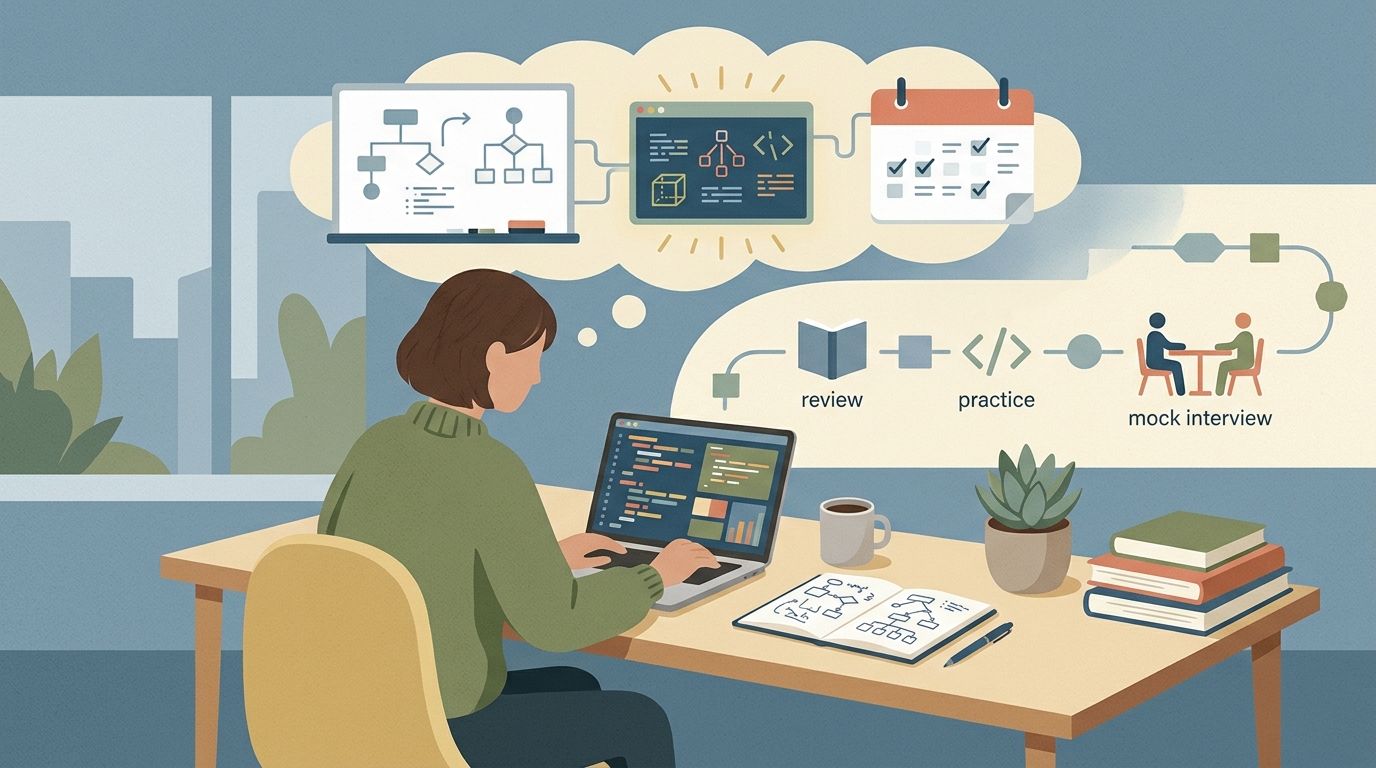
Preparing for a software engineer interview means three separate jobs: refreshing the technical fundamentals you'll be asked to code live, assembling concrete stories about work you've shipped, and handling the logistics so nothing goes wrong on the day. Most loops mix a coding exercise, a design or architecture discussion, and behavioral questions — employers use a mix of behavioral and hypothetical questions to assess things like leadership, how you get work done and how you collaborate (Google, undated).
The format varies a lot by employer and by level, so the first move is always to ask the recruiter exactly what the stages are. Demand for the occupation is projected to grow much faster than average for all occupations from 2025 to 2035 (U.S. Bureau of Labor Statistics, 2025), but each individual loop is still won on preparation.
Your Prep Timeline
- One week out — confirm the format and research the product (60-90 minutes). Email the recruiter and ask, in writing, how many rounds there are, how long each runs, whether coding is on a shared editor or a whiteboard, which languages are permitted, and who you'll meet. Then spend 30 minutes on the company's website learning what it actually does and noting any upcoming events or releases you can raise in the interview (CareerOneStop, U.S. Department of Labor). Write down the stack named in the job posting.
- Six to three days out — drill fundamentals in one language (45-60 minutes a day). Pick the language you are fastest in, not the one you think they want. Work through arrays and hash maps, two pointers, binary search, trees and graph traversal, and complexity analysis — one problem per session, typed out and run, not read. Software developers usually gain their programming background in school and must keep up to date on new tools and languages throughout their careers (U.S. Bureau of Labor Statistics, undated), so treat anything rusty as a study list, not a verdict.
- Three days out — write three STAR stories (60 minutes). Come prepared with several examples covering the soft-skill areas the interview assesses (Google, undated). Draft each as Situation, Task, Action, Result, and put a number in every Result: build time, error rate, tickets closed, users affected.
- Two days out — rehearse out loud (45 minutes). Review common interview questions and practise your answers with someone else or in front of a mirror (CareerOneStop). Say the STAR stories aloud until each lands in about 90 seconds. If you can, do one mock coding round where you narrate your thinking the whole time — hypothetical and situational questions are there to evaluate your thought process rather than a single right answer (Google, undated).
- Two days out — write your questions list (20 minutes). Make a list of questions in advance, choosing ones about the job and company that show genuine interest (CareerOneStop): the daily responsibilities, the qualities that matter most in an employee, whether training is available, and the organisation's future priorities (CareerOneStop). Add two engineering-specific ones, such as how code review works and what the on-call rotation looks like.
- The day before — handle logistics (45 minutes). Plan how to get there with plenty of time to spare (CareerOneStop), or for a remote round, test camera, microphone, screen share and the coding platform in the same browser you'll use. Print your documents. Lay out neat, clean clothes appropriate to that workplace (CareerOneStop).
- The morning of — short warm-up, then stop (30 minutes). Solve one easy problem you have already seen to get your hands moving, reread the job posting and your questions list, then close the laptop. Leave the coffee, water bottle and backpack at home or in the car, and turn your phone off before you go in (CareerOneStop).
Day-Of Checklist
- Extra printed copies of your resume — at least four, one per interviewer plus a spare (CareerOneStop).
- A printed reference list with current phone numbers and email addresses (CareerOneStop).
- A portfolio or printed work samples if the role calls for them — a one-page summary of two projects with the repo or product name and what you built (CareerOneStop).
- Any papers needed to complete an application on site, such as copies of work licences or ID documents the employer asked for (CareerOneStop).
- A pen and a notebook, opened to a page where you have already written your questions list (CareerOneStop).
- Clothes laid out the night before: neat, clean and appropriate to that workplace (CareerOneStop).
- Route timed with a buffer, or for remote rounds, a completed test call confirming camera, microphone and screen share all work.
- Phone switched off, and coffee, water bottle and backpack left at home or in the car (CareerOneStop).
- Recruiter's phone number and the interviewer names written on paper, not only in your phone.
- Your laptop charged and charger packed if you have been told to bring your own machine.
What to Say in Tricky Moments
Greeting the interviewer
At the door or on the call
"Hi, I'm Dana — good to meet you. Thanks for making the time. Before we start, how long do we have, so I can pace myself?"
"Tell me about yourself"
A 30-second frame, not a life story
"I'm a backend engineer, four years on payments systems in Go and Postgres. Most recently I owned the refunds service. I'm here because this role is closer to the data layer, which is where I do my best work."
A behavioral question, answered as STAR
"Tell me about a time you fixed something broken"
"Our CI suite took 22 minutes and people skipped it. I was asked to fix it. I profiled the tests, parallelised the slowest suite and mocked a live API call. Runtime dropped to 9 minutes and failures stopped being ignored."
When you don't recognise the problem
Out loud, in the first 30 seconds
"I haven't seen this exact problem, so let me think aloud. I'll start with a brute-force version to make sure I understand the inputs, then look for a hash map to cut the lookup cost. Tell me if I'm off track."
Declining a salary question early
When asked for a number in round one
"I'd rather learn the scope first. Can you tell me the band for this level? I'm checking the Occupational Outlook Handbook and CareerOneStop's salary data for this title and metro, so I'll have a figure before any offer stage."
Asking about next steps
In the last two minutes
"That covers my questions. What are the next steps, and when should I expect to hear? If it's helpful, I can send over the design doc from the project we discussed."
Frequently asked questions
How early should I arrive?
Arrive at the building 15 minutes early and check in at reception 10 minutes before the start time. Plan the journey the day before with plenty of time to spare (CareerOneStop), and wait in a nearby café rather than the lobby if you are very early.
What should I bring to a software engineer interview?
Bring extra copies of your resume, a reference list, work samples if the role needs them, any application paperwork requested, and a pen and notebook (CareerOneStop). Leave the coffee and backpack in the car and turn your phone off before going in.
Can I use my own laptop and editor for the coding round?
Ask the recruiter in writing a week ahead — many employers require their own shared editor with no autocomplete. Practise in that exact environment once beforehand so the keyboard shortcuts and missing linter don't surprise you.
Should I mention certifications?
Mention them only if the job posting names the product. Programmers may become certified in specific languages or vendor products, and some companies require certification in the products they use (U.S. Bureau of Labor Statistics, undated); CareerOneStop lists programming-related certifications.
Sources
- U.S. Bureau of Labor Statistics — Software Developers, Quality Assurance Analysts, and Testers : Occupational Outlook Handbook (2025)
- U.S. Bureau of Labor Statistics — Software Developers : Occupational Outlook Handbook

Written by
Desmond writes about the mechanics of job searching: resumes, interviews, the long silence after applying. He's fascinated by how much of getting hired depends on luck dressed up as skill.