How to Prepare for a Panel Interview
Three or more interviewers, one chair: how to learn who is on the panel, split your answers between them, and close by asking about next steps.
Quick answer
- One week out, email the recruiter for the names, titles and departments of everyone on the panel, then research each person before you go in (Let's Grow Leaders, undated).
- Three days out, run a mock panel: have several friends take turns firing questions at you so you rehearse the turn-taking, not just the content (CareerOneStop, undated).
- The night before, pack a folder with a resume copy for each panelist plus spares, a notepad and pens, your questions list and your reference list (4 Corner Resources, undated).
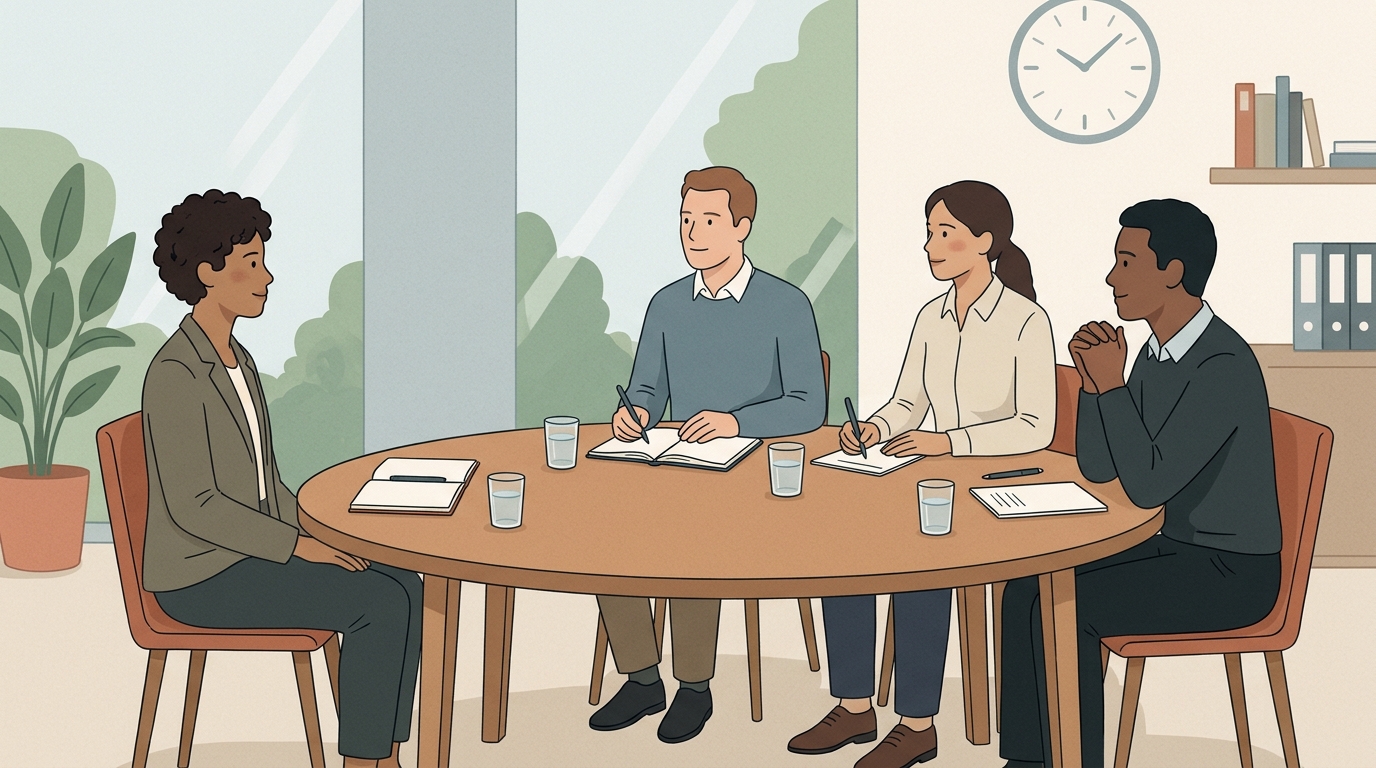
A panel interview puts three or more people from different levels or departments in the room, each asking questions and judging how you would fit the team (CareerOneStop, undated). Preparing for one is the same work as preparing for a single interviewer, plus two extras: learning who is on the panel before you arrive, and practicing how you divide your attention between them while you answer.
This guide gives you a week-long prep timeline, a checklist to run through on the day, and exact phrasing for the moments that catch people out.
Your Prep Timeline
- One week out — research the employer and build a panel roster (set aside about an hour). CareerOneStop lists researching the employer and the job as the first step in getting ready to interview (CareerOneStop, undated). Read the job posting line by line and note the exact nouns it uses for tools and duties. Then email the recruiter and ask for the names, titles and departments of everyone who will be on the panel. Career advisers recommend finding those names in advance and researching the people before you walk in (Let's Grow Leaders, undated). Write each one on an index card with their title, department and the part of the job they are most likely to probe.
- Five days out — draft your core stories (allow a long evening session). CareerOneStop advises practicing answers to common questions on paper as well as out loud (CareerOneStop, undated). Write stories covering a conflict, a deadline you saved, a mistake you fixed, a process you improved, a time you worked across departments, and your strongest technical result. Give each one a Situation, Task, Action and Result, and attach a real figure from your own work to the Result — a processing time, a volume, a named outcome — rather than "improved efficiency."
- Three days out — practice out loud with other people (allow about an hour). CareerOneStop recommends practicing out loud, including with a friend, and suggests a practice run such as a mock interview (CareerOneStop, undated). Ask several people to take turns asking questions so you get used to answering one person while a group watches. Practice giving the most eye contact to whoever asked the question while still engaging the rest of the panel (CareerAddict, undated).
- Two days out — fix the logistics (allow half an hour). For an in-person panel, plan how you will get there with plenty of time to spare, and check parking or transit at the same hour you will actually travel (CareerOneStop, undated). For a virtual panel, check that your computer, camera and microphone work and click through the employer's video platform so you know where mute and gallery view sit (CareerOneStop, undated).
- One day out — write your questions and pack (allow half an hour). Prepare two questions aimed at specific panelists — one about the team's workload, one about how this role's output is used elsewhere — plus your closing question about next steps. Pack a folder with resume copies, a cover letter copy, a notepad and pen, your questions list and your reference list (4 Corner Resources, undated). Add a card with the panelists' names and contact details so you can reference them and follow up afterwards (The Forage, undated).
- Morning of — review your roster, then leave early (allow a short review before you go). Read your panel cards and say your opening answer out loud once. Plan your schedule so you arrive early rather than exactly on time (CareerOneStop, undated). For a virtual panel, sit down well ahead of the start in a quiet, clutter-free, well-lit space and mute every notification (CareerOneStop, undated).
Day-Of Checklist
- Folder packed flat with a printed resume for each panelist plus spare copies, a cover letter copy, your reference list, your questions list, a notepad and pens (4 Corner Resources and CareerOneStop, undated).
- A card in the folder listing every panelist's name, title and email address for your follow-up notes (The Forage, undated).
- Route timed and your departure time written down, set so you arrive early with time to spare (CareerOneStop, undated).
- Phone switched fully off — not silent — before you walk into the lobby (CareerOneStop, undated).
- Coffee cup, water bottle and backpack left at home or in the car (CareerOneStop, undated).
- Anyone who drove you stays in the car; you go in by yourself (CareerOneStop, undated).
- Outfit laid out the night before, shoes included, and checked for lint and loose buttons.
- Closing question written at the top of your notepad: whether there will be additional interviews, and when the employer plans to decide (CareerOneStop, undated).
- Virtual panels only: camera, microphone and the employer's platform tested, background cleared, light in front of you rather than behind you (CareerOneStop, undated).
- Virtual panels only: a friend has run a short mock call with you on the same platform (CareerOneStop, undated).
What to Say in Tricky Moments
The wording below is sample phrasing with example details filled in. Swap in your own names, tools and results.
Greeting three or more people at once
Example greeting
"Good morning — I'm Dana Price. Thanks for all making time today. Marcus, good to meet you in person. Rosa, Tim — hello."
Use the names from your roster card, stay standing until you are shown a seat, and put your folder flat on the table rather than in your lap.
"Tell me about yourself"
Example opener
"I run billing operations for a clinic group. Claim denials were climbing, so I rebuilt the pre-submission checklist in our EHR and brought the denial rate down by nearly half over two quarters."
Stop there and let the next panelist pick it up. Save the longer version for the follow-up question.
When one panelist asks and the others watch
Example mid-answer
"Rosa, to your point about handoffs — we logged every handoff for a fortnight and found three were duplicated." Then turn to the group: "That finding is what convinced finance to fund the change."
Give the most eye contact to whoever asked the question, then widen out to the rest of the panel (CareerAddict, undated).
A question you cannot answer
Example response
"I haven't used that system. The closest thing I've done is migrating patient records between two scheduling tools over three weeks. How steep is the learning curve here?"
Deflecting a salary question
Example response
"I'd like to understand the scope first. Could you tell me the range budgeted for this role? I've been comparing current postings for the same title in this metro area, so I can respond against that."
Before the interview, check published pay data for the occupation and your state on CareerOneStop's salary pages and compare it with live postings for the same title, so any number you give is anchored to something.
Closing on next steps
Example closing question
"Before we finish — will there be additional interviews after this one, and when are you planning to make a decision?"
CareerOneStop suggests ending the interview with exactly these two questions (CareerOneStop, undated). Write the answer on your notepad before you stand up.
Frequently asked questions
How early should I arrive for a panel interview?
Plan to be at reception before your scheduled start time, not at it. CareerOneStop advises planning your schedule and route so you arrive early with time to spare (CareerOneStop, undated). Drive or ride the route at the same hour a few days beforehand.
How many copies of my resume should I bring?
Bring one copy per panelist plus spares, printed single-sided and carried flat in a folder with your reference list, questions list and notepad (4 Corner Resources, undated). Email the recruiter beforehand to confirm how many people will be in the room.
Can my partner drive me and wait inside?
Have them wait in the car. CareerOneStop advises going to the interview by yourself, and the same guidance says to leave a backpack, coffee or water bottle at home or in the car (CareerOneStop, undated).
Should I send one thank-you note or one per panelist?
Send one per panelist, each referencing something that person specifically asked about. That is why you bring their names and contact information with you (The Forage, undated). Send them the same day, while the detail is still fresh.
Sources
- CareerOneStop — Interview Tips
- CareerOneStop — Types of interviews
Written by
Wyatt covers work outside the office: construction, logistics, repair, and the people who keep things running. He's skeptical of career advice that assumes everyone sits at a desk.