How to Become an Electrician: Step-by-Step Guide
Electricians train mostly on the job, earning while they learn, then sit a licensing exam built around the National Electrical Code in most states.
Quick answer
- Minimum credential: a high school diploma or equivalent, plus completion of an apprenticeship and, in most states, a passed licensing exam (U.S. Bureau of Labor Statistics, 2025).
- Realistic time from starting out to working as a licensed journey-level electrician: roughly 4 to 6 years (48-72 months), because apprenticeships run 4 or 5 years (U.S. Bureau of Labor Statistics, 2025).
- You are paid from the first year, but the work is physical: you must be strong enough to move components weighing up to 50 pounds, and color vision matters because wires are identified by color (U.S. Bureau of Labor Statistics, 2025).
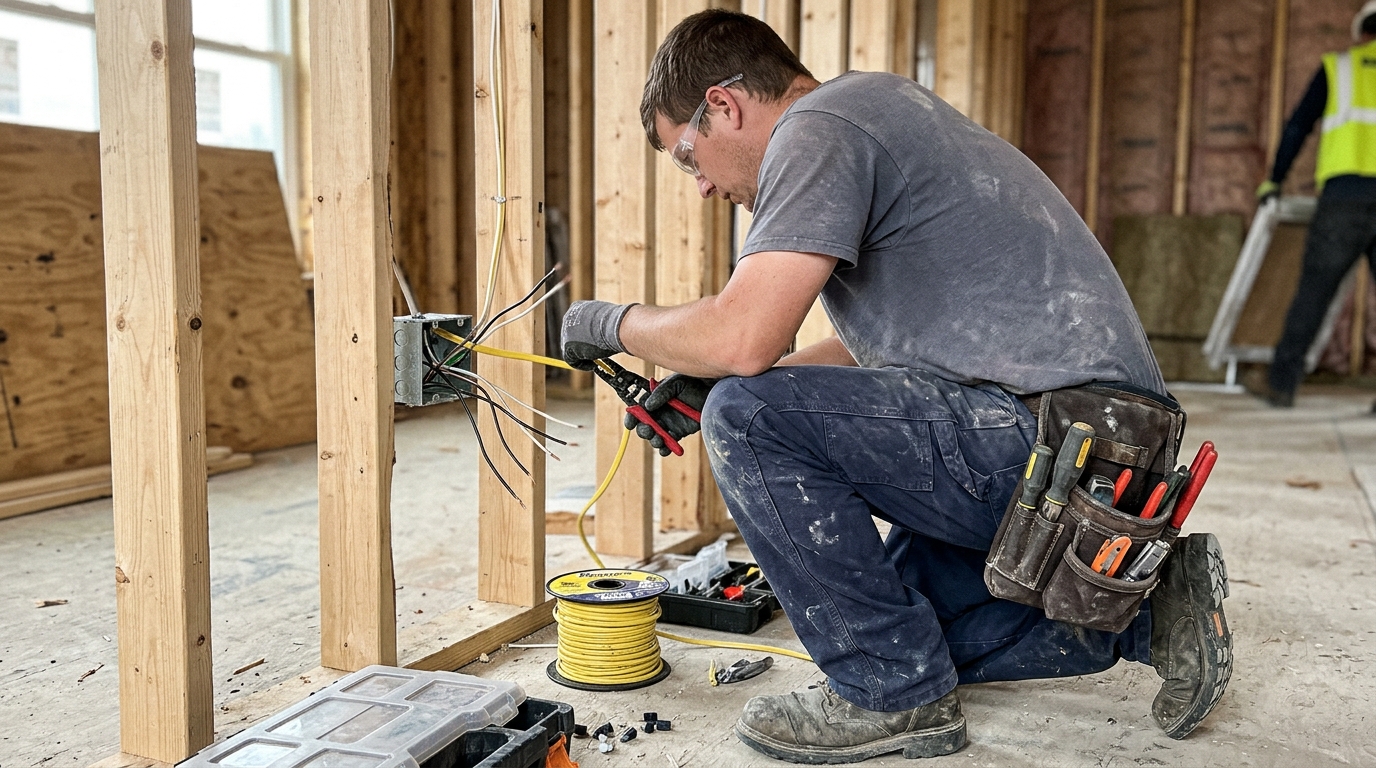
Becoming an electrician means getting hired into an apprenticeship, not graduating first and job-hunting after. Most electricians learn the trade in a 4- or 5-year apprenticeship that provides about 2,000 hours of paid on-the-job training each year plus technical instruction, and a high school diploma or equivalent is the baseline requirement (U.S. Bureau of Labor Statistics, 2025).
After the apprenticeship you are considered a journey worker and may work on your own, subject to local or state licensing rules, and most states require you to pass a test and hold a license (U.S. Bureau of Labor Statistics, 2025).
Step-by-Step Path to Entry
- Finish a high school diploma or GED, and take algebra. A high school diploma or equivalent is required to become an electrician (U.S. Bureau of Labor Statistics, 2025). Apprenticeship sponsors often go further: IBEW Local Union #5 / Western PA NECA applicants must be at least 18, hold a high school diploma or GED, and have credit for at least one secondary or post-secondary algebra course (IBEW Local 5 JATC).
- Consider a pre-apprenticeship to make your application stronger. The Home Builders Institute runs a preapprenticeship certificate training (PACT) program covering eight construction trades, including electricians (U.S. Bureau of Labor Statistics, 2025). A PACT certificate or a community college electrical course gives a sponsor evidence you can handle tools, codes and math before they commit four or five years to you.
- Apply to an apprenticeship and sit the entry aptitude test. Apply to a Joint Apprenticeship and Training Committee (JATC) run by an IBEW local and its NECA chapter, or to an Independent Electrical Contractors (IEC) chapter program. Entry testing commonly uses the General Aptitude Test Battery, a 3-hour test measuring algebra and reading comprehension (Evansville JATC). Interviews and ranked lists follow, and intakes may run only once or twice a year.
- Check whether your state requires a trainee registration first. Rules differ. In California, to work as an electrical trainee you must enroll in and graduate from a state-approved 26-week electrical trainee program, then take the state certification exam (I-TAP). Other states let you start as an apprentice employed directly by a licensed contractor — IEC-FECC's Florida program requires applicants to be working for, or eligible to work for, a licensed electrical contractor (IEC-FECC).
- Complete the apprenticeship hours. Most electricians learn the trade in a 4- or 5-year apprenticeship with roughly 2,000 hours of paid on-the-job training per year plus technical instruction (U.S. Bureau of Labor Statistics, 2025). NECA-IBEW Local 26's Inside Wireman apprenticeship is a five-year program requiring a minimum of 8,000 hours of on-the-job training and 900 hours of classroom instruction (IBEW Local 26). If you gained electrical experience in the military or in construction, you may qualify for a shortened apprenticeship based on experience and testing (U.S. Bureau of Labor Statistics, 2025).
- Pass your state or local licensing exam. Most states require electricians to pass a test and be licensed, and requirements vary by state; licensing exams include questions on the National Electrical Code and on state and local electrical codes (U.S. Bureau of Labor Statistics, 2025). Look up your own state's board through CareerOneStop before you apply anywhere, because the sequence of trainee card, hours and exam is set state by state.
- Keep the license current, then consider master electrician. Electricians may be required to take continuing education courses to maintain a license (U.S. Bureau of Labor Statistics, 2025). After meeting additional requirements and working as a qualified electrician, journey workers may advance to master electrician (U.S. Bureau of Labor Statistics, 2025).
Education and Certification Options
There is no single national price list for these routes, and tuition, book and tool costs are set by the individual program sponsor, school district or state. Ask each sponsor for its current fee schedule in writing, and check your state licensing board's exam and registration fees through CareerOneStop.
| Route | Typical duration | What it costs | Required or preferred |
|---|---|---|---|
| High school diploma or GED | Up to 4 years in school; GED prep is usually a matter of months | Public high school is free; GED testing fees are set by each state | Required to become an electrician (U.S. Bureau of Labor Statistics, 2025) |
| Pre-apprenticeship certificate, e.g. Home Builders Institute PACT | Weeks to a few months, depending on the delivery site | Varies by provider; some sites are grant-funded — ask before enrolling | Preferred, never a substitute for an apprenticeship (U.S. Bureau of Labor Statistics, 2025) |
| Union apprenticeship through a NECA-IBEW JATC | 5 years; Local 26's Inside Wireman program requires 8,000 on-the-job hours and 900 classroom hours (IBEW Local 26) | On-the-job training is paid; apprentices typically buy their own hand tools and books | The most common way electricians learn the trade (U.S. Bureau of Labor Statistics, 2025) |
| Independent contractor apprenticeship, e.g. an IEC chapter | About 4 years, roughly 8,000 on-the-job hours, one night of class per week (IEC-FECC) | Chapter tuition and fees vary — request the current figure from the chapter | A widely accepted alternative where you are already employed by a licensed contractor |
| State trainee program, e.g. California's 26-week electrical trainee program (I-TAP) | 26 weeks before you take the state certification exam | School tuition varies by provider; state exam fees are set by the state | Required in California to work as an electrical trainee; not applicable in every state |
| Military or prior construction electrical experience | Can shorten an apprenticeship, subject to experience review and testing (U.S. Bureau of Labor Statistics, 2025) | No tuition; you still complete the remaining apprenticeship hours | Credit toward a route, not a route on its own |
| Community college certificate or associate degree in electrical technology | Roughly 1-2 years full time | Per-credit tuition set by the college or district | Preferred by some sponsors and may count toward classroom hours; rarely required |
The tradeoff across all of these: the classroom portion usually happens in evenings after full working days on site, for four or five consecutive years.
Are You Ready? Readiness Checklist
Work through these before you spend time on applications. Each one is something you can check today.
- You hold a high school diploma or GED, the stated requirement for the occupation (U.S. Bureau of Labor Statistics, 2025).
- You are at least 18, the minimum age set by sponsors such as IBEW Local 5's JATC and IEC-FECC's Florida program.
- You have credit for at least one algebra course at secondary or post-secondary level, as IBEW Local 5's JATC requires — and you can still work algebra problems under time pressure, because entry testing may use the 3-hour General Aptitude Test Battery covering algebra and reading comprehension (Evansville JATC).
- You can lift and move components that may weigh up to 50 pounds; physical strength is listed as an important quality for the job (U.S. Bureau of Labor Statistics, 2025).
- You have normal color vision, since electricians must identify electrical wires by color (U.S. Bureau of Labor Statistics, 2025).
- You have reliable transportation and are physically capable of performing the work of the trade — both stated conditions in IEC-FECC's Florida apprenticeship requirements.
- You have looked up your own state's licensing board requirements through CareerOneStop, since most states require a test and a license and the rules vary by state (U.S. Bureau of Labor Statistics, 2025).
- You are willing to commit 4 or 5 years to an apprenticeship with about 2,000 hours of on-the-job training a year plus classroom work, before you can work independently as a journey worker (U.S. Bureau of Labor Statistics, 2025).
Sponsors may also require documentation of employment eligibility, a drug screen or a background check — confirm this with the specific program, as it is set by the employer or sponsor rather than nationally.
Typical Timeline From Start to First Job
Timings assume a standard apprenticeship route and no prior electrical experience. Intake dates are set by each sponsor, so waiting for the next application window can add months at the start.
- Month 0-3: Confirm prerequisites. Finish or document your high school diploma or GED, and complete an algebra course if you have not already taken one (IBEW Local 5 JATC). Look up your state's licensing board through CareerOneStop.
- Month 2-6: Optional pre-apprenticeship. Complete a Home Builders Institute PACT program or a community college electrical course to strengthen the application (U.S. Bureau of Labor Statistics, 2025).
- Month 4-9: Apply, test and interview. Submit applications to a NECA-IBEW JATC or an IEC chapter, sit the 3-hour General Aptitude Test Battery where it is used (Evansville JATC), interview, and wait for placement off the ranked list.
- Month 6-12: Start as a first-year apprentice electrician. This is your first paid job in the trade — about 2,000 hours of on-the-job training in the year, plus technical instruction, typically one or more evenings a week (U.S. Bureau of Labor Statistics, 2025; IEC-FECC).
- Year 2-4: Accumulate hours and classroom instruction. Programs such as NECA-IBEW Local 26's Inside Wireman apprenticeship require a minimum of 8,000 on-the-job hours and 900 classroom hours across five years (IBEW Local 26). In California, trainees complete a 26-week state-approved program and the state certification exam on a different schedule (I-TAP).
- Year 4-6: Pass the licensing exam and work as a journeyman electrician (inside wireman). Licensing tests cover the National Electrical Code plus state and local codes, and once you finish the apprenticeship you are a journey worker who may perform duties on your own, subject to local or state licensing (U.S. Bureau of Labor Statistics, 2025). Continuing education may then be required to keep the license (U.S. Bureau of Labor Statistics, 2025), and master electrician comes later, after additional requirements and more time in the trade.
Frequently asked questions
Can I become an electrician without a four-year degree?
Yes. The standard route is a 4- or 5-year apprenticeship with about 2,000 paid on-the-job hours per year plus technical instruction, entered with a high school diploma or equivalent (U.S. Bureau of Labor Statistics, 2025). O*NET places electricians in Job Zone Three, Medium Preparation Needed, describing three or four years of apprenticeship or several years of vocational training plus a licensing exam (O*NET OnLine).
Do I need a license, and who issues it?
Most states require electricians to pass a test and be licensed, and the requirements vary by state (U.S. Bureau of Labor Statistics, 2025). Exams include questions on the National Electrical Code and on state and local codes. Licensing is handled by state boards rather than a single national body, and CareerOneStop lists state licensing board requirements so you can check your own state before applying.
How much do electricians earn?
Pay is usually structured by apprenticeship step — a percentage of the journey-worker rate that rises as you complete hours — then at a journey or master rate, with overtime, shift differentials and per-diem on some jobs. Rates are negotiated locally and differ sharply by state and metro area. Check the current national and state figures in the U.S. Bureau of Labor Statistics Occupational Outlook Handbook and your local program's wage schedule.
Is demand for electricians growing?
The U.S. Bureau of Labor Statistics describes the job outlook for electricians over its 2025-35 projection period as much faster than average (U.S. Bureau of Labor Statistics, 2025). That is a national projection; hiring in your area depends on local construction activity and contractor demand, so also look at apprenticeship intake sizes and contractor job postings where you live.
I served in the military as an electrician. Does that count?
It can. Workers who gained electrical experience in the military or in the construction industry may qualify for a shortened apprenticeship based on their experience and testing (U.S. Bureau of Labor Statistics, 2025). Bring your service records and any training documentation to the JATC or IEC chapter and ask specifically how many on-the-job hours and classroom hours they will credit before you enroll.
What are the physical demands?
The U.S. Bureau of Labor Statistics (2025) lists physical strength as an important quality because electricians move heavy components that may weigh up to 50 pounds, and color vision because wires are identified by color. Expect ladders, crawl spaces, attics, trenches and outdoor work in weather, plus evening classes after full working days during the apprenticeship years.
Sources
- U.S. Bureau of Labor Statistics — Electricians : Occupational Outlook Handbook (2025)
- U.S. Bureau of Labor Statistics — Electricians : Occupational Outlook Handbook (2025)

Written by
Noor writes personal essays and interviews about career changes, burnout, and starting over. She's interested in the stories people tell themselves about what a job is supposed to mean.