Electrician Pay: Average Salary, Range, and What Affects It
Where the money sits across the trade, from first-year apprentice scale to the top ten percent, and which licenses, sectors and shifts move it.
Quick answer
- Electricians earned a median wage of $63,190 a year, or $30.38 an hour, in May 2025 (U.S. Bureau of Labor Statistics, 2025-05).
- Pay rises steeply with experience and license: the 10th percentile was $42,640 and the 90th percentile $108,510 a year in May 2025 (U.S. Bureau of Labor Statistics, 2025-05).
- Industry counts as much as tenure: government electricians had a median of $79,820 against $61,570 for electrical contractors in May 2025 (U.S. Bureau of Labor Statistics, 2025-05).
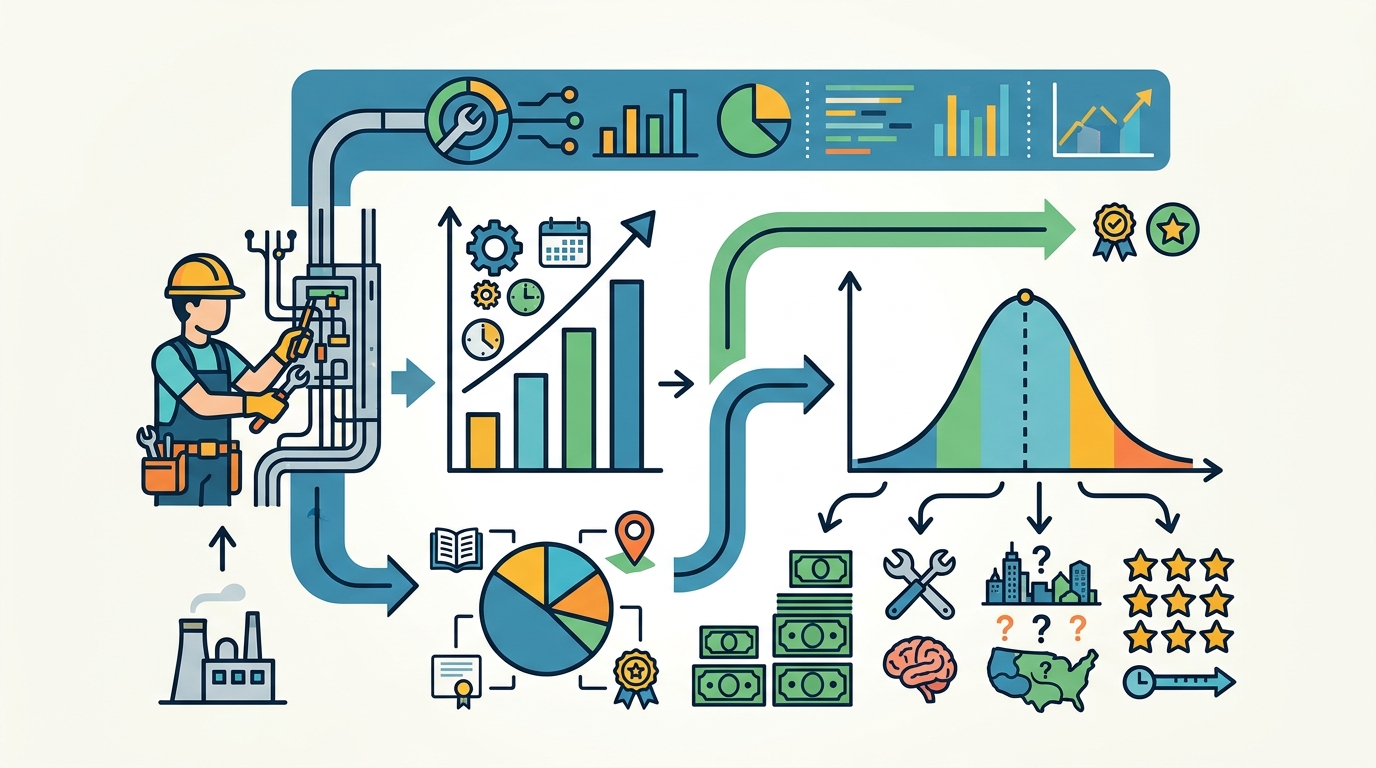
Electricians earned a median annual wage of $63,190, or $30.38 an hour, in May 2025 (U.S. Bureau of Labor Statistics, 2025-05). The spread is wide: the lowest-paid 10 percent earned less than $42,640 and the highest-paid 10 percent more than $108,510 in the same period (U.S. Bureau of Labor Statistics, 2025-05).
Where you land inside that range comes down to licensing stage, industry, union status, state, and how much overtime you take. This guide covers each one and compares electrician pay with nearby trades.
What This Job Pays
The median annual wage for electricians was $63,190 in May 2025, equal to $30.38 an hour (U.S. Bureau of Labor Statistics, 2025-05). Median means half of electricians earned more and half earned less. It is neither a starting figure nor an average.
The full national percentile picture using 2025 BLS wage data (O*NET OnLine, sourced to the U.S. Bureau of Labor Statistics, 2025):
- 10th percentile: $42,640 a year, $20.50 an hour
- 25th percentile: $49,430 a year, $23.76 an hour
- Median: $63,190 a year, $30.38 an hour
- 75th percentile: $83,940 a year, $40.36 an hour
- 90th percentile: $108,510 a year, $52.17 an hour
For comparison, the May 2023 Occupational Employment and Wage Statistics release put the median at $61,590 and the mean annual wage at $67,810, or $32.60 an hour (U.S. Bureau of Labor Statistics, 2023-05). The mean sits above the median because a tail of high earners pulls the average up.
These are wage figures, not total compensation packages. They do not show employer-paid health coverage or pension and annuity contributions, which union agreements negotiate separately — one cited Washington, DC-area joint apprenticeship training committee scale lists journeyman scale reaching $62.00 an hour "plus paid benefits" by June 2026 (CourseCareers, undated), with the benefit value sitting on top of the hourly rate.
Overtime also forms a real part of many electricians' annual earnings. Almost all electricians work full time, schedules can include evenings and weekends, and overtime is common (U.S. Bureau of Labor Statistics, 2024). So when you compare an offer, ask whether the number quoted is base hourly scale, expected annual earnings including overtime, or a total package including benefits. Those are three different figures.
Salary by Experience and Location
Electrician pay is usually set as an hourly rate rather than a salary, and the rate steps up through apprenticeship and then licensing. Each row below names what kind of figure it is and where it comes from.
| Stage, place or industry | Figure | Type | Source and year |
|---|---|---|---|
| First-year apprentice, DC-area union scale | $27.90/hr (45% of journeyman scale) | Negotiated scale | CourseCareers, undated |
| Sixth-period apprentice, same scale | $49.60/hr (80% of journeyman scale) | Negotiated scale | CourseCareers, undated |
| Journeyman, same agreement (by June 2026) | $62.00/hr plus paid benefits | Negotiated scale | CourseCareers, undated |
| Entry-level, national (10th percentile) | $42,640/yr, $20.50/hr | Percentile wage | U.S. Bureau of Labor Statistics, 2025-05 |
| Lower quarter, national (25th percentile) | $49,430/yr, $23.76/hr | Percentile wage | U.S. Bureau of Labor Statistics, 2025-05 |
| Mid-career, national (median) | $63,190/yr, $30.38/hr | Median wage | U.S. Bureau of Labor Statistics, 2025-05 |
| Experienced, national (75th percentile) | $83,940/yr, $40.36/hr | Percentile wage | U.S. Bureau of Labor Statistics, 2025-05 |
| Top earners, national (90th percentile) | $108,510/yr, $52.17/hr | Percentile wage | U.S. Bureau of Labor Statistics, 2025-05 |
| New York state | $77,460/yr | Median wage | O*NET OnLine, sourced to BLS, 2024 |
| New York-Newark-Jersey City, NY-NJ metro | $76,450/yr | Median wage | O*NET OnLine, sourced to BLS, 2024 |
| United States, same release | $62,350/yr | Median wage | O*NET OnLine, sourced to BLS, 2024 |
| California | $78,140/yr | Mean wage | U.S. Bureau of Labor Statistics, 2022-05 |
| Texas | $54,980/yr | Mean wage | U.S. Bureau of Labor Statistics, 2022-05 |
| Florida | $50,710/yr | Mean wage | U.S. Bureau of Labor Statistics, 2022-05 |
| Michigan | $62,850/yr | Mean wage | U.S. Bureau of Labor Statistics, 2022-05 |
| New York (same release) | $81,740/yr | Mean wage | U.S. Bureau of Labor Statistics, 2022-05 |
Read the state rows with their dates in mind. The California, Texas, Florida, Michigan and New York numbers are mean wages from May 2022 and will have moved since; the gap between them is the useful part, with California at $78,140 against Florida at $50,710 in that same month for the same job title (U.S. Bureau of Labor Statistics, 2022-05).
For a current local number, check your state labor department's wage pages, or look up wages by ZIP code using CareerOneStop's Salary Finder, run by the U.S. Department of Labor (CareerOneStop, undated).
What Affects Pay in This Field
- Apprenticeship stage. Apprentices are paid while they train, and the rate rises as they qualify to do more (U.S. Bureau of Labor Statistics, undated). One cited Washington, DC-area JATC scale runs from $27.90 an hour at 45 percent of journeyman scale to $49.60 an hour at 80 percent by the sixth period (CourseCareers, undated).
- Licensing. Most states require electricians to be licensed (U.S. Bureau of Labor Statistics, 2025). The effect shows in the gap between helpers and the licensed trade: helpers–electricians had a median annual wage of $38,340 in May 2023 (U.S. Bureau of Labor Statistics, 2023-05), against an electrician median of $63,190 in May 2025 (U.S. Bureau of Labor Statistics, 2025-05). Exam steps and hour requirements vary by state, so check your state licensing board before assuming hours transfer.
- Industry. In May 2025, median annual wages by top industry were $79,820 in government (excluding state and local education and hospitals), $74,550 in manufacturing, $61,570 with electrical contractors and other wiring installation contractors, and $57,760 in employment services (U.S. Bureau of Labor Statistics, 2025-05).
- Union status. One secondary analysis reported unionized electricians averaging $82,664 against about $56,180 for non-union electricians (Best Electrician Jobs, undated). That is not a government wage survey, so treat it as indicative; negotiated scales also publish benefit contributions separately (CourseCareers, undated).
- State and metro. New York state's median was $77,460 and the New York-Newark-Jersey City metro's $76,450 using 2024 wage data, against $62,350 nationally (O*NET OnLine, sourced to BLS, 2024).
- Overtime and shift work. Overtime is common and schedules may include evenings and weekends (U.S. Bureau of Labor Statistics, 2024), so hours beyond the standard week are paid on top of the base hourly rate. Treat that portion as variable income, not base pay, when budgeting.
- Local demand. Employment of electricians is projected to grow 9 percent from 2024 to 2034, much faster than the average for all occupations, with about 81,000 openings projected each year on average (U.S. Bureau of Labor Statistics, 2024). Tight local labor markets give you more leverage on rate.
How This Job's Pay Compares
The electrician median of $63,190 in May 2025 sat above the median for construction trades workers as a group, $58,150, and above the median for all occupations nationally, $50,980 (U.S. Bureau of Labor Statistics, 2025-05).
Helpers–electricians (SOC 47-3013). This is where many people start, and it is often confused with the licensed trade. Helpers had a median annual wage of $38,340 and a mean of $41,240, or $19.83 an hour, in May 2023 (U.S. Bureau of Labor Statistics, 2023-05). The distance between that and the electrician median of $63,190 in May 2025 (U.S. Bureau of Labor Statistics, 2025-05) is the clearest case for finishing an apprenticeship and getting licensed.
Electrical power-line installers and repairers. Often grouped with electricians in job searches, but a separate occupation working on transmission and distribution lines, with median pay of $92,560 a year, or $44.50 an hour, in the most recent reporting year (U.S. Bureau of Labor Statistics, 2024). The work involves outdoor conditions, storm call-outs and a different training route, so it is not a straight swap.
Other electricians. Within the trade itself, sector matters more than the job title: government electricians had a median of $79,820 and employment-services electricians $57,760 in May 2025 (U.S. Bureau of Labor Statistics, 2025-05). Both are "electrician" pay.
Frequently asked questions
How much do electricians make starting out?
Use the bottom of the national range as your reference: the lowest-paid 10 percent earned less than $42,640 a year, or $20.50 an hour, and the 25th percentile was $49,430, in May 2025 (U.S. Bureau of Labor Statistics, 2025-05). Apprentices earn less than fully trained electricians, with pay rising as they learn to do more (U.S. Bureau of Labor Statistics, undated); one cited Washington, DC-area JATC scale starts first-year apprentices at $27.90 an hour, 45 percent of journeyman scale (CourseCareers, undated). Your own rate will track your state, whether the shop is union, and which apprenticeship period you are in.
Can electricians earn over $100,000?
At the top of the range, yes: the highest-paid 10 percent of electricians earned more than $108,510 a year, about $52.17 an hour, in May 2025 (U.S. Bureau of Labor Statistics, 2025-05). Getting there usually combines a higher-paying industry such as government at a $79,820 median or manufacturing at $74,550 (U.S. Bureau of Labor Statistics, 2025-05), a higher-wage state such as New York at a $77,460 median (O*NET OnLine, sourced to BLS, 2024), and regular overtime, which is common in the trade (U.S. Bureau of Labor Statistics, 2024).
How long does it take to reach full electrician pay?
Most electricians learn the trade through a 4- or 5-year apprenticeship, each year including about 2,000 hours of paid on-the-job training plus technical instruction (U.S. Bureau of Labor Statistics, 2025). Programs usually provide at least 144 hours of occupation-specific technical instruction and 2,000 hours of on-the-job training per year over three to five years (U.S. Bureau of Labor Statistics, undated). Pay steps up during that period rather than at the end: the cited DC-area scale moves from 45 percent to 80 percent of journeyman rate across the periods (CourseCareers, undated).
Why do published figures for electrician pay differ, and where should I check my area?
They differ because they measure different things in different years and areas. The median was $61,590 with a mean of $67,810 in the May 2023 wage release (U.S. Bureau of Labor Statistics, 2023-05), $62,350 using 2024 data (O*NET OnLine, sourced to BLS, 2024), and $63,190 in May 2025 (U.S. Bureau of Labor Statistics, 2025-05). Check four things on any number: median versus mean, hourly versus annual, the data year, and whether the geography is national, state or metro. For your own area, use the BLS Occupational Employment and Wage Statistics pages, CareerOneStop's Salary Finder, which looks up wages by ZIP code (CareerOneStop, undated), your state labor department, and the published local scale if the work is union.
Sources
- U.S. Bureau of Labor Statistics — Electricians : Occupational Outlook Handbook (2025-05)
- U.S. Bureau of Labor Statistics — Occupational Employment and Wages, May 2023 - 47-2111 Electricians (2023-05)

Written by
Wyatt covers work outside the office: construction, logistics, repair, and the people who keep things running. He's skeptical of career advice that assumes everyone sits at a desk.