Choosing Between Counseling and Social Work as a Career Changer
Both paths lead to licensed clinical practice, but they differ in how fast you can start earning, who you serve, and how much paperwork you carry.
Quick answer
- Fastest paid entry: substance abuse and behavioral disorder counseling, where at least a bachelor's degree is typically enough to start (U.S. Bureau of Labor Statistics, 2025), while clinical roles in either field need a master's.
- Highest median pay: social work, at $61,780 versus $59,350 for counselors in May 2025 (U.S. Bureau of Labor Statistics, 2025) — close enough that your setting matters more than the title.
- Widest job market: social work, with about 69,100 openings projected a year, though counseling grows faster at 18% from 2025 to 2035 (U.S. Bureau of Labor Statistics, 2025).
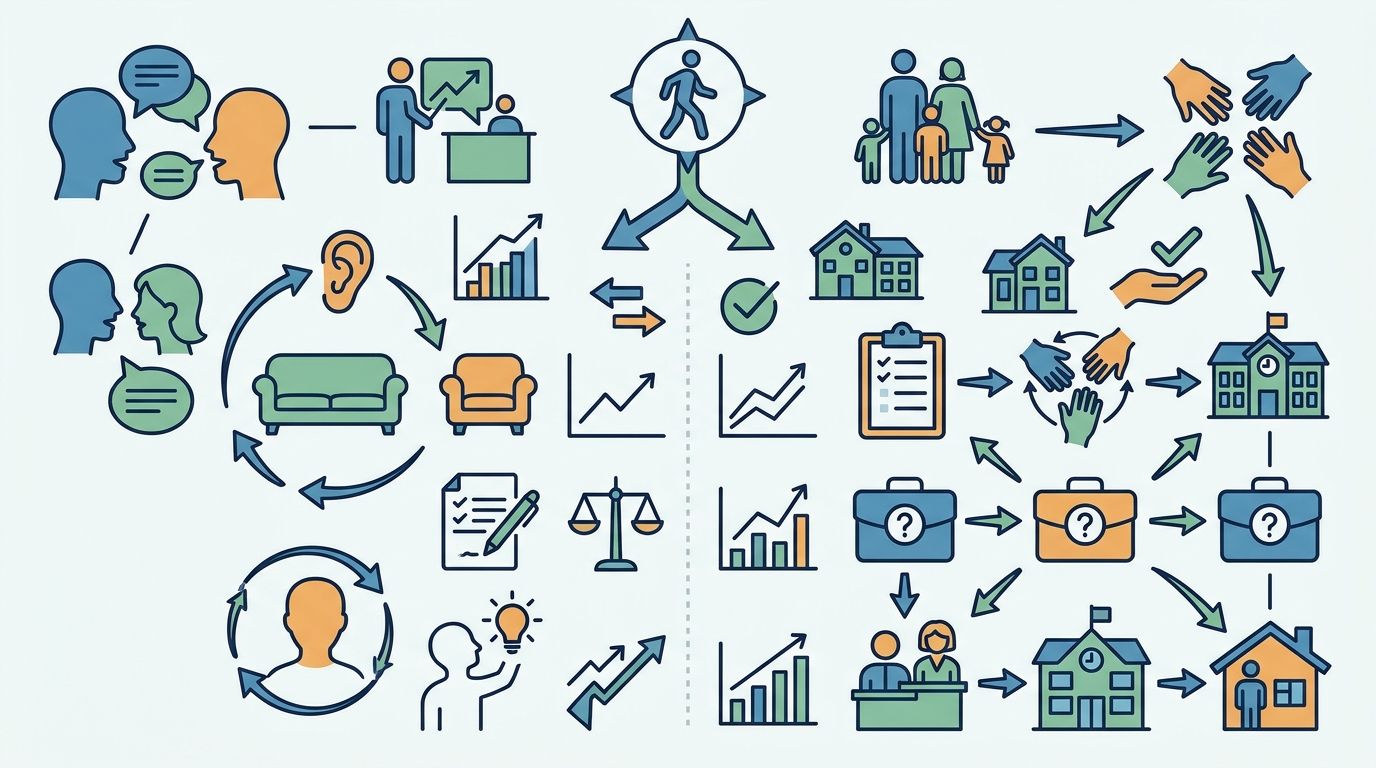
Counseling and social work overlap enough that career changers often apply to both, then find the real decision is about scope: counselors treat mental health, substance use and behavioral problems, while social workers help people prevent and cope with problems in their everyday lives (U.S. Bureau of Labor Statistics, 2025) — which often means housing, benefits, courts and family systems as well as therapy.
Median pay is close: $59,350 for substance abuse, behavioral disorder and mental health counselors and $61,780 for social workers in May 2025 (U.S. Bureau of Labor Statistics, 2025). So the deciding factors are how long you can afford to study, how much case management you want, and which clients you want to sit with.
Side-by-Side Comparison
| Dimension | Counseling | Social work |
|---|---|---|
| Typical entry education | Substance abuse and behavioral disorder counselors typically need at least a bachelor's degree; mental health counselors typically need a master's plus a clinically supervised internship (U.S. Bureau of Labor Statistics, 2025) | A bachelor's (BSW) or master's (MSW) in social work; clinical practice requires a master's plus supervised clinical experience (U.S. Bureau of Labor Statistics, 2025) |
| Transition time from an unrelated job | Roughly 1–2 years into a bachelor's-level substance use counseling role if you already hold a degree; 4–6 years to full licensure | Roughly 2–3 years for an MSW if you already hold a bachelor's degree; 4–6 years to clinical licensure |
| Median pay | $59,350 a year, $28.53 an hour, May 2025 (U.S. Bureau of Labor Statistics, 2025) | $61,780 a year, $29.70 an hour, May 2025 (U.S. Bureau of Labor Statistics, 2025) |
| Licensing | All states license mental health counselors, requiring a national examination and supervised clinical work under a licensed counselor; private-practice substance use counselors need a master's, supervised hours, an exam and annual continuing education (U.S. Bureau of Labor Statistics, 2025) | Requirements vary by state; clinical social workers need a master's, supervised clinical experience and a license from the state where they practice (U.S. Bureau of Labor Statistics, 2025) |
| Schedule and physical demands | Mostly seated sessions in mental health centers, community health centers and private practice; most work full time, though part-time work is common (U.S. Bureau of Labor Statistics, 2025). Some jobs require BLS or CPR certification | Child welfare, healthcare and school settings, with home visits and travel; most work full time and some work evenings, weekends and holidays (U.S. Bureau of Labor Statistics, 2025) |
| Growth and openings | 18% growth 2025–2035, about 50,500 openings a year (U.S. Bureau of Labor Statistics, 2025) | 6% growth 2025–2035, about 69,100 openings a year (U.S. Bureau of Labor Statistics, 2025) |
| Typical starting age range | No age floor; master's cohorts mix people in their 20s with changers in their 40s and 50s | The same, with bachelor's-level roles also drawing entrants straight from undergraduate study |
What Each Job Looks Like Day to Day
A counselor's day is built around sessions and the records that follow them. You evaluate a client's mental and physical health, addiction or problematic behavior and assess readiness for treatment, then develop and review treatment goals and plans, help clients build the skills recovery requires, and document progress (U.S. Bureau of Labor Statistics, 2025). In practice that can mean an intake assessment first thing, a relapse-prevention group before lunch, three individual sessions after it, and an hour of notes you cannot push to tomorrow. Settings include mental health centers, community health centers and private practice, and part-time work is common (U.S. Bureau of Labor Statistics, 2025).
A social worker's day is built around the problems surrounding the client as much as the client. The core job is helping people prevent and cope with problems in their everyday lives (U.S. Bureau of Labor Statistics, 2025), so a morning might be a home visit to check a child's living conditions, an afternoon coordinating a hospital discharge so a patient has transport and medication, and calls to a landlord or benefits office between the two. Employers include child welfare and human service agencies, healthcare providers and schools (U.S. Bureau of Labor Statistics, 2025). Clinical social workers also carry a therapy caseload, which is where the two careers converge.
Which Fits Your Background
- Registered nurse or paramedic: social work. You already read charts and coordinate discharges, and healthcare providers are a major employer of social workers (U.S. Bureau of Labor Statistics, 2025). Evening and weekend shifts will not surprise you.
- Elementary or high school teacher: social work, if you want to stay in schools, where social workers are commonly employed (U.S. Bureau of Labor Statistics, 2025). You already handle meetings, parent conflict and documentation.
- Retail or restaurant manager: counseling. Scheduling, de-escalation and structured conversations with distressed people transfer into group facilitation and intake; a bachelor's-level substance use role is often the fastest door in (U.S. Bureau of Labor Statistics, 2025).
- Someone with personal recovery from alcohol or drug addiction: counseling. Counselors who have overcome addictions themselves are sometimes viewed as especially helpful and insightful by those seeking treatment (U.S. Bureau of Labor Statistics, 2025).
- HR generalist or benefits administrator: social work. Navigating eligibility rules, confidentiality and systems on someone else's behalf is most of case management.
- Probation officer, paralegal or court clerk: social work, especially child welfare, where court reports, mandated timelines and interagency work are the job.
- Psychology or social science graduate returning to work: either. Psychology, public policy and social services, and social science are common undergraduate backgrounds for people entering master's-level counseling programs (U.S. Bureau of Labor Statistics, 2025).
How to Decide and Test the Waters
- Check your state's rules before you pay for anything. Supervised hour counts and exam sequences differ by state in both fields. CareerOneStop publishes state licensing board requirements for counselors (U.S. Bureau of Labor Statistics, 2025); your state social work board publishes its own. Two states can differ by a year of supervised practice.
- Volunteer somewhere that uses both roles. A community health center, crisis line or shelter will have counselors and social workers in the same building. Six months of weekly evening shifts teaches you more than any program brochure.
- Shadow one of each for a full day, and stay to the end. Counselors document client progress on every case (U.S. Bureau of Labor Statistics, 2025); social workers carry court and agency paperwork on top of visits. The last hour is the honest part of the day.
- Take a low-cost credential first. BLS or CPR certification is required for some counselor jobs (U.S. Bureau of Labor Statistics, 2025) and takes a day. Many states also offer a trainee-level substance use counselor credential you can earn while still employed elsewhere.
- Price the income gap honestly. A master's in either field usually means two to three years of tuition and reduced hours, then one to two years of supervised practice at pre-licensure rates before you reach the May 2025 medians of $59,350 for counselors or $61,780 for social workers (U.S. Bureau of Labor Statistics, 2025). Plan for three to five lean years, not one.
- Keep your current job through the first year of study. Part-time counseling work is common (U.S. Bureau of Labor Statistics, 2025), so many people step down gradually. Decide in advance what would make you stop — a failed field placement, for instance.
Frequently asked questions
Which one gets me working and earning sooner?
Counseling, in one specific form. Substance abuse and behavioral disorder counselors typically need at least a bachelor's degree, while mental health counselors and clinical social workers both need a master's plus supervised clinical hours (U.S. Bureau of Labor Statistics, 2025). With any bachelor's degree already in hand, substance use counseling can be 1–2 years away, against 4–6 years to independent licensure in either field. Counseling is also growing faster, at 18% from 2025 to 2035 versus 6% for social work (U.S. Bureau of Labor Statistics, 2025).
I am 52. Is it too late to start a master's for either path?
Ages 50 to 60 is where people most often fear being screened out as too close to retirement, and that is fair in fields built on long internal ladders. These two are not those fields: about 50,500 counselor openings and 69,100 social worker openings are projected each year on average over 2025–2035 (U.S. Bureau of Labor Statistics, 2025), and both rely on clinical judgment that life experience feeds. Finish either master's at 55, license at 57, and a working decade remains — and part-time counseling work is common (U.S. Bureau of Labor Statistics, 2025), which makes a gradual wind-down possible.
Which pays more once I am licensed?
Social work, slightly: the median annual wage was $61,780 for social workers and $59,350 for counselors in May 2025 (U.S. Bureau of Labor Statistics, 2025). The gap is small enough that your setting, and whether you reach private practice, will matter more than the job title. Private practice requires licensure in both careers, including a master's degree, a specified number of supervised clinical hours and a passing exam (U.S. Bureau of Labor Statistics, 2025).
Sources
- U.S. Bureau of Labor Statistics — Substance Abuse, Behavioral Disorder, and Mental Health Counselors : Occupational Outlook Handbook (2025)
- U.S. Bureau of Labor Statistics — Social Workers : Occupational Outlook Handbook (2025)

Written by
Priya tracks wages, layoffs, and the slow shifts in what counts as a stable job. She writes for readers trying to make sense of numbers that rarely match their own experience.