Accountant vs. Financial Analyst: Which Career Path Is Right for You?
Both roles live in spreadsheets, but one verifies what already happened while the other forecasts what comes next — here is how to tell them apart.
Quick answer
- The biggest practical difference: accountants are judged on whether the numbers are correct and compliant; analysts are judged on whether their forecast and recommendation held up.
- Accounting typically requires more upfront credentialing time — a bachelor's degree is the typical entry-level education for both occupations (U.S. Bureau of Labor Statistics, 2025), and CPA licensure adds state-set coursework, an exam sequence and supervised experience, while any FINRA registration an analyst role needs is usually employer-sponsored after you start.
- Both are desk jobs with overtime — accountants during quarterly audits and tax season, analysts when deals, earnings or reporting deadlines land (U.S. Bureau of Labor Statistics, 2025) — so check current median pay and the exact projection period for each in the BLS Occupational Outlook Handbook before you commit.
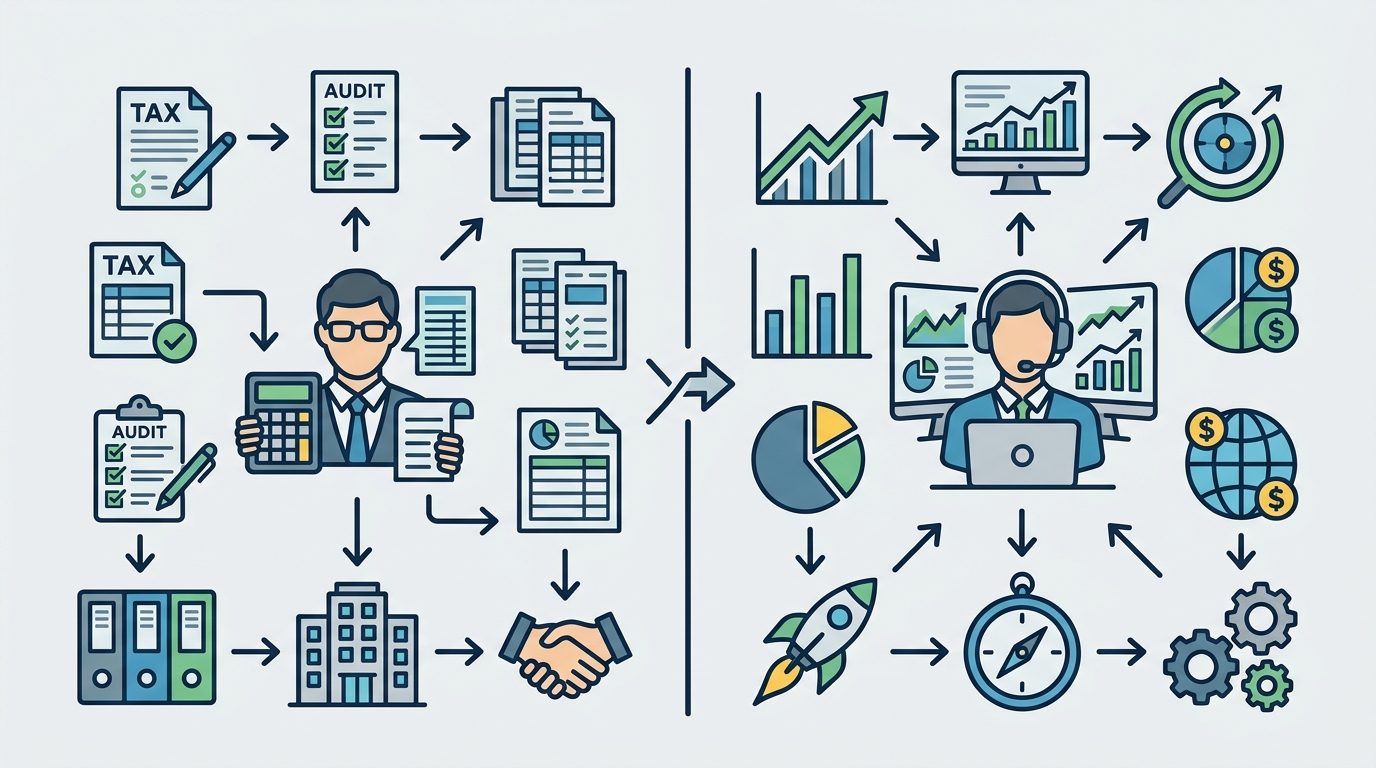
Accountants prepare and examine financial records; financial analysts research financial data, forecast trends, and write reports recommending what a business or investor should do (U.S. Bureau of Labor Statistics, 2025). Both usually start with a bachelor's degree, but accounting has a clearer licensing ladder through the CPA, while analyst roles lean more on forecasting skill and, for some jobs, employer-sponsored FINRA licensure.
If you prefer accuracy, rules and a defensible answer, accounting fits better. If you prefer judgment calls, assumptions and defending a recommendation that might be wrong, lean analyst.
Head-to-Head Comparison
| Dimension | Accountant / auditor | Financial analyst |
|---|---|---|
| Typical entry requirement | Bachelor's degree is the typical entry-level education, usually four years full time, normally in accounting or a related field; CPA licensure may improve job prospects (U.S. Bureau of Labor Statistics, 2025) | Bachelor's degree is the typical entry-level education, usually four years full time; some employers prefer a master's degree, commonly one to two years more (U.S. Bureau of Labor Statistics, 2025) |
| Median pay | BLS publishes a single national median annual wage for accountants and auditors in its Occupational Outlook Handbook quick facts (U.S. Bureau of Labor Statistics, 2025); look it up before you decide, and treat it as national, not local | BLS publishes a median annual wage for financial and investment analysts and a separate median for financial risk specialists, plus a combined quick-facts figure for financial analysts (U.S. Bureau of Labor Statistics, 2025); the two specialisms do not pay the same |
| Physical / schedule demands | Office or hybrid work, seated and screen-heavy; most work full time, and overtime is typical during quarterly audits and tax season (U.S. Bureau of Labor Statistics, 2025) | Typically an office setting; most work full time and some work more than 40 hours a week (U.S. Bureau of Labor Statistics, 2025), with peaks around reporting, earnings and deal deadlines |
| Five-year outlook | BLS projects employment of accountants and auditors to grow over its current ten-year projection period and publishes an average number of annual openings and a total employment count (U.S. Bureau of Labor Statistics, 2025) | BLS projects employment of financial analysts to grow over the same ten-year projection period, with its own published figures for average annual openings and total jobs (U.S. Bureau of Labor Statistics, 2025) |
A few notes on reading that table:
- On pay. Neither occupation pays a flat rate. Compensation is usually a base salary, sometimes with a bonus tied to firm or fund performance (more common on the analyst side) or to busy-season billable hours (more common in public accounting). State and metro pay differ substantially from the national median, so pull both the national Occupational Outlook Handbook median and your own state and metro figures from the BLS Occupational Employment and Wage Statistics tables rather than relying on one number.
- On outlook. BLS projects growth for both occupations over its current ten-year horizon (U.S. Bureau of Labor Statistics, 2025). There is no official five-year projection, so the honest read is: take the published decade figure, check the exact years it covers on the Handbook page, and halve your expectations about how much of it lands in your first five years. Accounting is the larger occupation by headcount and by average annual openings, which matters more for your odds of finding a first job than the growth percentage does.
- On credentials. The CPA is the clearest difference in structure. It is a state-issued license, so the education-hour requirement, exam sequence and experience rules are set by your state board, not nationally. Analyst licensure works the other way round: FINRA is the main licensing organization for the securities industry, some analyst positions require registration, and it is usually sponsored by an employer, so it is not expected before you start a job (U.S. Bureau of Labor Statistics, 2025).
- The tradeoff nobody mentions. Accounting's busy season is predictable and unavoidable — if you want February through mid-April free, public accounting will disappoint you. Analyst hours are less seasonal but less bounded, and your work is openly second-guessed when a forecast misses.
Day-to-Day Differences
Picture the same Tuesday in the second week of a new quarter at two desks in the same building.
The accountant. You arrive to a close checklist. The core of the job is preparing and examining financial records (U.S. Bureau of Labor Statistics, 2025), so the morning goes on reconciliations: tying the bank statement to the ledger, chasing a variance that turns out to be a payment posted to the wrong cost center, and writing the journal entry to correct it. Before lunch you pull supporting documentation for an external auditor who has asked about three invoices over the approval threshold. In the afternoon you review an accrual schedule a junior prepared, send it back with two queries, and start drafting the note disclosure that will sit in the quarterly statements. Everything you produced today has to be traceable to a document. If it is an audit practice rather than industry, swap the close checklist for fieldwork: sampling transactions, testing controls, and documenting what you tested so someone else could repeat it.
The financial analyst. You arrive to a model and a question from someone senior: should the company fund a second distribution site next year, or not. The job is to research and evaluate financial data, forecast trends, and prepare reports with recommendations (U.S. Bureau of Labor Statistics, 2025), so your Tuesday is spent choosing assumptions and defending them — freight cost inflation, how quickly a new site reaches volume, what happens if demand comes in ten percent under plan. You rebuild the sensitivity table twice, call operations to sanity-check a throughput number, and spend the last two hours writing a two-page memo that says what you recommend and what would have to be true for you to be wrong. Nothing you produced today is auditable fact; it is argued judgment.
The contrast in concrete tasks:
- An accountant signs off a reconciliation and prepares statutory financial statements and filings. An analyst never does this — they consume those statements rather than produce them.
- An analyst builds a forward forecast and issues a written recommendation that someone will act on. A staff accountant never does this; recommending a capital decision sits outside the accounting remit.
- Only the accountant sits across from an external auditor handing over evidence. Only the analyst sits on a call arguing that the base case is too optimistic.
Who Thrives in Each Path
Accounting fits you if:
- You find errors satisfying rather than irritating. The work is examining records (U.S. Bureau of Labor Statistics, 2025), and people who enjoy hunting a $40 variance until it resolves last longer than people who want to move on.
- You have worked somewhere with a procedure manual — pharmacy tech, payroll, insurance claims, military logistics. Comfort with documented process and evidence trails transfers directly into close and audit work.
- You want a license you can carry between employers and states. CPA licensure may improve job prospects (U.S. Bureau of Labor Statistics, 2025), and the credential is legible to any hiring manager, which makes career moves less dependent on who knows you.
- You can absorb a hard seasonal peak. Overtime is typical during quarterly audits and tax season (U.S. Bureau of Labor Statistics, 2025), so a predictable annual crunch has to be acceptable, not just tolerable.
Financial analysis fits you if:
- You are comfortable being wrong in writing. Forecasting trends and issuing recommendations (U.S. Bureau of Labor Statistics, 2025) means your judgment is on record and sometimes contradicted by events.
- You came from a quantitative or research background — economics, engineering, statistics, even a lab role. Building a model is less about arithmetic and more about deciding which variables matter and testing what breaks the answer.
- You like arguing a case to people more senior than you. A model nobody acts on is wasted work, so persuasion and plain-English writing count as much as the spreadsheet.
- You are willing to specialize early. BLS reports separate wages for financial and investment analysts and for financial risk specialists (U.S. Bureau of Labor Statistics, 2025); which branch you enter shapes both pay and the kind of work you get offered next.
Frequently asked questions
Which path takes longer to qualify for?
Accounting, if you pursue the CPA. Both occupations typically require a bachelor's degree as entry-level education (U.S. Bureau of Labor Statistics, 2025), roughly four years full time. CPA licensure adds state-set education hours, an exam sequence and supervised experience on top. Analysts can usually start without a license, since any required FINRA registration is normally employer-sponsored after hiring (U.S. Bureau of Labor Statistics, 2025).
Can I switch from accounting to financial analysis mid-career?
Yes, and the common route is internal. Move from the controller's side into financial planning and analysis at the same employer, where your close experience is an asset. If you want external moves, a master's degree in finance helps because some employers prefer one (U.S. Bureau of Labor Statistics, 2025), and any FINRA registration a securities role needs is typically sponsored once you start (U.S. Bureau of Labor Statistics, 2025).
Which has better job security?
BLS projects employment growth for both occupations over its current ten-year projection period (U.S. Bureau of Labor Statistics, 2025). Accounting is the larger occupation by total jobs and by average annual openings, which usually means more entry points and more replacement hiring. Check the Occupational Outlook Handbook pages for both, note the exact projection years, and compare the openings figures rather than the growth rates alone.
How do I compare pay between the two fairly?
Use the same source for both. Pull the median annual wage from the BLS Occupational Outlook Handbook quick facts for accountants and auditors and for financial analysts (U.S. Bureau of Labor Statistics, 2025), noting that analysts are split into financial and investment analysts and financial risk specialists. Then check your state and metro figures in BLS Occupational Employment and Wage Statistics, since national medians hide large local differences.
Do I need to decide before I finish my degree?
No, but your coursework narrows your options. Accounting requires a bachelor's in accounting or a related field and, for CPA licensure, specific credit hours set by your state board (U.S. Bureau of Labor Statistics, 2025). Analyst roles accept broader quantitative degrees. Taking the accounting core keeps both doors open; skipping it makes a later move into licensed accounting work slower and more expensive.
Sources
- U.S. Bureau of Labor Statistics — Accountants and Auditors : Occupational Outlook Handbook (2025)
- U.S. Bureau of Labor Statistics — Financial Analysts : Occupational Outlook Handbook (2025)

Written by
Desmond writes about the mechanics of job searching: resumes, interviews, the long silence after applying. He's fascinated by how much of getting hired depends on luck dressed up as skill.