7-Day Plan to Prepare for Your Job Interview
A day-by-day schedule for the week before, from matching the posting to your evidence to rehearsing out loud, timing the route and sending the note.
Quick answer
- Seven days out, list every requirement from the posting next to your own evidence and plan how you'll address the gaps (CareerOneStop (U.S. Department of Labor), undated).
- Three days out, say your answers out loud and, for a video interview, test your camera, microphone and the employer's platform such as Zoom or Teams (CareerOneStop (U.S. Department of Labor), undated).
- The morning of, leave early enough to arrive 10 to 15 minutes before the start time, then send your thank-you note within 24 hours (CareerOneStop (U.S. Department of Labor), undated).
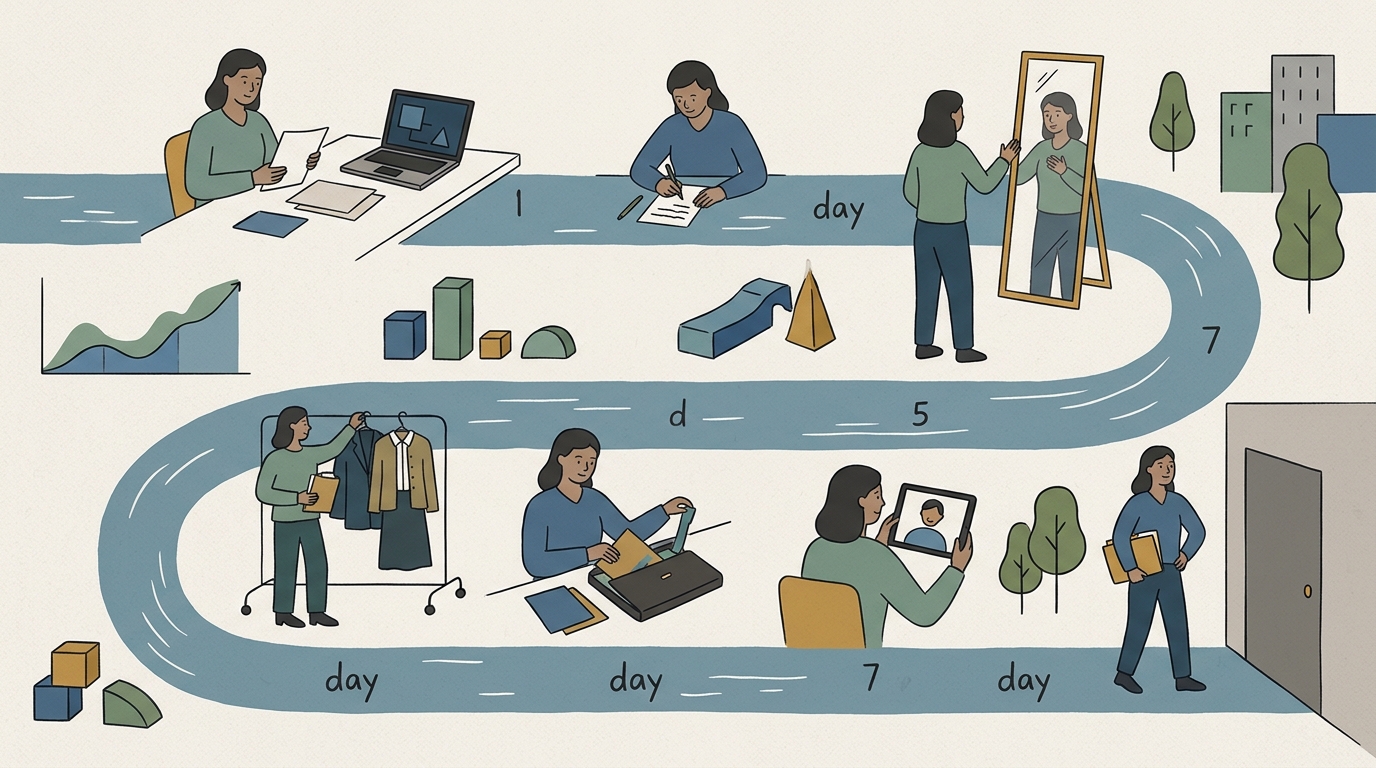
Seven days is enough time to prepare properly if you spread the work out instead of cramming the night before. This plan gives you one task per day: build a requirements grid from the posting, research the employer, write and rehearse structured answers, test your technology or your route, and lay everything out the night before.
The tasks are the same whether the interview is in an office or on video — only the logistics change.
Your Prep Timeline
- Seven days out — build your requirements grid (60 minutes). Copy each listed requirement from the posting into the left column of a two-column document. In the right column, write the job, project or number that proves you meet it. General interview guidance tells candidates to review the job description and work out in advance how well they qualify, writing their qualifications against each requirement (CareerOneStop (U.S. Department of Labor), undated). Any empty right-hand cell is a gap to plan an answer for.
- Five days out — research the employer (45 minutes). Read the company's own About and newsroom pages, its last ten social posts, and any public annual report. Write down five facts and three questions you could not have got from the posting. Researching the employer and job is step one of the four-step prep sequence from CareerOneStop (U.S. Department of Labor), undated.
- Four days out — write answers on paper (90 minutes). Draft six answers using STAR — Situation, Task, Action, Result — the structured technique employers use to evaluate behavioural and situational responses (Wikipedia, undated). Include the hard ones: a firing, an employment gap, a job you left quickly. Job-search guidance specifically advises writing out answers to hard-to-answer questions like these (CareerOneStop (U.S. Department of Labor), undated).
- Three days out — rehearse out loud, twice (two 30-minute sessions). Prep guidance says to practise both on paper and out loud (CareerOneStop (U.S. Department of Labor), undated). Record yourself on your phone, play it back, and cut any answer running past two minutes. For a video interview, confirm now that your computer, camera and microphone work and practise with the employer's platform, such as Zoom or Teams (CareerOneStop (U.S. Department of Labor), undated).
- Two days out — logistics and pay range (45 minutes). Travel the route at the same time of day the interview will happen and note the door-to-door minutes. Confirm building, floor, suite and a direct phone number. Then pull three to five comparable postings for the same title in your metro area and take the middle of their advertised ranges; career guidance frames the standard answer as a researched range rather than a single number, leaving room to discuss the full package (topresume.com, undated). Pay structure and disclosure rules differ by state and employer, so check current local rates.
- The day before — pack and lay out (30 minutes). Print five copies of your resume, your reference sheet and your question list. Add a notebook and two pens; day-of advice is to bring a notebook and pens and dress in a manner appropriate to the job (CareerOneStop (U.S. Department of Labor), undated). Lay the outfit out and clean your shoes.
- The morning of — leave on the clock. Add 15 minutes to your timed route so you arrive 10 to 15 minutes early (CareerOneStop (U.S. Department of Labor), undated). Re-read your five facts and three questions in the car, not in the doorway.
Day-Of Checklist
Tick each item off physically before you leave the house.
- Five printed resumes and your two-column requirements grid, in a clean folder.
- A notebook and two pens you have tested on paper (CareerOneStop (U.S. Department of Labor), undated).
- Your printed list of three questions for the interviewer.
- A reference sheet with names, titles and current phone numbers, plus photo ID if the building requires sign-in.
- The interviewer's full name and a direct phone number written on paper, not only in your phone.
- Outfit on and checked in a full-length mirror; shoes cleaned the night before.
- Phone charged above 80 percent and switched to silent, not vibrate.
- Coffee cup, water bottle and backpack left at home or in the car — the explicit advice from CareerOneStop (U.S. Department of Labor), undated.
- Travelling alone, with nobody waiting in the lobby (CareerOneStop (U.S. Department of Labor), undated).
- For video: laptop on mains power, the meeting link opened once to confirm it loads, camera and microphone tested inside the employer's platform (CareerOneStop (U.S. Department of Labor), undated).
What to Say in Tricky Moments
Read these aloud twice beforehand so the wording is in your mouth, not just on the page.
Announcing yourself at reception
At the front desk, 15 minutes early
"Good morning. I'm Priya Raman, here at 10:15 for a 10:30 interview with Dana Cole in operations. Should I sign in here?"
When the interviewer collects you, offer a firm whole-hand handshake and make eye contact — both recommended by CareerOneStop (U.S. Department of Labor), undated.
"Tell me about yourself"
A 35-second opener built on STAR
"I schedule for a 40-person clinic. Our no-show rate hit 22 percent last spring, so I built a two-text reminder sequence in our booking software and trained the front desk. No-shows dropped to 9 percent in three months."
Explaining a six-month employment gap
Factual, short, forward-looking
"I was out from March to September caring for my father after surgery. I kept my pharmacy technician certification current and finished two online inventory courses. I've been available full time since October."
Deflecting the salary question early
When the number comes up before you've seen the role
"I compared four postings for this title in my metro area, so I do have a range. Could you share the budgeted range first? I'd like to weigh the whole package, not just base pay."
Asking about next steps
As the interviewer starts wrapping up
"Thank you — this has confirmed my interest. What are your next steps in the hiring process, and when should I follow up if I haven't heard from you?"
Asking at exactly that point is the advice given by CareerOneStop (U.S. Department of Labor), undated.
Frequently asked questions
How early should I actually arrive?
Walk into the building 15 minutes before the start time. CareerOneStop (U.S. Department of Labor), undated, says to plan your schedule to arrive 10 to 15 minutes early, and HuffPost, undated, reports hiring experts agreeing 15 minutes is best for an in-office interview.
What should I carry in, and what should I leave behind?
Carry a folder with resume copies, a notebook and pens. Leave your coffee, water bottle and backpack at home or in the car, and go by yourself rather than bringing someone with you (CareerOneStop (U.S. Department of Labor), undated).
When do I send the thank-you note?
Send it the same day, and no later than 24 hours after the interview, even if it went badly (CareerOneStop (U.S. Department of Labor), undated). A survey cited by The Job Hopper newsletter, undated, reports 80 percent of hiring managers find them helpful. A formal email is acceptable.
Sources
- CareerOneStop (U.S. Department of Labor) — Interview Tips
- CareerOneStop (U.S. Department of Labor) — Virtual interviews

Written by
Noor writes personal essays and interviews about career changes, burnout, and starting over. She's interested in the stories people tell themselves about what a job is supposed to mean.